

100 Francs CFA – Cameroon
Cameroon
Context
Years: 1975–1986
Issuer: Cameroon 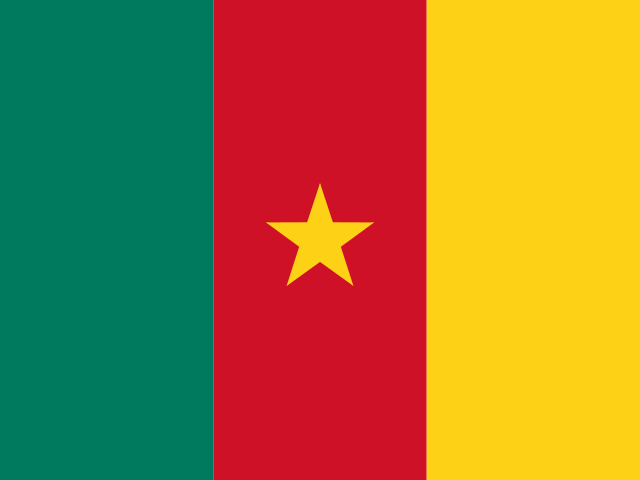
Issuing organization: Bank of Central African States
Period:
(since 1960)
Currency:
(since 1973)
Total mintage: 16,500,000
Material
References
KM: #Click to copy to clipboard17
Numista: #4380
Value
Exchange value: 100 XAF
Obverse
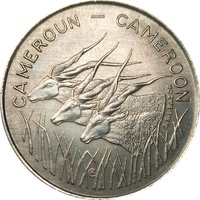
Description:
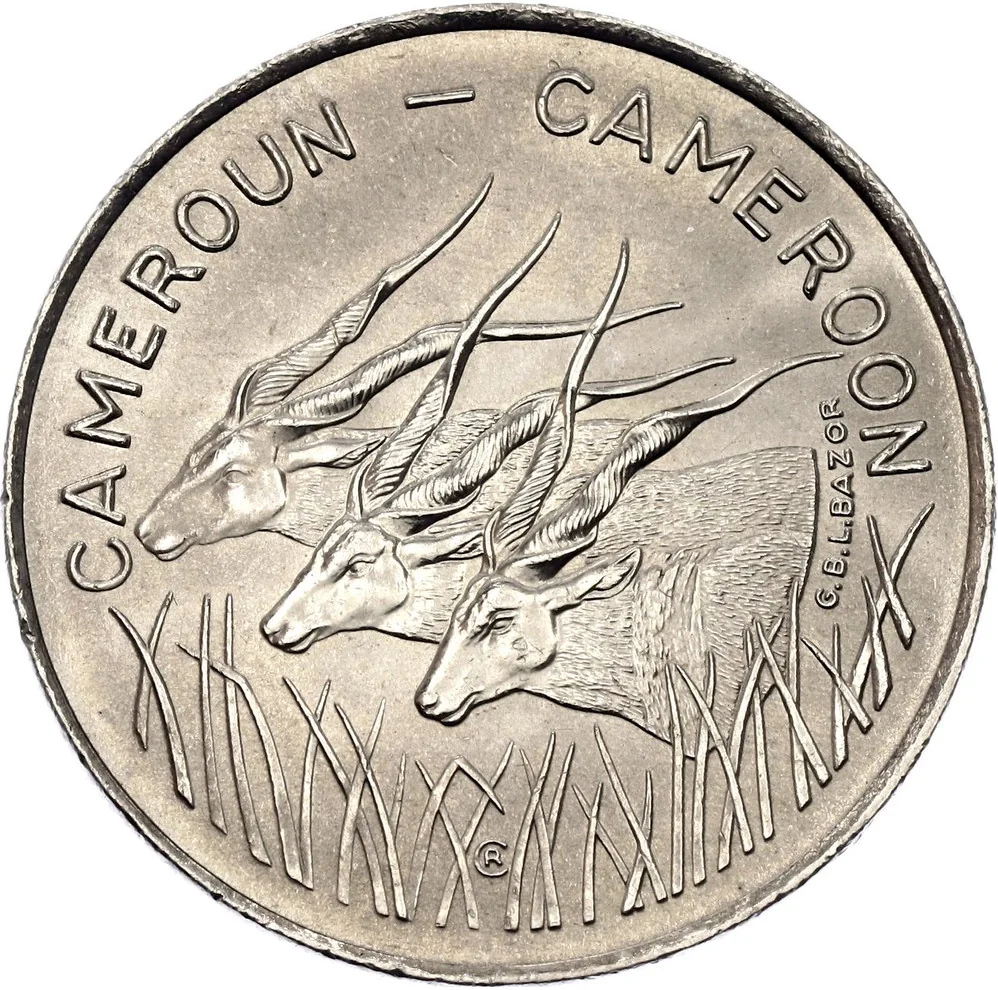
Three giant elands facing left.
Inscription:
CAMEROUN - CAMEROON
G. B. L. BAZOR
CR
G. B. L. BAZOR
CR
Translation:
Republic of Cameroon
G. B. L. Bazor
G. B. L. Bazor
Script: Latin
Engraver: Lucien Georges Bazor
Reverse
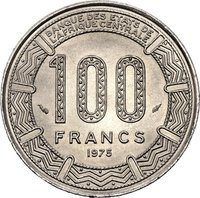
Description:
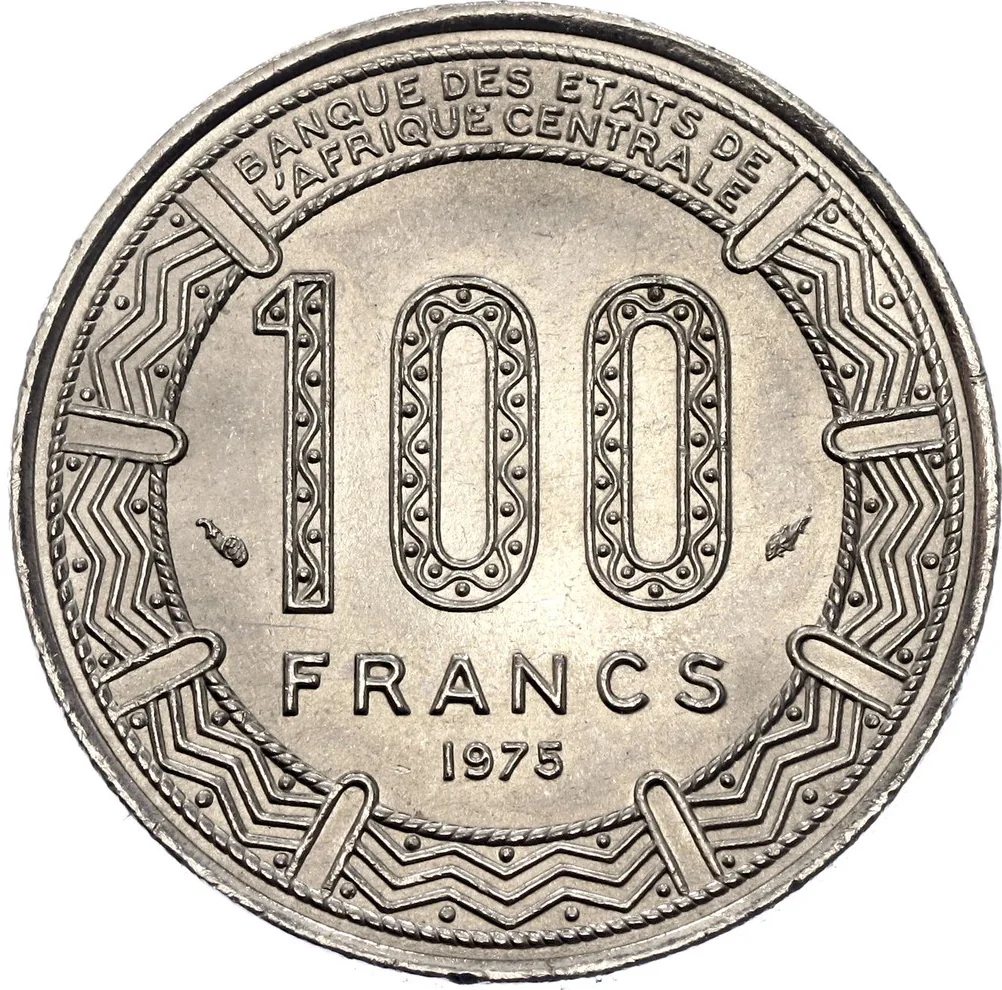
Circle denomination.
Inscription:
BANQUE DES ETATS DE
L'AFRIQUE CENTRALE
100
FRANCS
1975
L'AFRIQUE CENTRALE
100
FRANCS
1975
Translation:
BANK OF THE STATES OF
CENTRAL AFRICA
100
FRANCS
1975
CENTRAL AFRICA
100
FRANCS
1975
Script: Latin
Language: French
Engraver: Lucien Georges Bazor
Edge
Reeded
Mints
| Name | Mark |
|---|---|
| Monnaie de Paris | — |
Mintings
| Year | Mint Mark | Mintage | Quality | Collection |
|---|---|---|---|---|
| 1975 | — | 11,000,000 | ||
| 1980 | — | — | ||
| 1982 | — | — | ||
| 1983 | — | 3,000,000 | ||
| 1984 | — | 500,000 | ||
| 1986 | — | 2,000,000 |
Historical background
In 1975, Cameroon's currency situation was defined by its membership in the CFA franc zone, a monetary union underpinned by a fixed exchange rate and guaranteed convertibility by France. The currency in circulation was the CFA franc (BEAC), shared with other members of the Central African Monetary Union. This arrangement provided significant macroeconomic stability, low inflation, and facilitated trade with France and other CFA partners, which was crucial for Cameroon's growing export economy, then heavily reliant on commodities like cocoa, coffee, and oil, which had just begun production.
However, this stability came with trade-offs. The fixed peg to the French franc (and indirectly to other strong currencies) was sometimes criticized for potentially making Cameroonian exports less competitive on the global market compared to countries with floating currencies. Furthermore, monetary policy was not set independently in Yaoundé but by the Central Bank of the Central African States (BEAC), limiting national tools to address local economic conditions. The system also entrenched a strong economic and political linkage with the former colonial power, France.
Overall, the 1975 currency backdrop was one of managed stability within a post-colonial framework. The CFA franc system provided a predictable financial environment that supported the nation's early stages of economic growth under President Ahmadou Ahidjo, who prioritized development within a framework of close cooperation with France. The benefits of this stability were generally perceived to outweigh the costs of limited monetary sovereignty during this period of nation-building and expanding primary exports.
However, this stability came with trade-offs. The fixed peg to the French franc (and indirectly to other strong currencies) was sometimes criticized for potentially making Cameroonian exports less competitive on the global market compared to countries with floating currencies. Furthermore, monetary policy was not set independently in Yaoundé but by the Central Bank of the Central African States (BEAC), limiting national tools to address local economic conditions. The system also entrenched a strong economic and political linkage with the former colonial power, France.
Overall, the 1975 currency backdrop was one of managed stability within a post-colonial framework. The CFA franc system provided a predictable financial environment that supported the nation's early stages of economic growth under President Ahmadou Ahidjo, who prioritized development within a framework of close cooperation with France. The benefits of this stability were generally perceived to outweigh the costs of limited monetary sovereignty during this period of nation-building and expanding primary exports.
🌱 Very Common