

100 francs – Cameroon
Add to wishlist
Cameroon
Obverse
Description:
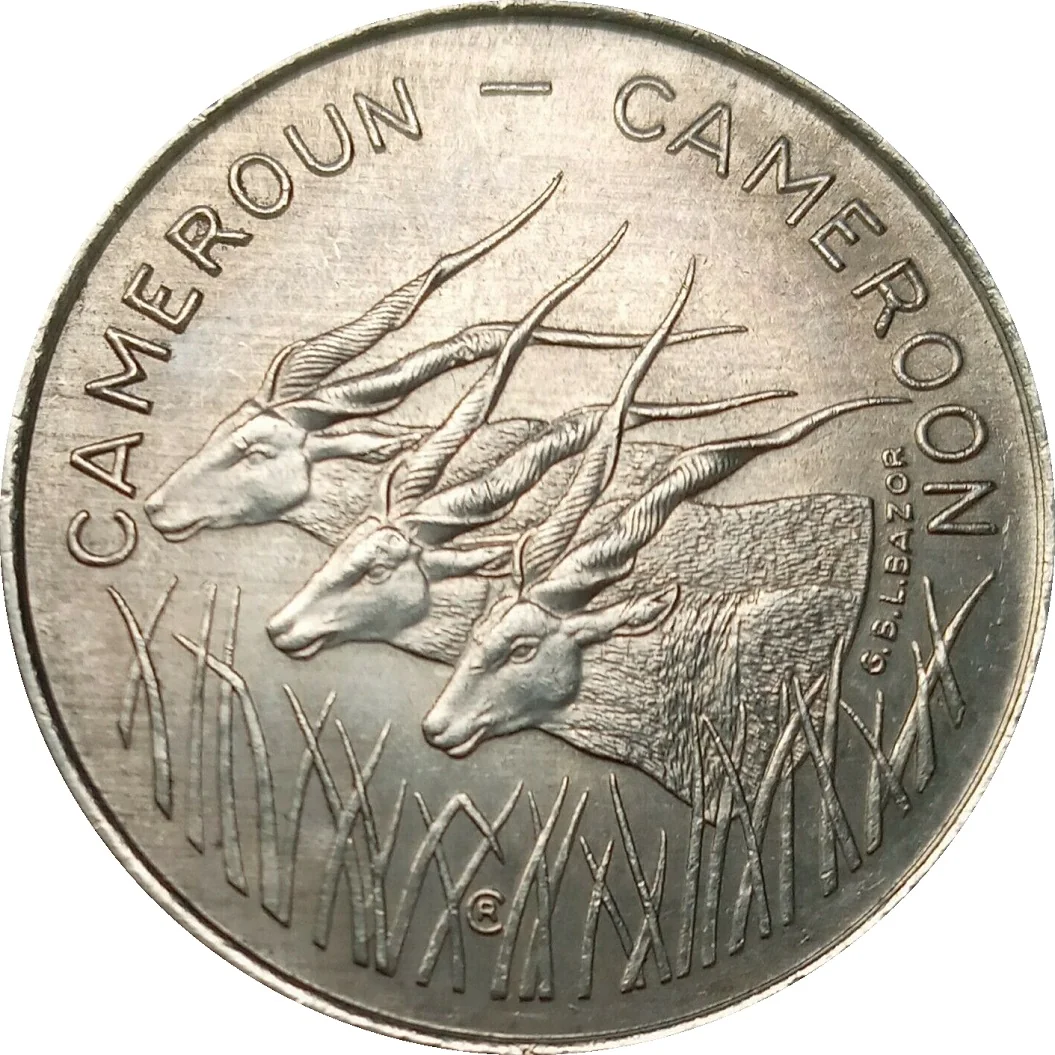
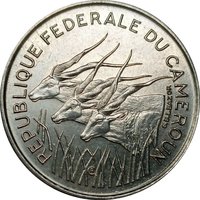
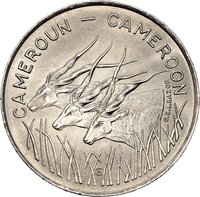
Three giant elands facing left.
Inscription:
CAMEROUN - CAMEROON
G.B.L.BAZOR
CR
G.B.L.BAZOR
CR
Translation:
Cameroon - Cameroon
G.B.L. Bazor
100 Francs
G.B.L. Bazor
100 Francs
Script: Latin
Engraver: Lucien Georges Bazor
Reverse
Description:
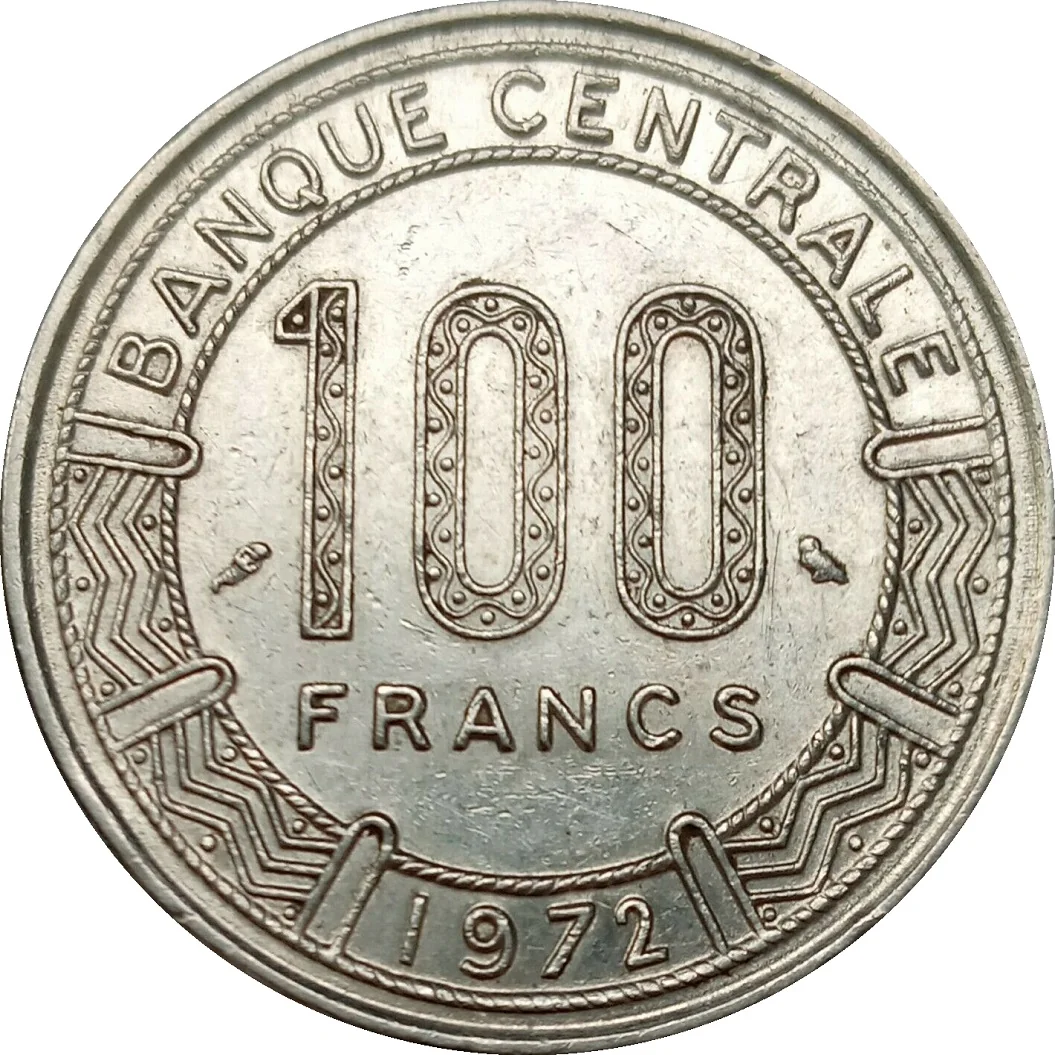
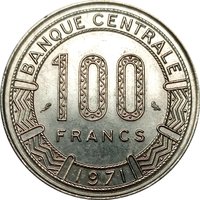
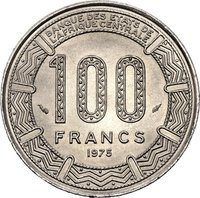
Circle denomination.
Inscription:
BANQUE CENTRALE
100
FRANCS
1972
100
FRANCS
1972
Translation:
Central Bank
100
Francs
1972
100
Francs
1972
Script: Latin
Language: French
Engraver: Lucien Georges Bazor
Edge
Reeded
Mints
| Name | Mark |
|---|---|
| Monnaie de Paris | — |
Mintings
| Year | Mint Mark | Mintage | Quality | Collection |
|---|---|---|---|---|
| 1972 | — | 4,000,000 |
Historical background
In 1972, Cameroon’s currency situation was fundamentally shaped by the nation's political unification. Following the 1961 referendum, the country operated as a federal republic with two distinct currency zones: the Franc CFA (Coopération Financière en Afrique) in the former French-administered East Cameroon, and the Nigerian pound (later the Biafran pound during the Nigerian Civil War) in the former British-administered West Cameroon. This dual system reflected the colonial legacies and created practical complications for internal trade and national economic policy.
The pivotal change came with the constitutional referendum of May 20, 1972, which abolished the federal system and established the United Republic of Cameroon. This political centralization necessitated a single, unified currency as a symbol of sovereignty and a tool for integrated economic management. Consequently, the Franc CFA, pegged to the French franc and guaranteed by the French Treasury, was adopted as the sole legal tender for the entire nation. This move formally integrated West Cameroon into the CFA franc zone, which was part of the broader BEAC (Bank of Central African States) system.
The unification under the CFA franc in 1972 solidified Cameroon’s monetary alignment with France and its Central African neighbors. It eliminated exchange rate uncertainties within the country and facilitated administrative and commercial integration. However, it also meant that monetary policy sovereignty was largely ceded to the BEAC, with the currency's stability and convertibility underpinned by its link to the French franc. This framework provided immediate post-unification stability but would later become a point of economic and political debate regarding external dependence and regional monetary autonomy.
The pivotal change came with the constitutional referendum of May 20, 1972, which abolished the federal system and established the United Republic of Cameroon. This political centralization necessitated a single, unified currency as a symbol of sovereignty and a tool for integrated economic management. Consequently, the Franc CFA, pegged to the French franc and guaranteed by the French Treasury, was adopted as the sole legal tender for the entire nation. This move formally integrated West Cameroon into the CFA franc zone, which was part of the broader BEAC (Bank of Central African States) system.
The unification under the CFA franc in 1972 solidified Cameroon’s monetary alignment with France and its Central African neighbors. It eliminated exchange rate uncertainties within the country and facilitated administrative and commercial integration. However, it also meant that monetary policy sovereignty was largely ceded to the BEAC, with the currency's stability and convertibility underpinned by its link to the French franc. This framework provided immediate post-unification stability but would later become a point of economic and political debate regarding external dependence and regional monetary autonomy.
🌱 Common