

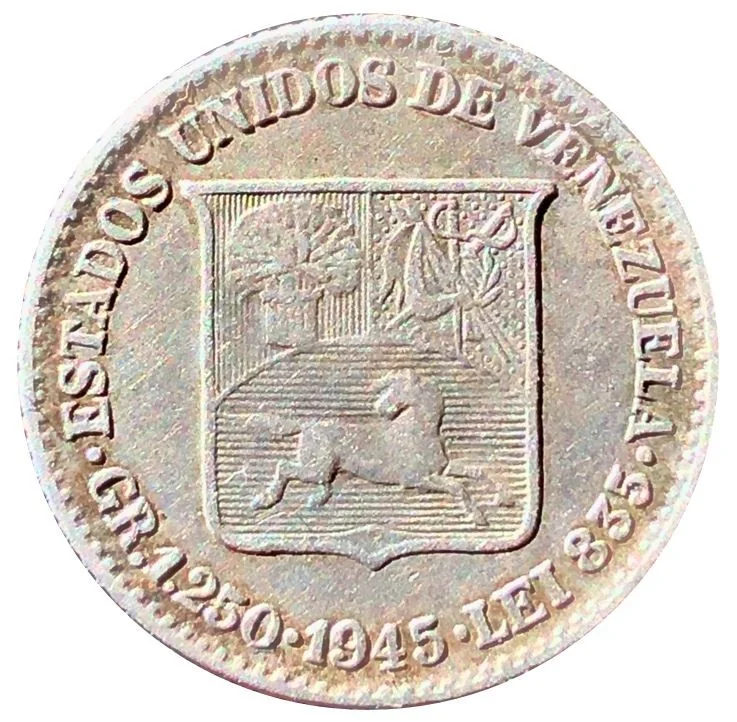
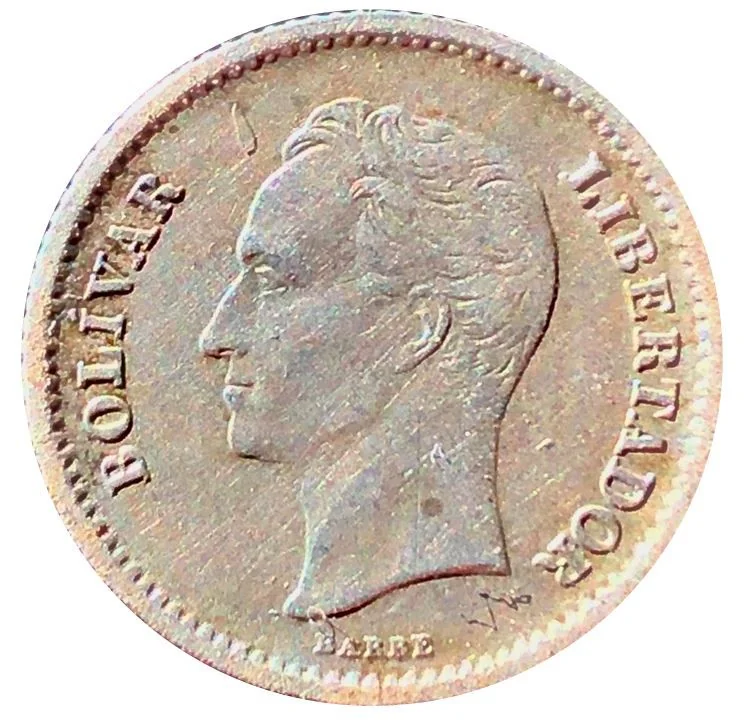
Obverse
Description:
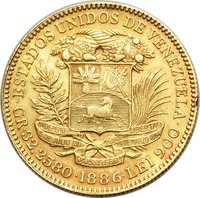
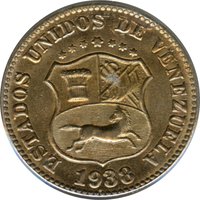
Coat of arms encircled by legend. Weight, date, and fineness below.
Inscription:
•ESTADOS UNIDOS DE VENEZUELA•
GRAM•1,250•1911•LEI 835
GRAM•1,250•1911•LEI 835
Translation:
UNITED STATES OF VENEZUELA
1.250 GRAMS 1911 LAW 835
1.250 GRAMS 1911 LAW 835
Script: Latin
Language: Spanish
Engraver: Désiré-Albert Barre
Reverse
Edge
Reeded
Categories
| Animal> Horse |
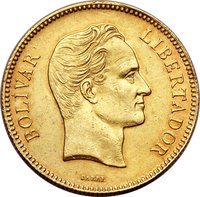
| Person> Military leader |
| Person> Politician |
| Symbols> Coat of Arms |
Mints
| Name | Mark |
|---|---|
| Monnaie de Paris | — |
| United States Mint of Denver | — |
| United States Mint of Philadelphia | — |
| United States Mint of San Francisco | — |
| Monnaie de Paris | (A) |
Mintings
| Year | Mint Mark | Mintage | Quality | Collection |
|---|---|---|---|---|
| 1894 | A | 2,000,000 | ||
| 1900 | — | 407,000 | ||
| 1901 | — | 393,000 | ||
| 1903 | — | 400,000 | ||
| 1911 | — | 600,000 | ||
| 1912 | — | 800,000 | ||
| 1919 | — | 400,000 | ||
| 1921 | — | — | ||
| 1924 | — | 400,000 | ||
| 1929 | — | 1,200,000 | ||
| 1935 | — | 3,400,000 | ||
| 1936 | — | 2,800,000 | ||
| 1944 | — | 1,800,000 | ||
| 1945 | — | 8,000,000 | ||
| 1946 | — | 8,000,000 | ||
| 1948 | — | 8,637,944 |
Historical background
In 1894, Venezuela’s currency system was characterized by significant instability and complexity, a legacy of 19th-century political turmoil and fiscal mismanagement. The nation operated on a bimetallic standard in law, but in practice, its currency was dominated by depreciated silver coins, particularly the venezolano (also called the peso or fuerte). Years of civil wars (like the Federal War) and excessive printing of paper money by regional caudillos and the central government had led to severe inflation and a severe loss of public confidence. By the 1890s, the country's money supply was a chaotic mix of worn silver coins, various banknotes of questionable value, and foreign gold coins, which were preferred for major transactions.
The administration of President Joaquín Crespo (1892-1898) was acutely aware that this monetary disorder was a major obstacle to foreign investment and economic modernization, particularly as Venezuela sought to leverage its booming coffee exports. The international price of silver was in steep decline globally, further devaluing Venezuela's silver-based currency and exacerbating trade imbalances. Consequently, the government was actively pursuing a radical solution: the transition to a modern, gold-standard monetary system. This reform was seen as essential for stabilizing the economy, attracting European capital, and facilitating the repayment of substantial external debts.
Therefore, 1894 stands as a pivotal year within a longer reform process. It was a period of intense planning and legislative groundwork, culminating in the Monetary Law of 1894, which formally proposed the introduction of a new gold-backed currency, the bolívar, set to replace the venezolano at a fixed rate. While the full implementation and successful stabilization under the gold standard would not be realized until the later and stronger government of Cipriano Castro (1903-1904), the crucial legal and policy foundations were being decisively laid in the mid-1890s, marking the beginning of the end for Venezuela's chaotic 19th-century currency experience.
The administration of President Joaquín Crespo (1892-1898) was acutely aware that this monetary disorder was a major obstacle to foreign investment and economic modernization, particularly as Venezuela sought to leverage its booming coffee exports. The international price of silver was in steep decline globally, further devaluing Venezuela's silver-based currency and exacerbating trade imbalances. Consequently, the government was actively pursuing a radical solution: the transition to a modern, gold-standard monetary system. This reform was seen as essential for stabilizing the economy, attracting European capital, and facilitating the repayment of substantial external debts.
Therefore, 1894 stands as a pivotal year within a longer reform process. It was a period of intense planning and legislative groundwork, culminating in the Monetary Law of 1894, which formally proposed the introduction of a new gold-backed currency, the bolívar, set to replace the venezolano at a fixed rate. While the full implementation and successful stabilization under the gold standard would not be realized until the later and stronger government of Cipriano Castro (1903-1904), the crucial legal and policy foundations were being decisively laid in the mid-1890s, marking the beginning of the end for Venezuela's chaotic 19th-century currency experience.
🌱 Common