

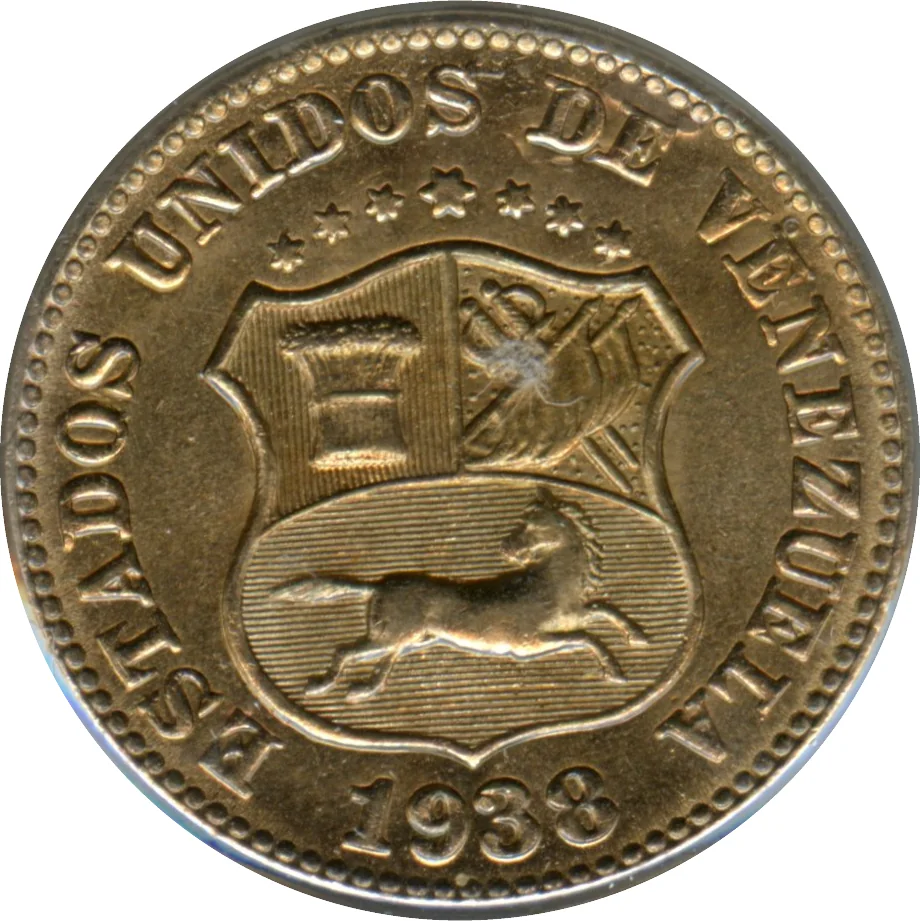
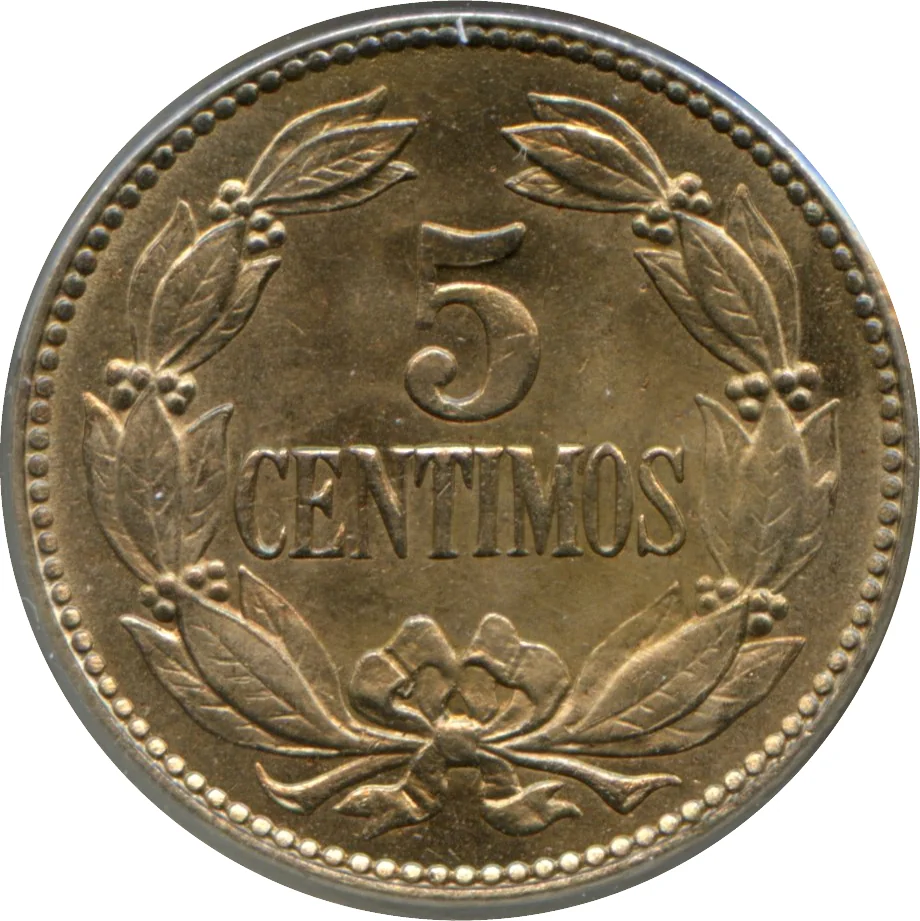
5 Centimos – Venezuela
Venezuela
Context
Years: 1896–1938
Issuer: Venezuela 
Period:
(1864—1953)
Currency:
(1879—2007)
Demonetization: 31 December 2011
Total mintage: 25,000,000
Material
References
Y: #Click to copy to clipboard27
Numista: #8727
Value
Exchange value: 0.05 VEB
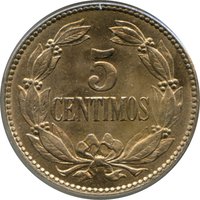
Obverse
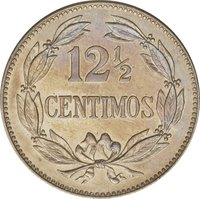
Reverse
Edge
Plain
Mints
| Name | Mark |
|---|---|
| Berlin | — |
| United States Mint of Philadelphia | — |
Mintings
| Year | Mint Mark | Mintage | Quality | Collection |
|---|---|---|---|---|
| 1896 | — | 4,000,000 | ||
| 1915 | — | 2,000,000 | ||
| 1921 | — | 2,000,000 | ||
| 1925 | — | 2,000,000 | ||
| 1927 | — | 2,000,000 | ||
| 1929 | — | 2,000,000 | ||
| 1936 | — | 5,000,000 | ||
| 1938 | — | 6,000,000 |
Historical background
In 1896, Venezuela’s currency system was defined by the enduring dominance of silver, despite a global shift toward the gold standard. The official currency was the silver Venezuelan peso, also known as the venezolano, which had been established by the Monetary Law of 1879. This law aimed to create a national currency based on a bimetallic system (gold and silver), but in practice, silver coins circulated widely for everyday transactions, while gold coins were used for larger commercial and international dealings. The country’s monetary policy was heavily influenced by the need to manage a significant foreign debt and to stabilize an economy still recovering from the long period of civil conflict known as the Guerras Federales (Federal Wars).
The era was marked by chronic monetary instability and scarcity of specie (hard currency). Years of political turmoil, economic contraction, and fiscal mismanagement had led to a severe depreciation of paper money issued by various governments and banks in prior decades. By 1896, while the government under President Joaquín Crespo sought to promote the use of the silver venezolano, the public retained a deep distrust of paper notes. Consequently, a heterogeneous mix of foreign coins—particularly British sovereigns, French francs, and U.S. gold dollars—circulated alongside domestic coinage, especially in port cities and for international trade, creating a complex and unofficial multi-currency environment.
This fragmented monetary landscape occurred against a backdrop of escalating international tension. Venezuela was embroiled in a major border dispute with British Guiana, which would culminate in the Venezuela Crisis of 1895 and the involvement of the United States, asserting the Monroe Doctrine. The crisis strained Venezuela’s finances further, as the government diverted resources to military preparedness and diplomatic efforts. Thus, the currency situation of 1896 reflected a nation struggling to assert monetary sovereignty while being deeply entangled in global economic currents and geopolitical pressures that would soon have profound consequences for its financial autonomy.
The era was marked by chronic monetary instability and scarcity of specie (hard currency). Years of political turmoil, economic contraction, and fiscal mismanagement had led to a severe depreciation of paper money issued by various governments and banks in prior decades. By 1896, while the government under President Joaquín Crespo sought to promote the use of the silver venezolano, the public retained a deep distrust of paper notes. Consequently, a heterogeneous mix of foreign coins—particularly British sovereigns, French francs, and U.S. gold dollars—circulated alongside domestic coinage, especially in port cities and for international trade, creating a complex and unofficial multi-currency environment.
This fragmented monetary landscape occurred against a backdrop of escalating international tension. Venezuela was embroiled in a major border dispute with British Guiana, which would culminate in the Venezuela Crisis of 1895 and the involvement of the United States, asserting the Monroe Doctrine. The crisis strained Venezuela’s finances further, as the government diverted resources to military preparedness and diplomatic efforts. Thus, the currency situation of 1896 reflected a nation struggling to assert monetary sovereignty while being deeply entangled in global economic currents and geopolitical pressures that would soon have profound consequences for its financial autonomy.
🌱 Common