

100 bolivars – Venezuela
Add to wishlist
Venezuela
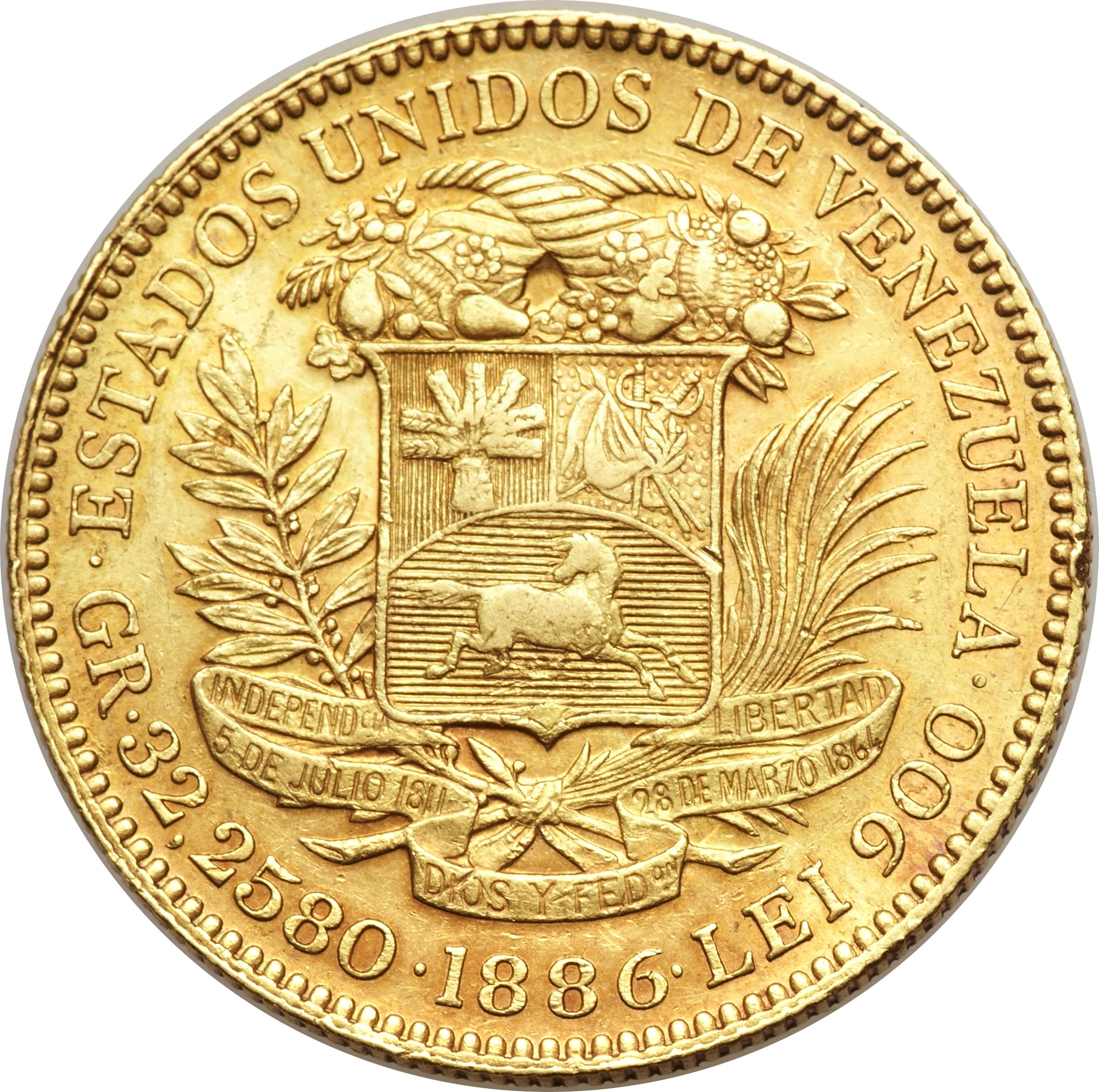
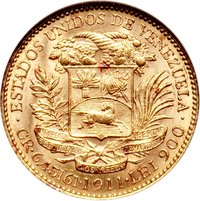
Obverse
Description:
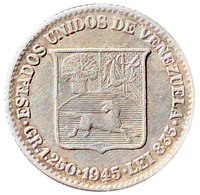
Coat of arms above, weight, date, and fineness below.
Inscription:
•ESTADOS UNIDOS DE VENEZUELA•
GR•32,2580 • 1886 • LEI 900
GR•32,2580 • 1886 • LEI 900
Translation:
UNITED STATES OF VENEZUELA
GR•32,2580 • 1886 • 900 THOUSANDTHS
GR•32,2580 • 1886 • 900 THOUSANDTHS
Script: Latin
Language: Spanish
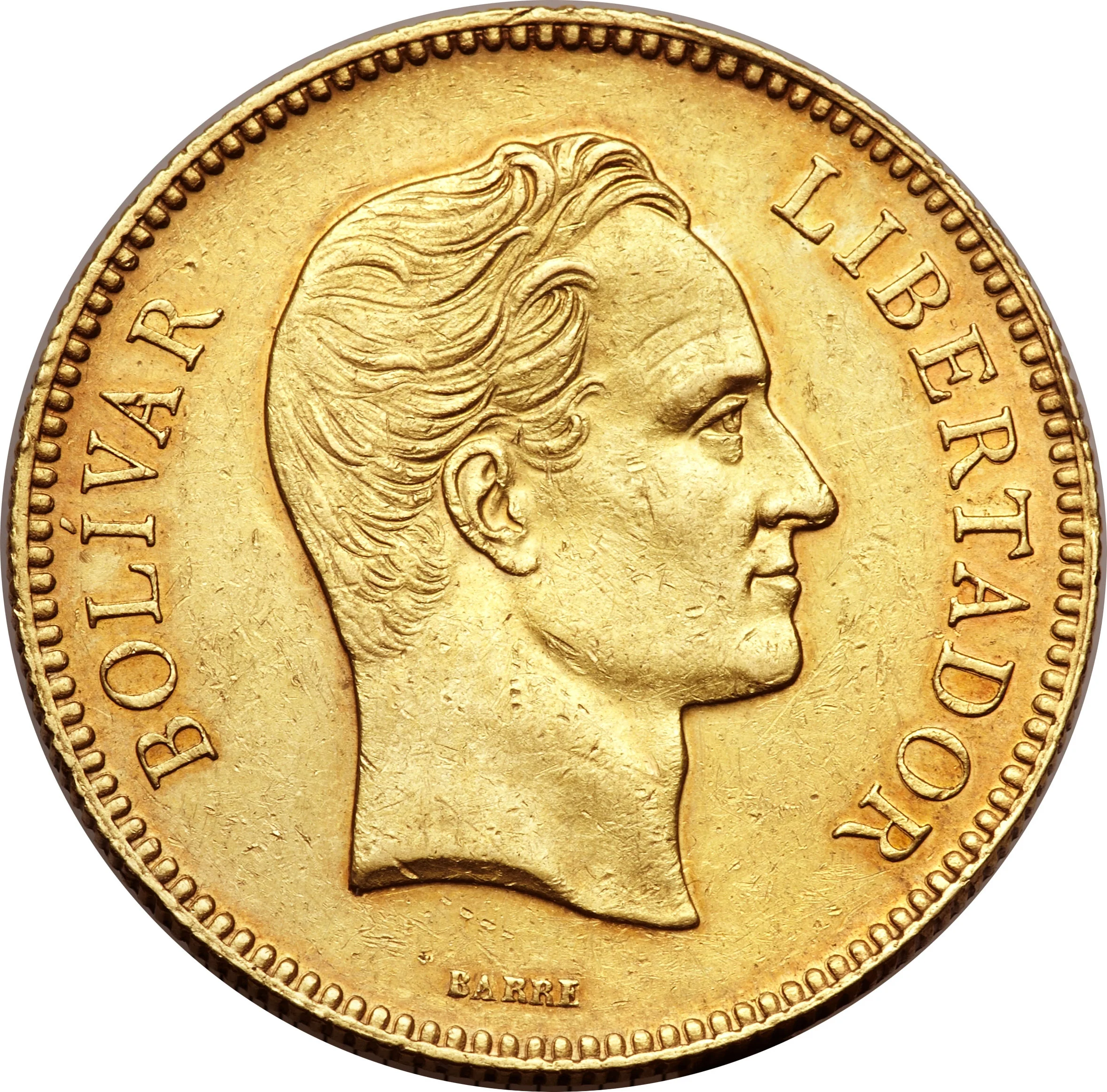
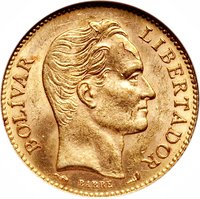
Engraver: Désiré-Albert Barre
Reverse
Edge
Reeded
Categories
| Symbol> Cornucopia |
| Animal> Horse |
| Person> Military leader |
| Person> Politician |
| Symbols> Coat of Arms |
Mints
| Name | Mark |
|---|---|
| Caracas | — |
Mintings
| Year | Mint Mark | Mintage | Quality | Collection |
|---|---|---|---|---|
| 1886 | — | 4,250 | ||
| 1887 | — | 28,000 | ||
| 1888 | — | 32,000 | ||
| 1889 | — | 23,000 |
Historical background
In 1886, Venezuela's currency situation was characterized by the dominance of foreign coinage and persistent monetary instability, a legacy of post-independence economic fragmentation. Following the collapse of Gran Colombia, the nation lacked a unified, state-controlled currency. Instead, a chaotic mix of coins circulated, primarily foreign silver, such as the Colombian peso, the French franc, and the British sovereign, alongside worn and clipped Spanish colonial pieces. This system was highly inefficient for commerce and state finance, as the value of these coins fluctuated based on their metal content and international exchange rates, rather than a fixed national standard.
The government of President Antonio Guzmán Blanco, in a push for modernization and centralization, had taken a significant step a decade earlier with the Monetary Law of 1874. This law had officially introduced the venezolano (also called the peso fuerte) as the national decimal currency, theoretically valued at 100 centavos and pegged to the French franc on a bimetallic (gold and silver) standard. However, by 1886, the venezolano had failed to achieve widespread circulation. The promised gold and silver coins were minted in limited quantities abroad, and paper money issued by private banks remained suspect. In practice, the old, heterogeneous foreign silver continued to be the medium of daily exchange for most citizens.
Consequently, the currency situation in 1886 was one of transition and frustration. The state's ambition for a stable, sovereign monetary system, symbolized by the venezolano, was undermined by a lack of public trust, insufficient minting, and the entrenched use of foreign specie. This monetary disarray reflected broader challenges of national consolidation and economic dependence, hindering domestic investment and complicating Venezuela's integration into the global economy. True monetary unification and stability would remain elusive until the major currency reform of 1879, which introduced the bolívar as we know it, a process still being consolidated in the late 1880s.
The government of President Antonio Guzmán Blanco, in a push for modernization and centralization, had taken a significant step a decade earlier with the Monetary Law of 1874. This law had officially introduced the venezolano (also called the peso fuerte) as the national decimal currency, theoretically valued at 100 centavos and pegged to the French franc on a bimetallic (gold and silver) standard. However, by 1886, the venezolano had failed to achieve widespread circulation. The promised gold and silver coins were minted in limited quantities abroad, and paper money issued by private banks remained suspect. In practice, the old, heterogeneous foreign silver continued to be the medium of daily exchange for most citizens.
Consequently, the currency situation in 1886 was one of transition and frustration. The state's ambition for a stable, sovereign monetary system, symbolized by the venezolano, was undermined by a lack of public trust, insufficient minting, and the entrenched use of foreign specie. This monetary disarray reflected broader challenges of national consolidation and economic dependence, hindering domestic investment and complicating Venezuela's integration into the global economy. True monetary unification and stability would remain elusive until the major currency reform of 1879, which introduced the bolívar as we know it, a process still being consolidated in the late 1880s.
💎 Extremely Rare