

½ centavo – Philippines
Add to wishlist
Philippines
Context
Years: 1903–1908
Issuer: Philippines
Period:
(1901—1935)
Currency:
(1857—1967)
Demonetized: Yes
Total mintage: 17,743,384
Material
References
KM: #
Numista: #4354
Obverse
Description:
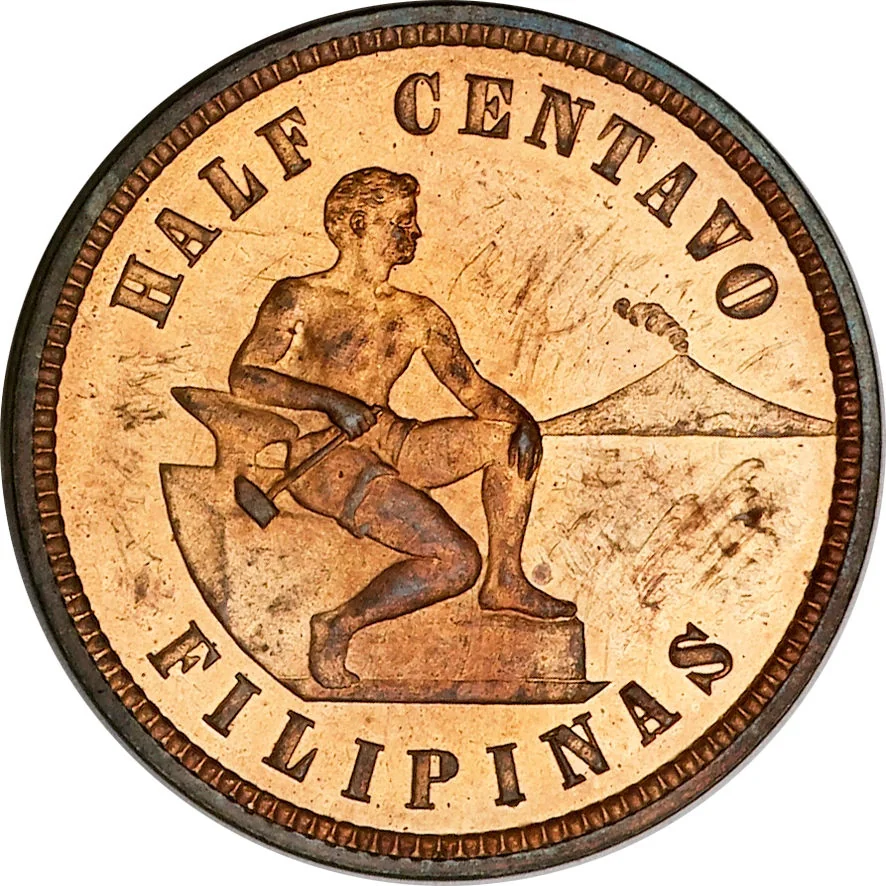
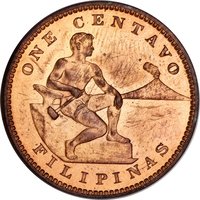
Man seated with hammer and anvil, volcano smoking at right.
Inscription:
HALF CENTAVO
FILIPINAS
FILIPINAS
Translation:
Half Centavo
Philippines
Philippines
Script: Latin
Designers: Melicio Figueroa, Charles Barber
Reverse
Description:
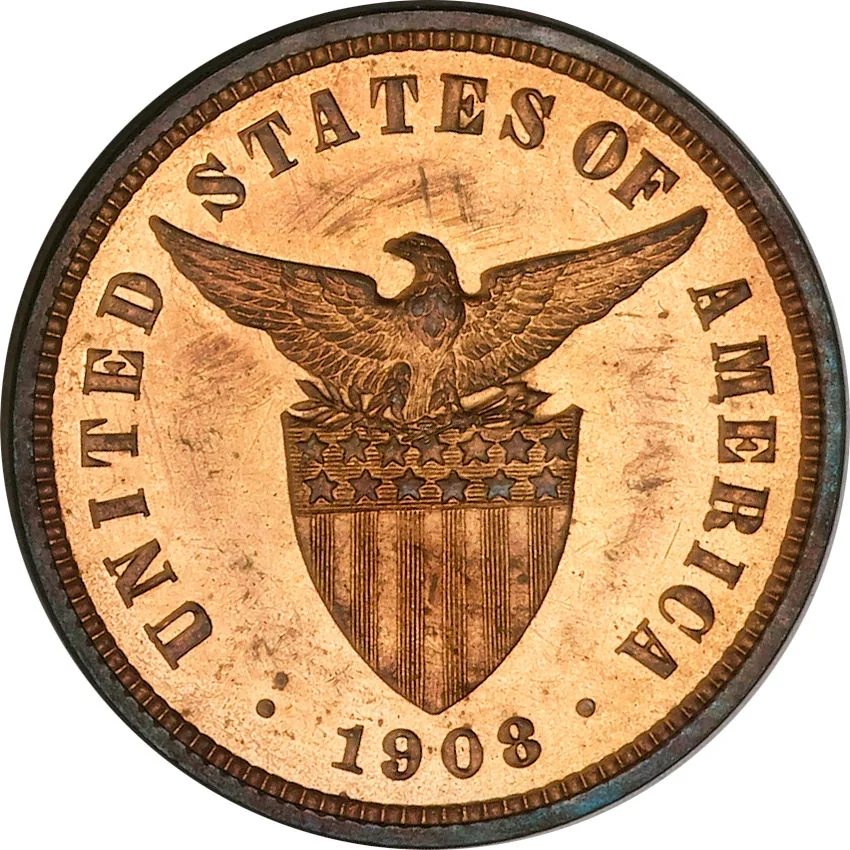
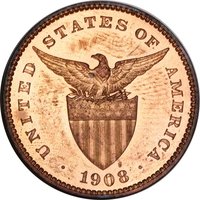
Eagle wings spread over shield.
Inscription:
UNITED STATES OF AMERICA
· 1908 ·
· 1908 ·
Script: Latin
Designers: Melicio Figueroa, Charles Barber
Edge
Plain
Categories
| Geography> Mountain |
| Symbols> Coat of Arms |
Mints
| Name | Mark |
|---|---|
| United States Mint of Philadelphia | — |
Mintings
| Year | Mint Mark | Mintage | Quality | Collection |
|---|---|---|---|---|
| 1903 | — | 12,084,000 | ||
| 1903 | — | 2,558 | Proof | |
| 1904 | — | 5,654,000 | ||
| 1904 | — | 1,355 | Proof | |
| 1905 | — | 471 | Proof | |
| 1906 | — | 500 | Proof | |
| 1908 | — | 500 | Proof |
Historical background
In 1903, the Philippines found itself in a complex monetary transition under the new American colonial administration following the Spanish-American War. The currency system was a chaotic mixture of the old Spanish-Filipino silver pesos, Mexican silver dollars, and fractional coinage, alongside a plethora of privately issued bank notes and certificates. This fragmentation created significant uncertainty for trade and economic stability, as the value and authenticity of various forms of money were often in question, hindering the islands' commercial development.
To resolve this, the U.S. Philippine Commission enacted the Coinage Act of 1903, which established a new, gold-standard currency system pegged directly to the U.S. dollar. The Philippine peso was defined as exactly 12.9 grains of gold, equivalent to half the value of a U.S. dollar, creating a fixed exchange rate of 2 Philippine pesos to 1 U.S. dollar. The act authorized the minting of new silver and copper coins bearing Filipino symbols, as well as the issuance of silver certificates, all backed by a gold reserve held in the U.S. Treasury.
This reform successfully imposed uniformity and stability, integrating the Philippine economy firmly into the American financial orbit. It facilitated U.S. investment and trade, but also meant that the archipelago's monetary policy was entirely dictated by Washington. While ending the prior chaos, the system tied the Philippine economy closely to the fortunes and decisions of the United States, a relationship that would define its financial landscape for decades to come.
To resolve this, the U.S. Philippine Commission enacted the Coinage Act of 1903, which established a new, gold-standard currency system pegged directly to the U.S. dollar. The Philippine peso was defined as exactly 12.9 grains of gold, equivalent to half the value of a U.S. dollar, creating a fixed exchange rate of 2 Philippine pesos to 1 U.S. dollar. The act authorized the minting of new silver and copper coins bearing Filipino symbols, as well as the issuance of silver certificates, all backed by a gold reserve held in the U.S. Treasury.
This reform successfully imposed uniformity and stability, integrating the Philippine economy firmly into the American financial orbit. It facilitated U.S. investment and trade, but also meant that the archipelago's monetary policy was entirely dictated by Washington. While ending the prior chaos, the system tied the Philippine economy closely to the fortunes and decisions of the United States, a relationship that would define its financial landscape for decades to come.
Series: 1903 series
🌱 Common