

1 peso – Philippines
Add to wishlist
Philippines
Context
Year: 1897
Issuer: Philippines
Ruler: Alfonso XIII
Currency:
(1857—1967)
Demonetized: Yes
Total mintage: 6,000,000
Material
References
KM: #
Numista: #15891
Value
Bullion value: $56.20
Obverse
Description:
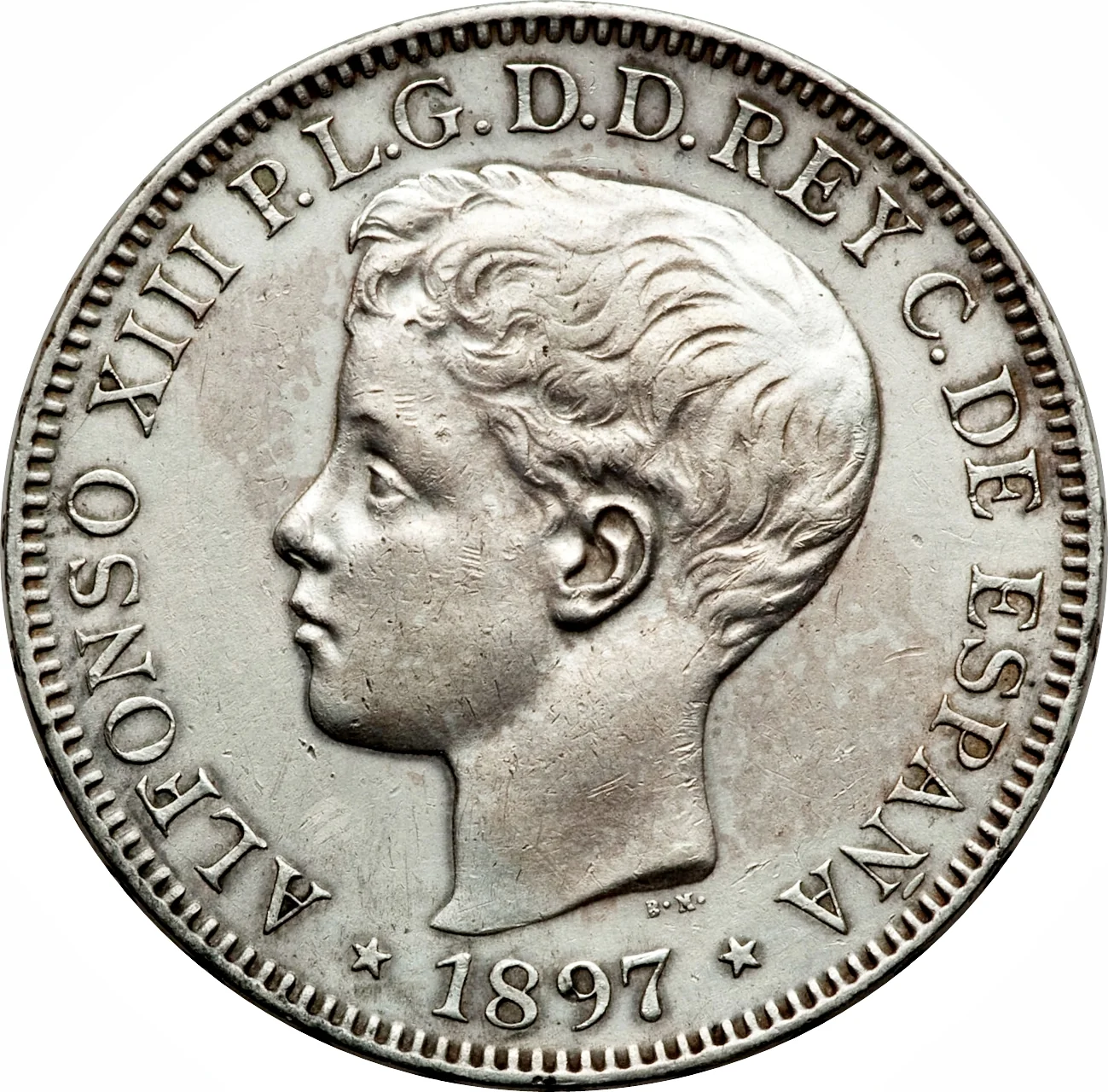
King Alfonso III, left-facing profile.
Inscription:
ALFONSO XIII P. L. G. D. D. REY C. DE ESPAÑA
B. M.
🞲 1897 🞲
B. M.
🞲 1897 🞲
Translation:
Alfonso XIII, by the grace of God, King of Spain
B. M.
🞲 1897 🞲
B. M.
🞲 1897 🞲
Script: Latin
Engraver: Bartolomé Maura Montaner
Reverse
Description:
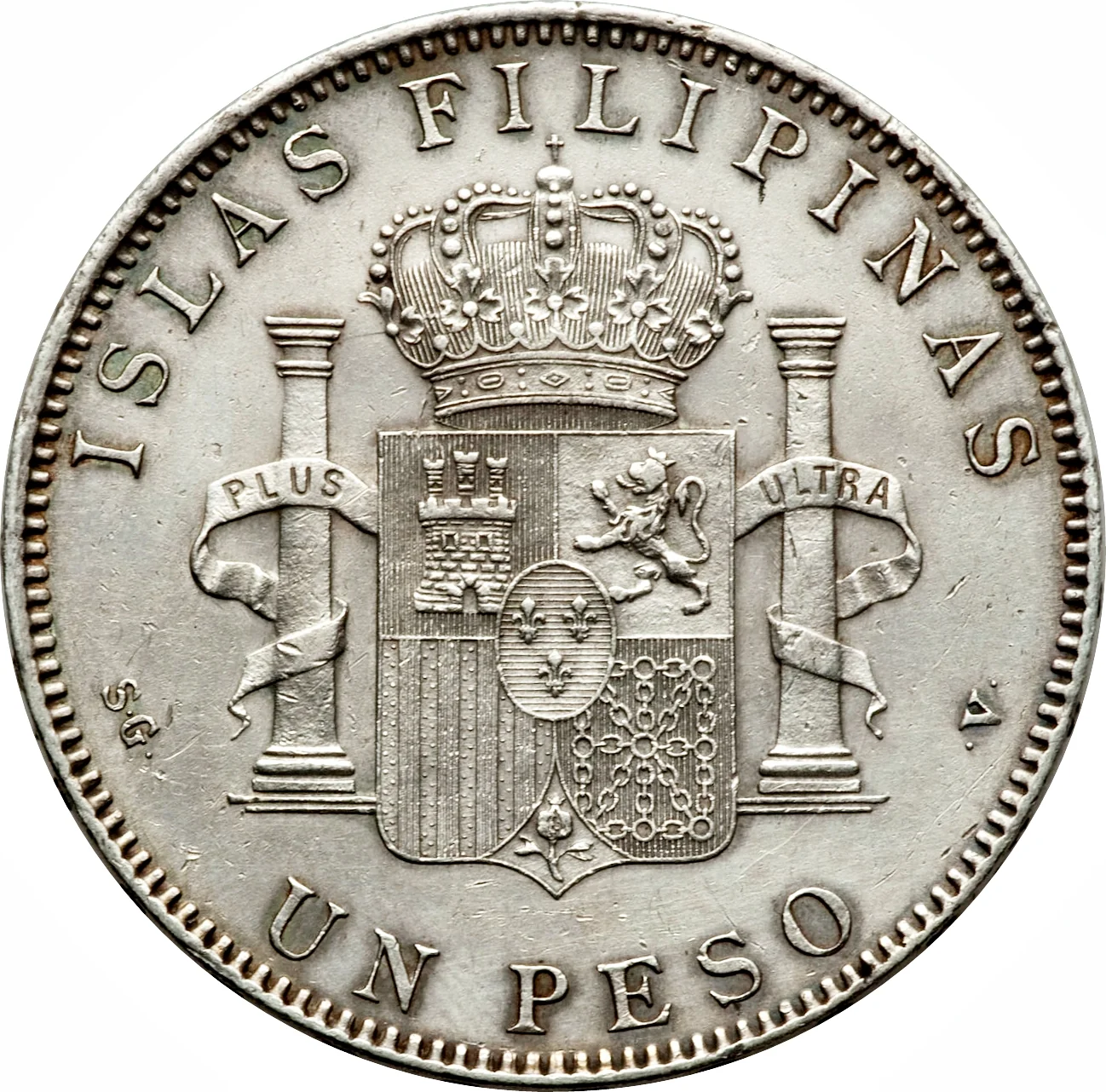
Spanish coat of arms.
Inscription:
ISLAS FILIPINAS
PLUS ULTRA
S · G · UN PESO · V ·
PLUS ULTRA
S · G · UN PESO · V ·
Translation:
Philippine Islands
Further Beyond
S · G · One Peso · V ·
Further Beyond
S · G · One Peso · V ·
Script: Latin
Language: Spanish
Engraver: Bartolomé Maura Montaner
Edge
© Mt Hood Coins
Categories
| Person> Monarch |
| Symbols> Coat of Arms |
Mintings
| Year | Mint Mark | Mintage | Quality | Collection |
|---|---|---|---|---|
| 1897 | — | 6,000,000 |
Historical background
In 1897, the Philippines was in the midst of the Philippine Revolution against Spanish colonial rule, creating a complex and fragmented currency situation. The Spanish colonial administration maintained its monetary system, based on the silver Peso Fuerte (strong peso) and its subsidiary coins. However, the revolutionary government under Emilio Aguinaldo, first from the Tejeros Convention and later from Biak-na-Bato, faced severe financial constraints. To fund the struggle, the Republic issued its own paper currency and bonds, most notably the "Billete del Gobierno Revolucionario" (Note of the Revolutionary Government). These early banknotes, printed hastily and with simple designs, represented a bold assertion of sovereignty but had limited circulation and acceptance, primarily within revolutionary-held areas.
The broader economy suffered from instability, with trade disrupted by warfare. The Spanish peseta and Mexican silver dollars (which had long circulated in Asia) remained the most trusted mediums of exchange in many regions, especially in cities and ports under Spanish control. Counterfeiting of Spanish coins was also a reported problem, further eroding trust. Crucially, the revolutionary currency lacked the robust backing of specie (precious metal reserves) or a stable government apparatus to enforce its use, leading to skepticism among the general populace and merchants who preferred tangible silver.
This monetary duality—the entrenched Spanish system versus the nascent revolutionary notes—mirrored the political conflict of the period. The signing of the Pact of Biak-na-Bato in December 1897 temporarily suspended hostilities, but it did not resolve the fundamental currency divide. The revolutionary experiment with paper money, though short-lived in this phase, set a critical precedent. It established the principle of a national currency issued by a Filipino government, a concept that would be fully realized after the revolution's resurgence and the subsequent establishment of the First Philippine Republic in 1899.
The broader economy suffered from instability, with trade disrupted by warfare. The Spanish peseta and Mexican silver dollars (which had long circulated in Asia) remained the most trusted mediums of exchange in many regions, especially in cities and ports under Spanish control. Counterfeiting of Spanish coins was also a reported problem, further eroding trust. Crucially, the revolutionary currency lacked the robust backing of specie (precious metal reserves) or a stable government apparatus to enforce its use, leading to skepticism among the general populace and merchants who preferred tangible silver.
This monetary duality—the entrenched Spanish system versus the nascent revolutionary notes—mirrored the political conflict of the period. The signing of the Pact of Biak-na-Bato in December 1897 temporarily suspended hostilities, but it did not resolve the fundamental currency divide. The revolutionary experiment with paper money, though short-lived in this phase, set a critical precedent. It established the principle of a national currency issued by a Filipino government, a concept that would be fully realized after the revolution's resurgence and the subsequent establishment of the First Philippine Republic in 1899.
🌱 Fairly Common