

1 Real (The Real) – Brazil
Circulating commemorative coins
Commemoration: 30 Years of the Real
Brazil
Context

Material

References
KM: #Click to copy to clipboard738
Numista: #435300
Value
Exchange value: 1 BRL = $0.20
Inflation-adjusted value: 1.04 BRL
Obverse
Description:
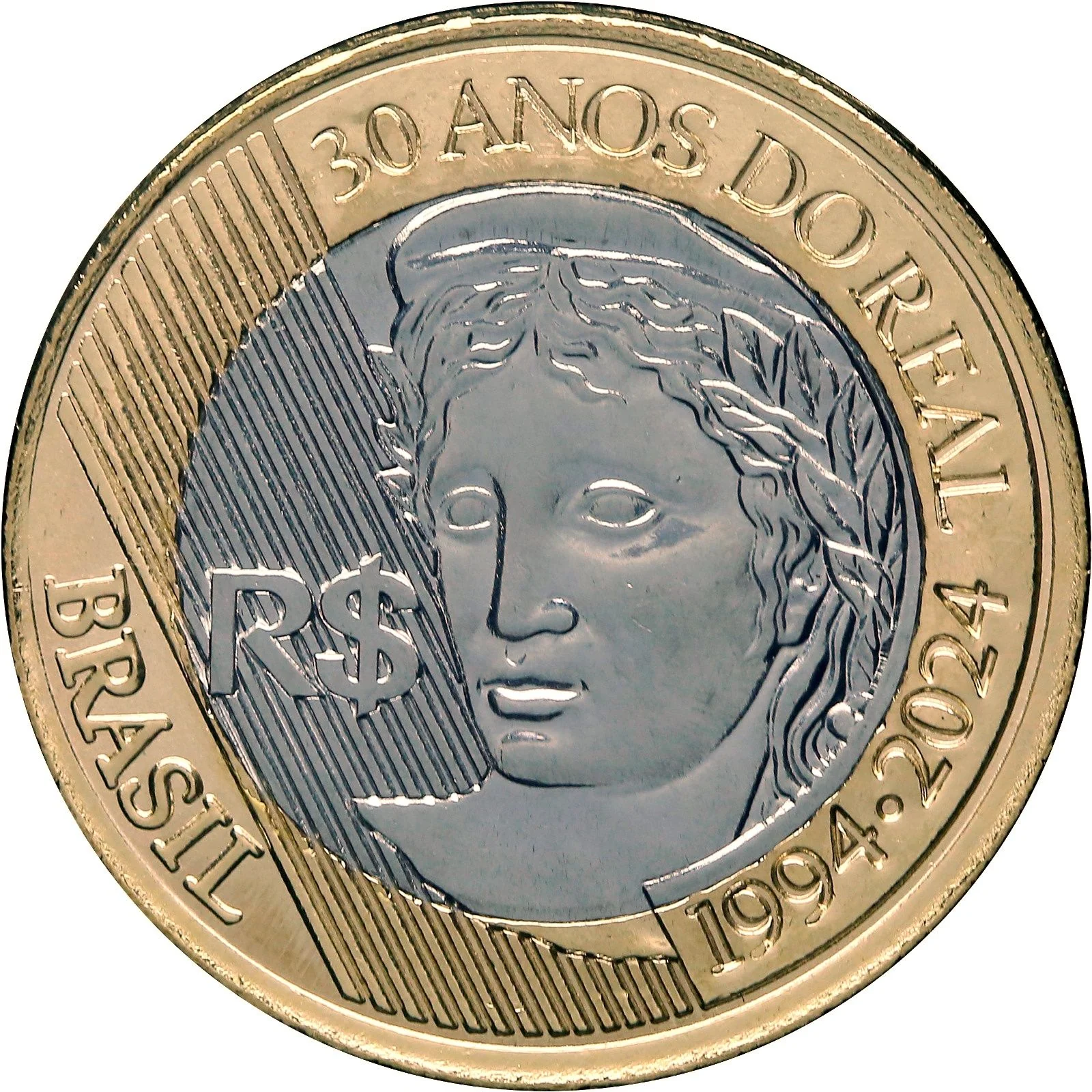
Obverse: Republic effigy with diagonal lines and R$ symbol. Event name above, country name lower left, dates lower right.
Inscription:
30 ANOS DO REAL
R$
BRASIL 1994 • 2024
R$
BRASIL 1994 • 2024
Translation:
30 Years of the Real
R$
Brazil 1994 • 2024
R$
Brazil 1994 • 2024
Script: Latin
Language: Portuguese
Designer: Central Bank of Brazil
Reverse
Description:
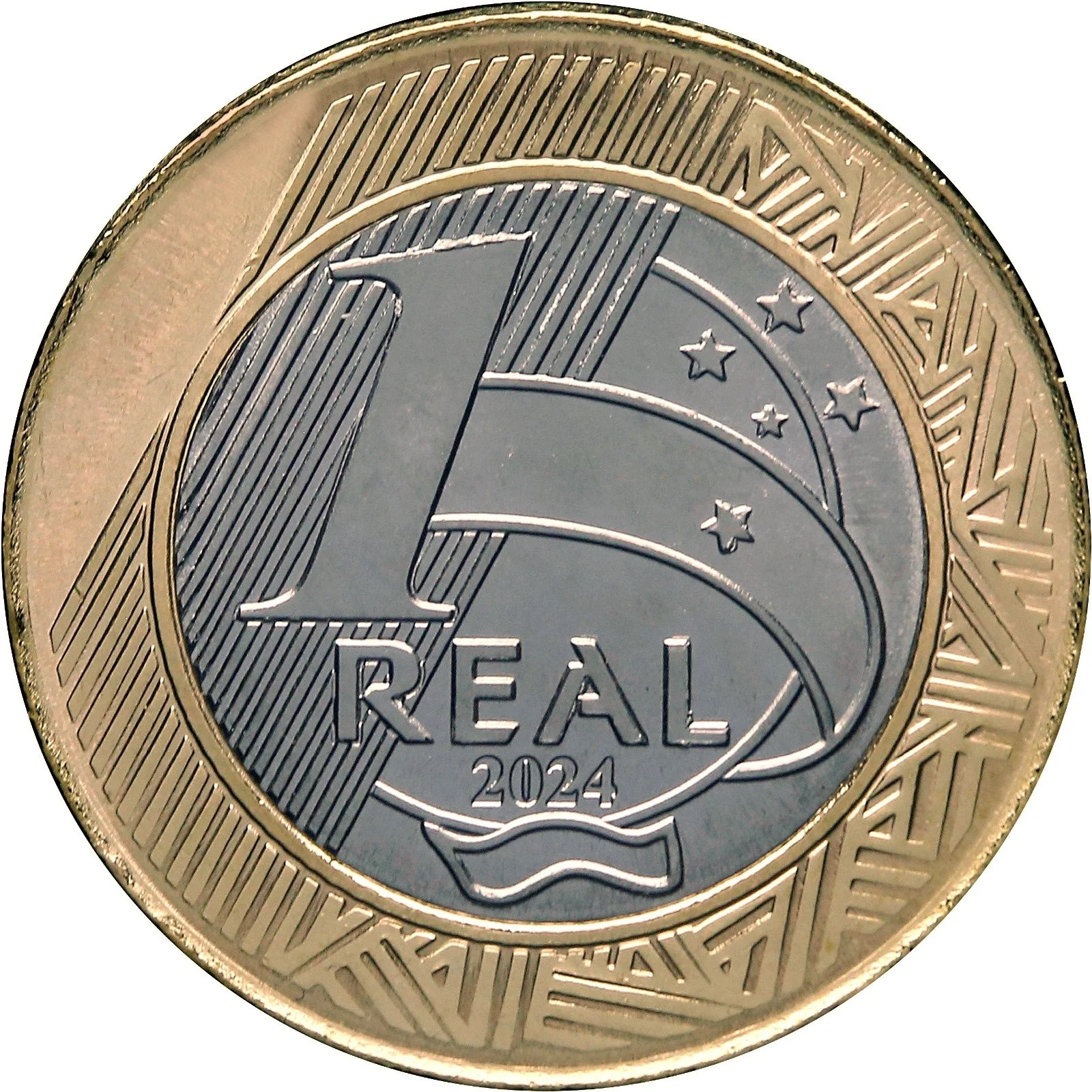
Denomination, date, and Southern Cross within geometric patterns.
Inscription:
1
REAL
2024
REAL
2024
Script: Latin
Designer: Central Bank of Brazil
Edge
Segmeted reeding
Mints
| Name | Mark |
|---|---|
| Casa da Moeda do Brasil | — |
Mintings
| Year | Mint Mark | Mintage | Quality | Collection |
|---|---|---|---|---|
| 2024 | — | 45,000,000 |
Historical background
In 2024, Brazil's currency, the real (BRL), operates within a context of relative stability but persistent challenges. The Central Bank of Brazil (BCB) has maintained a hawkish monetary policy, having initiated an aggressive tightening cycle in 2021 to combat post-pandemic inflation. Although inflation has receded closer to the official target, the BCB has proceeded with caution, lowering the benchmark Selic rate gradually from its peak. This high-interest rate environment, one of the highest real rates among major economies, has provided support for the real by attracting foreign capital inflows into Brazilian assets, preventing significant depreciation despite global volatility.
However, the currency faces significant headwinds rooted in fiscal concerns and external dependencies. The primary source of pressure is investor anxiety over the nation's fiscal trajectory, particularly the government's commitment to achieving a primary surplus and controlling public debt, which remains above 70% of GDP. Furthermore, the real remains vulnerable to global commodity price swings—as a major exporter of soybeans, iron ore, and oil—and shifts in global risk sentiment and U.S. monetary policy. Any signal of prolonged high rates in developed markets tends to strengthen the dollar and pressure emerging market currencies like the real.
Looking ahead, the currency's path in 2024 is tightly linked to the credibility of fiscal policy and the BCB's ability to navigate a soft landing. Markets are closely watching the government's ability to pass revenue-raising measures and meet its zero-primary-deficit target. Success on this front could bolster the real and allow for a smoother interest rate cutting cycle, while any perceived fiscal slippage could trigger capital outflows and depreciation. Consequently, the real's stability is less about immediate crisis and more a fragile balance maintained by attractive yields, countered by underlying structural and political-economic uncertainties.
However, the currency faces significant headwinds rooted in fiscal concerns and external dependencies. The primary source of pressure is investor anxiety over the nation's fiscal trajectory, particularly the government's commitment to achieving a primary surplus and controlling public debt, which remains above 70% of GDP. Furthermore, the real remains vulnerable to global commodity price swings—as a major exporter of soybeans, iron ore, and oil—and shifts in global risk sentiment and U.S. monetary policy. Any signal of prolonged high rates in developed markets tends to strengthen the dollar and pressure emerging market currencies like the real.
Looking ahead, the currency's path in 2024 is tightly linked to the credibility of fiscal policy and the BCB's ability to navigate a soft landing. Markets are closely watching the government's ability to pass revenue-raising measures and meet its zero-primary-deficit target. Success on this front could bolster the real and allow for a smoother interest rate cutting cycle, while any perceived fiscal slippage could trigger capital outflows and depreciation. Consequently, the real's stability is less about immediate crisis and more a fragile balance maintained by attractive yields, countered by underlying structural and political-economic uncertainties.



🌱 Common