

1 real (The Real) – Brazil
Add to wishlist
Circulating commemorative coins
Commemoration: 25 Years of the Real
Brazil
Context
Material

References
KM: #
Numista: #177625
Value
Exchange value: 1 BRL
Inflation-adjusted value: 1.38 BRL
Obverse
Description:
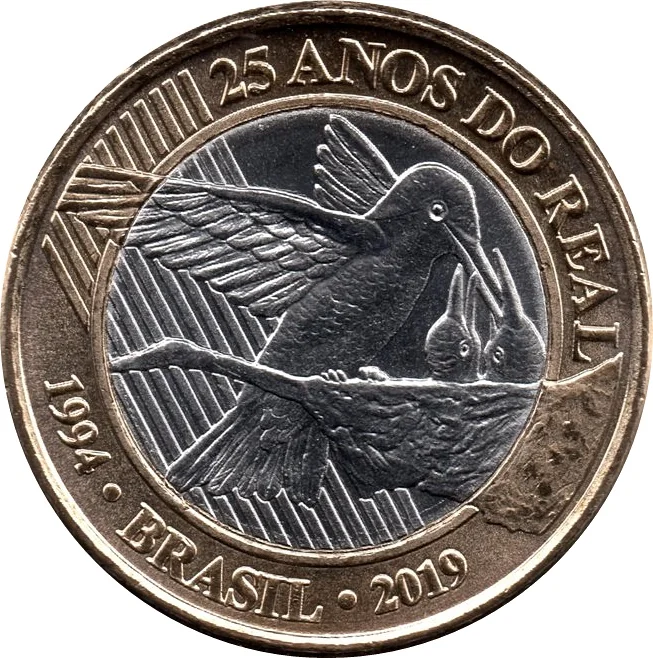
Hummingbird feeding chicks in a nest, with striped background. Styled like Real coins, featuring curved legends for the event, years, and country.
Inscription:
25 ANOS DO REAL
1994 • BRASIL • 2019
1994 • BRASIL • 2019
Translation:
25 Years of the Real
1994 • Brazil • 2019
1994 • Brazil • 2019
Script: Latin
Language: Portuguese
Engravers: Glória A. Ferreira Dias, Katia M. Abreu Dias.
Designer: Luis Henrique Ferreira
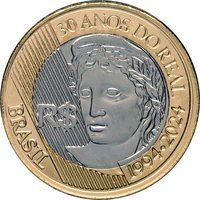
Reverse
Description:
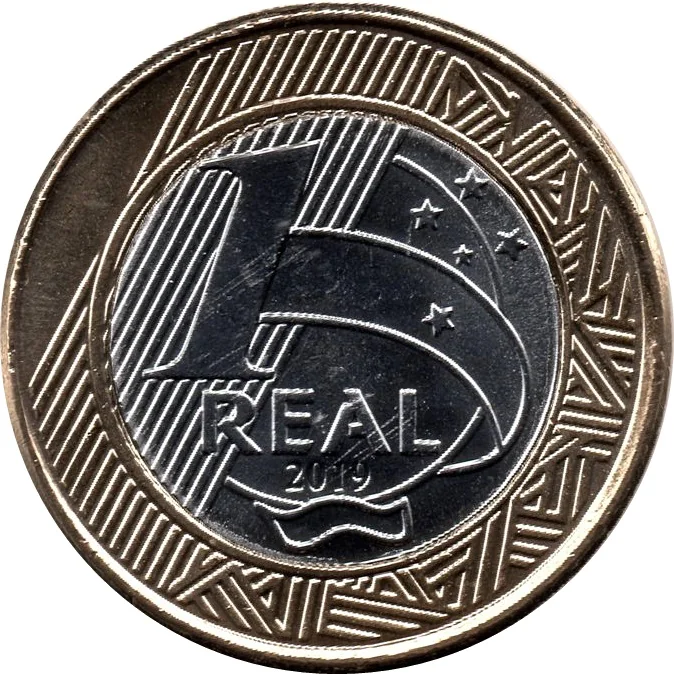
Central design with denomination before a globe and Southern Cross, backed by stripes and date. Outer ring features Marajoara geometric patterns.
Inscription:
1
REAL
2019
REAL
2019
Translation:
One Real
2019
2019
Script: Latin
Engravers: Glória A. Ferreira Dias, Katia M. Abreu Dias
Designer: Luis Henrique Ferreira
Edge
Segmented reeding
Mints
| Name | Mark |
|---|---|
| Casa da Moeda do Brasil | — |
Mintings
| Year | Mint Mark | Mintage | Quality | Collection |
|---|---|---|---|---|
| 2019 | — | 25,000,000 |
Historical background
In 2019, Brazil's currency, the real (BRL), experienced significant volatility and depreciation, largely influenced by a combination of domestic political uncertainty and shifting global risk sentiment. The year began with optimism following the October 2018 election of right-wing President Jair Bolsonaro, whose pro-market agenda and promised pension reform fueled a "Bolsonaro Rally." This sent the real to around BRL 3.70/USD, its strongest level in over two years, as international investors anticipated long-overdue fiscal adjustments to address the country's large public debt.
However, this strength proved fleeting. As the year progressed, political fragmentation in Congress stalled the crucial pension reform, undermining confidence in the government's ability to stabilize public finances. Concurrently, a slowdown in economic growth, exacerbated by a weaker-than-expected recovery from the 2015-2016 recession, pressured the currency. The real's trajectory was further dictated by external factors, particularly the monetary policy of the U.S. Federal Reserve. As the Fed paused its rate-hiking cycle and later cut rates, it provided some relief to emerging market currencies like the real by reducing the dollar's yield advantage.
By the end of 2019, the real had weakened considerably, closing the year near BRL 4.00/USD, a depreciation of roughly 8% from its January peak. This reflected a market reassessment of Brazil's near-term economic prospects and reform pace. Ultimately, the year highlighted the real's sensitivity to the domestic reform timetable, with its performance serving as a key barometer for investor confidence in the Bolsonaro administration's ability to deliver its economic agenda amidst a challenging political landscape.
However, this strength proved fleeting. As the year progressed, political fragmentation in Congress stalled the crucial pension reform, undermining confidence in the government's ability to stabilize public finances. Concurrently, a slowdown in economic growth, exacerbated by a weaker-than-expected recovery from the 2015-2016 recession, pressured the currency. The real's trajectory was further dictated by external factors, particularly the monetary policy of the U.S. Federal Reserve. As the Fed paused its rate-hiking cycle and later cut rates, it provided some relief to emerging market currencies like the real by reducing the dollar's yield advantage.
By the end of 2019, the real had weakened considerably, closing the year near BRL 4.00/USD, a depreciation of roughly 8% from its January peak. This reflected a market reassessment of Brazil's near-term economic prospects and reform pace. Ultimately, the year highlighted the real's sensitivity to the domestic reform timetable, with its performance serving as a key barometer for investor confidence in the Bolsonaro administration's ability to deliver its economic agenda amidst a challenging political landscape.


🌱 Very Common