


1 real (Central Bank of Brazil) – Brazil
Add to wishlist
Circulating commemorative coins
Commemoration: 60 Years of the Central Bank of Brazil
Brazil
Context
Year: 2025
Issuer: Brazil
Issuing organization: Central Bank of Brazil
Period:
(since 1967)
Currency:
(since 1994)
Total mintage: 23,168,000
Material

References
Numista: #479064
Value
Exchange value: 1 BRL
Obverse
Description:
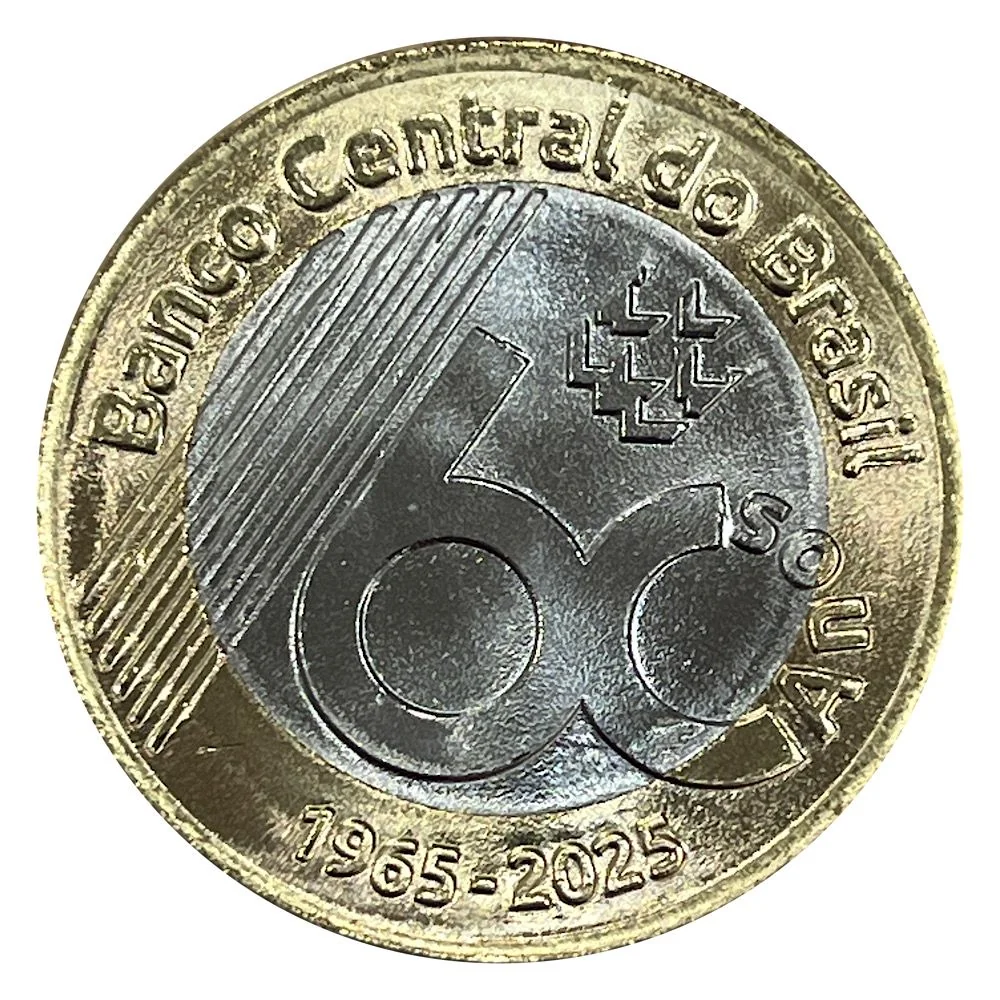
This commemorative stamp for the 60th Anniversary of the Central Bank of Brazil features the institution's logo on the obverse, with its name above and the anniversary dates centered below.
Inscription:
Banco Central do Brasil
60 Anos
1965 - 2025
60 Anos
1965 - 2025
Translation:
Central Bank of Brazil
60 Years
1965 - 2025
60 Years
1965 - 2025
Script: Latin
Language: Portuguese
Reverse
Description:
Denomination, date, and Southern Cross within geometric patterns.
Inscription:
1
REAL
2025
REAL
2025
Script: Latin
Edge
Segmented reeding
Mints
| Name | Mark |
|---|---|
| Casa da Moeda do Brasil | — |
Mintings
| Year | Mint Mark | Mintage | Quality | Collection |
|---|---|---|---|---|
| 2025 | — | 23,168,000 |
Historical background
In 2025, Brazil's currency, the Real (BRL), operates within a context of cautious stability but persistent underlying pressures. The Central Bank of Brazil (BCB), having successfully anchored inflation back to target in 2023-2024, maintains a relatively high benchmark interest rate (Selic) to preserve these gains and manage inflation expectations. This monetary policy stance, while attracting foreign capital inflows, also contributes to a stronger-than-fundamentals exchange rate, creating headwinds for export competitiveness and industrial growth. The currency's value is thus caught between the support of high yields and the drag of a complex domestic fiscal outlook.
The primary shadow over the Real remains the nation's challenging fiscal trajectory. Despite efforts at reform, public debt levels continue to hover near 80% of GDP, and markets closely monitor the government's ability to meet its zero-primary-deficit target. Any perceived slippage in fiscal discipline or political turbulence around spending priorities triggers volatility and depreciation pressure on the BRL. Furthermore, the global economic environment in 2025—marked by slower growth in key trade partner China and uncertain monetary policy paths in advanced economies—adds an external layer of risk, making the Real susceptible to shifts in global risk appetite.
Looking ahead, the currency's trajectory in 2025 hinges on a delicate balance. Sustained stability requires credible and sustained fiscal consolidation to reduce the debt burden and allow the BCB room to eventually lower interest rates without triggering capital flight or a inflationary spiral. Success would likely lead to a more moderately valued, investment-driven Real. However, the prevailing consensus among analysts is that the currency will remain in a state of managed vulnerability, with periods of strength punctuated by sudden corrections, as the government navigates the politically difficult trade-offs required for long-term economic rebalancing.
The primary shadow over the Real remains the nation's challenging fiscal trajectory. Despite efforts at reform, public debt levels continue to hover near 80% of GDP, and markets closely monitor the government's ability to meet its zero-primary-deficit target. Any perceived slippage in fiscal discipline or political turbulence around spending priorities triggers volatility and depreciation pressure on the BRL. Furthermore, the global economic environment in 2025—marked by slower growth in key trade partner China and uncertain monetary policy paths in advanced economies—adds an external layer of risk, making the Real susceptible to shifts in global risk appetite.
Looking ahead, the currency's trajectory in 2025 hinges on a delicate balance. Sustained stability requires credible and sustained fiscal consolidation to reduce the debt burden and allow the BCB room to eventually lower interest rates without triggering capital flight or a inflationary spiral. Success would likely lead to a more moderately valued, investment-driven Real. However, the prevailing consensus among analysts is that the currency will remain in a state of managed vulnerability, with periods of strength punctuated by sudden corrections, as the government navigates the politically difficult trade-offs required for long-term economic rebalancing.

🌟 Uncommon