

5 escudos – Chile
Add to wishlist
Chile
Context
Material
Diameter: 23.03 mm
Weight: 4.53 g
Thickness: 1.6 mm
Shape: Round
Composition: Copper-nickel
Technique: Milled
Alignment: Coin alignment
flip
References
KM: #
Numista: #4330
Obverse
Description:
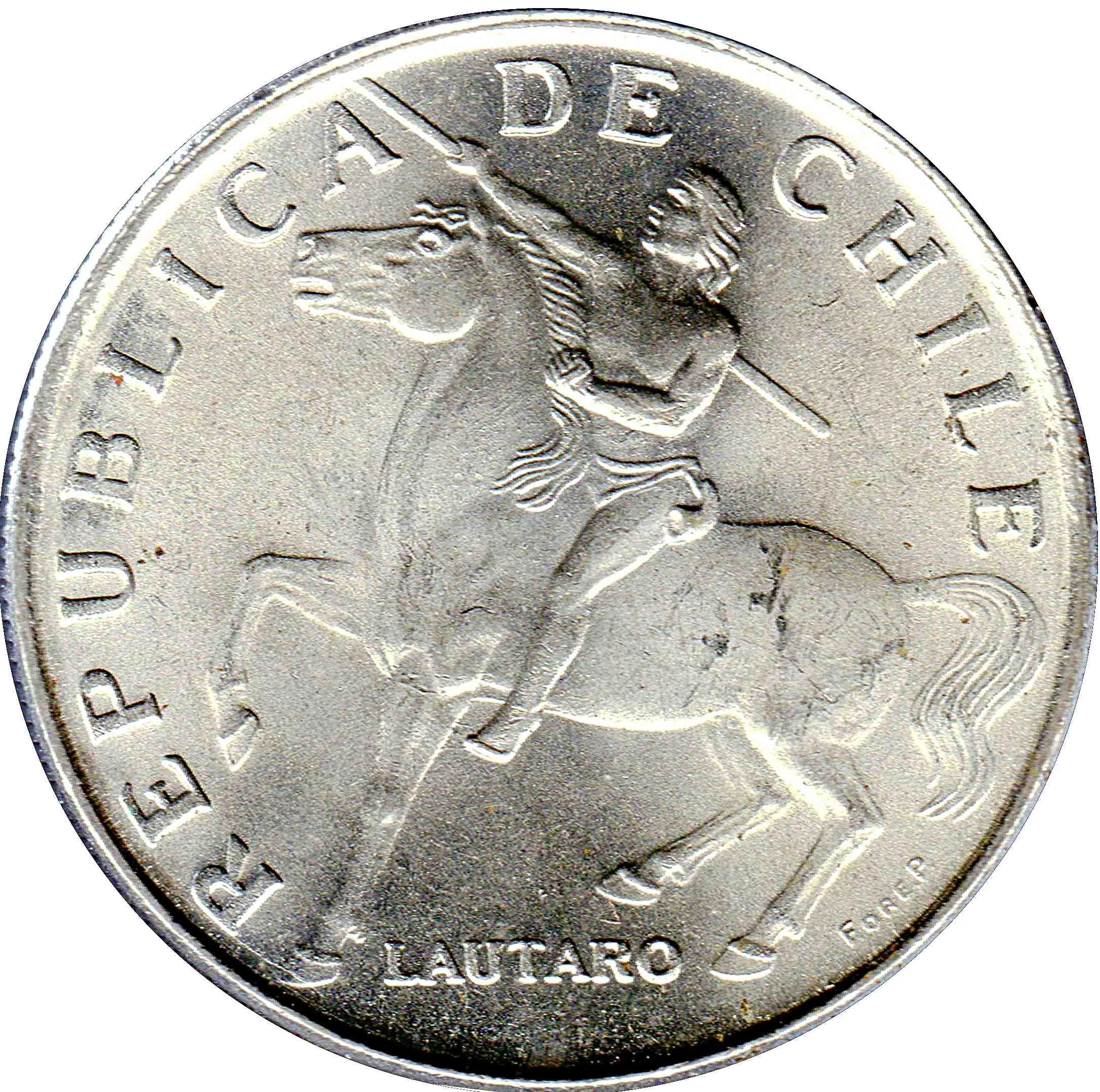
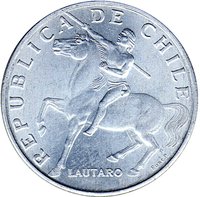
Lautaro (c. 1535–1557), a renowned Mapuche military leader who resisted the Spanish conquest of Chile.
Inscription:
REPUBLICA DE CHILE
LAUTARO
F. ORE. P.
LAUTARO
F. ORE. P.
Translation:
REPUBLIC OF CHILE
LAUTARO
F. ORE. P.
LAUTARO
F. ORE. P.
Script: Latin
Engraver: Francisco Orellana Pavéz
Reverse
Edge
Reeded
Categories
| Animal> Horse |
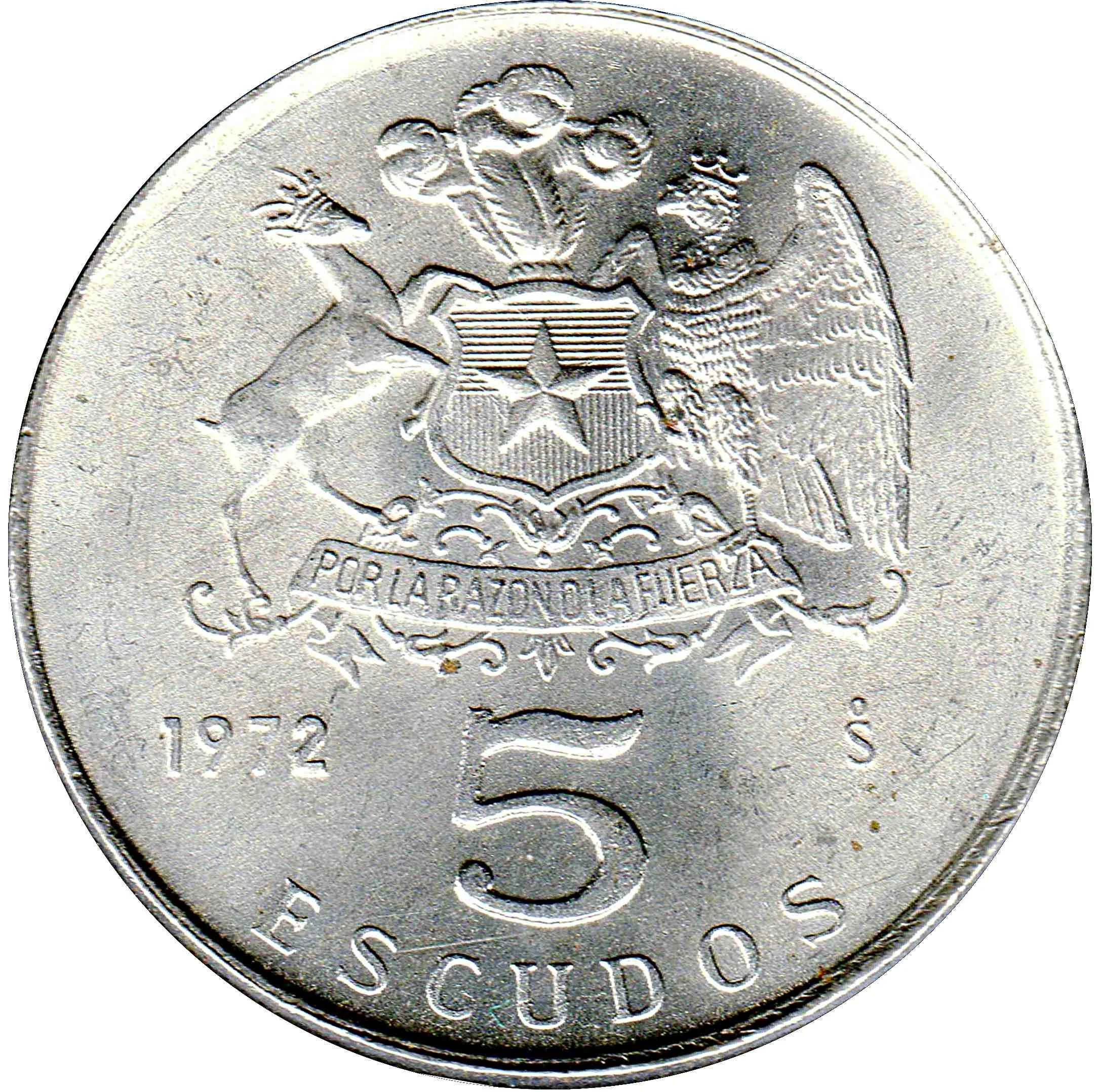
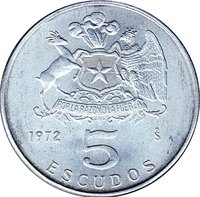
| Symbols> Coat of Arms |
Mints
| Name | Mark |
|---|---|
| Casa de Moneda de Chile | (So) |
Mintings
| Year | Mint Mark | Mintage | Quality | Collection |
|---|---|---|---|---|
| 1971 | So | — | ||
| 1972 | So | — | ||
| 1972 | So | — | Proof |
Historical background
In 1971, Chile's currency situation was deeply intertwined with the radical economic policies of President Salvador Allende's Unidad Popular government, elected in 1970. The administration pursued a "Chilean Road to Socialism," which involved massive state intervention, including the nationalization of key industries—most notably the copper mines—and significant expansion of social spending. To finance this agenda and stimulate demand, the government dramatically increased the money supply, while also implementing extensive price controls and raising wages. This combination created powerful inflationary pressures, as a surge in consumer demand chased a supply of goods that was constrained by production bottlenecks and growing business uncertainty.
Externally, the currency faced severe strain. The nationalization of the U.S.-owned copper companies, without compensation deemed adequate by the U.S. government, led to an international financial blockade. Chile's access to foreign credit and loans from international institutions and private banks was severely restricted, crippling its ability to finance imports or support the peso. Consequently, the country's foreign reserves dwindled rapidly. The fixed exchange rate, maintained by the government, became increasingly overvalued, creating a thriving black market for U.S. dollars where the peso traded at a fraction of its official value. This overvaluation further discouraged exports (aside from state-controlled copper) and made vital imports prohibitively expensive for the state.
By the end of 1971, the underlying imbalances were becoming starkly apparent. While initial wage hikes boosted popular consumption, the economy was overheating. The expansionary fiscal and monetary policies, combined with the external financial stranglehold and a growing budget deficit, set the stage for the hyperinflation and severe goods shortages that would cripple the Chilean economy in the following years. The currency situation of 1971 thus represented the first act of a profound economic crisis, where political objectives collided with economic realities and external pressure, eroding the value of the peso and destabilizing the national economy.
Externally, the currency faced severe strain. The nationalization of the U.S.-owned copper companies, without compensation deemed adequate by the U.S. government, led to an international financial blockade. Chile's access to foreign credit and loans from international institutions and private banks was severely restricted, crippling its ability to finance imports or support the peso. Consequently, the country's foreign reserves dwindled rapidly. The fixed exchange rate, maintained by the government, became increasingly overvalued, creating a thriving black market for U.S. dollars where the peso traded at a fraction of its official value. This overvaluation further discouraged exports (aside from state-controlled copper) and made vital imports prohibitively expensive for the state.
By the end of 1971, the underlying imbalances were becoming starkly apparent. While initial wage hikes boosted popular consumption, the economy was overheating. The expansionary fiscal and monetary policies, combined with the external financial stranglehold and a growing budget deficit, set the stage for the hyperinflation and severe goods shortages that would cripple the Chilean economy in the following years. The currency situation of 1971 thus represented the first act of a profound economic crisis, where political objectives collided with economic realities and external pressure, eroding the value of the peso and destabilizing the national economy.
Series: 1971 Chile circulation coins
🌱 Very Common