

1 Cent – Canada
Canada
Context
Years: 1953–1964
Issuer: Canada 
Ruler: Elizabeth II
Currency:
(since 1858)
Total mintage: 1,676,679,384
Material
References
KM: #Click to copy to clipboard49
Numista: #433
Value
Exchange value: 0.01 CAD = $0.01
Inflation-adjusted value: 0.11 CAD
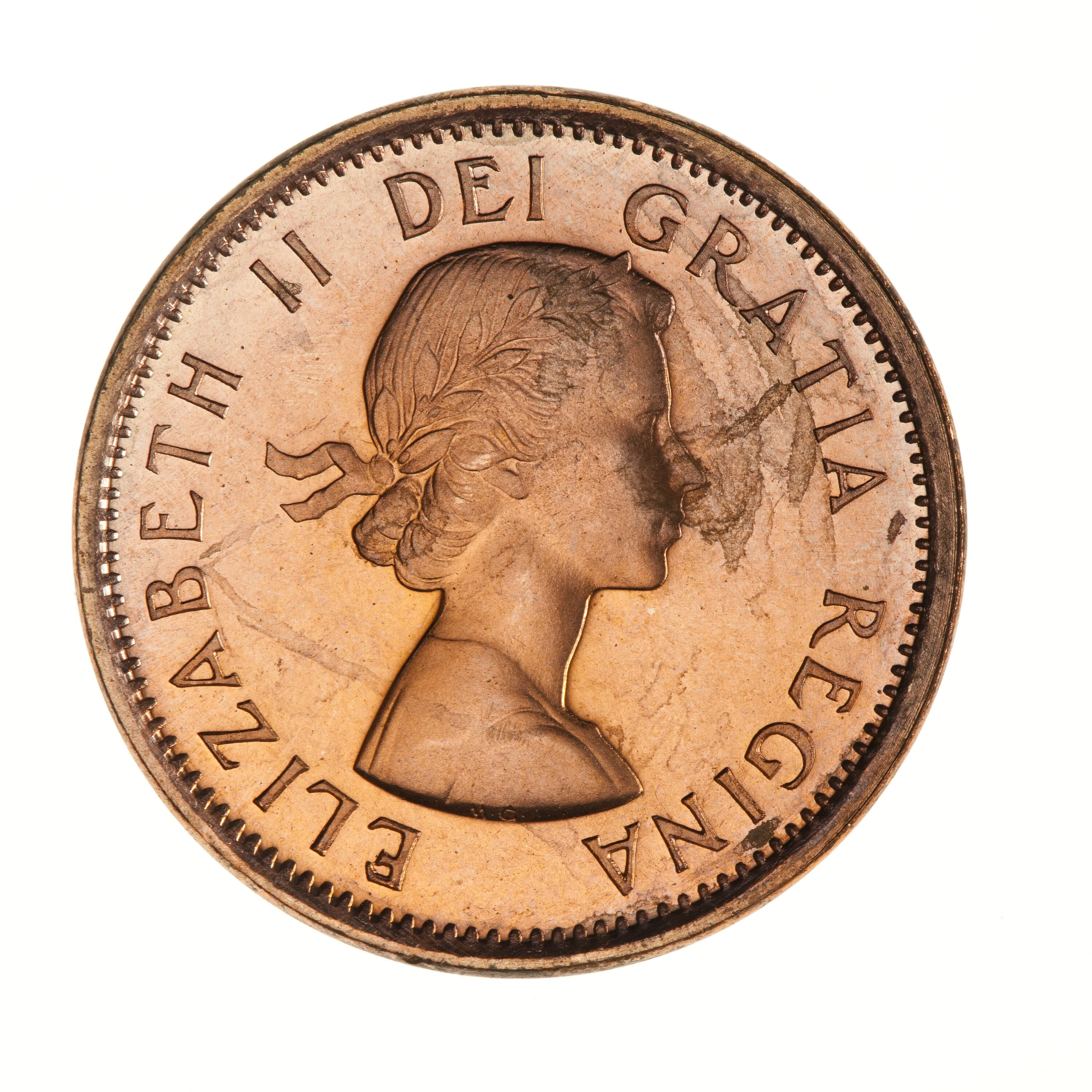
Obverse
Description:
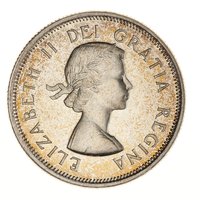
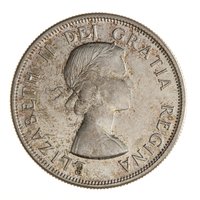
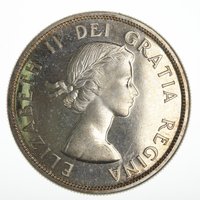
Bust of 27-year-old Elizabeth II, facing right, wearing a wreath, with engraver's initials in truncation.
Inscription:
ELIZABETH II DEI GRATIA REGINA
M·G·
M·G·
Translation:
Elizabeth II by the Grace of God Queen
M·G·
M·G·
Script: Latin
Engravers: Mary Gillick, Thomas Shingles
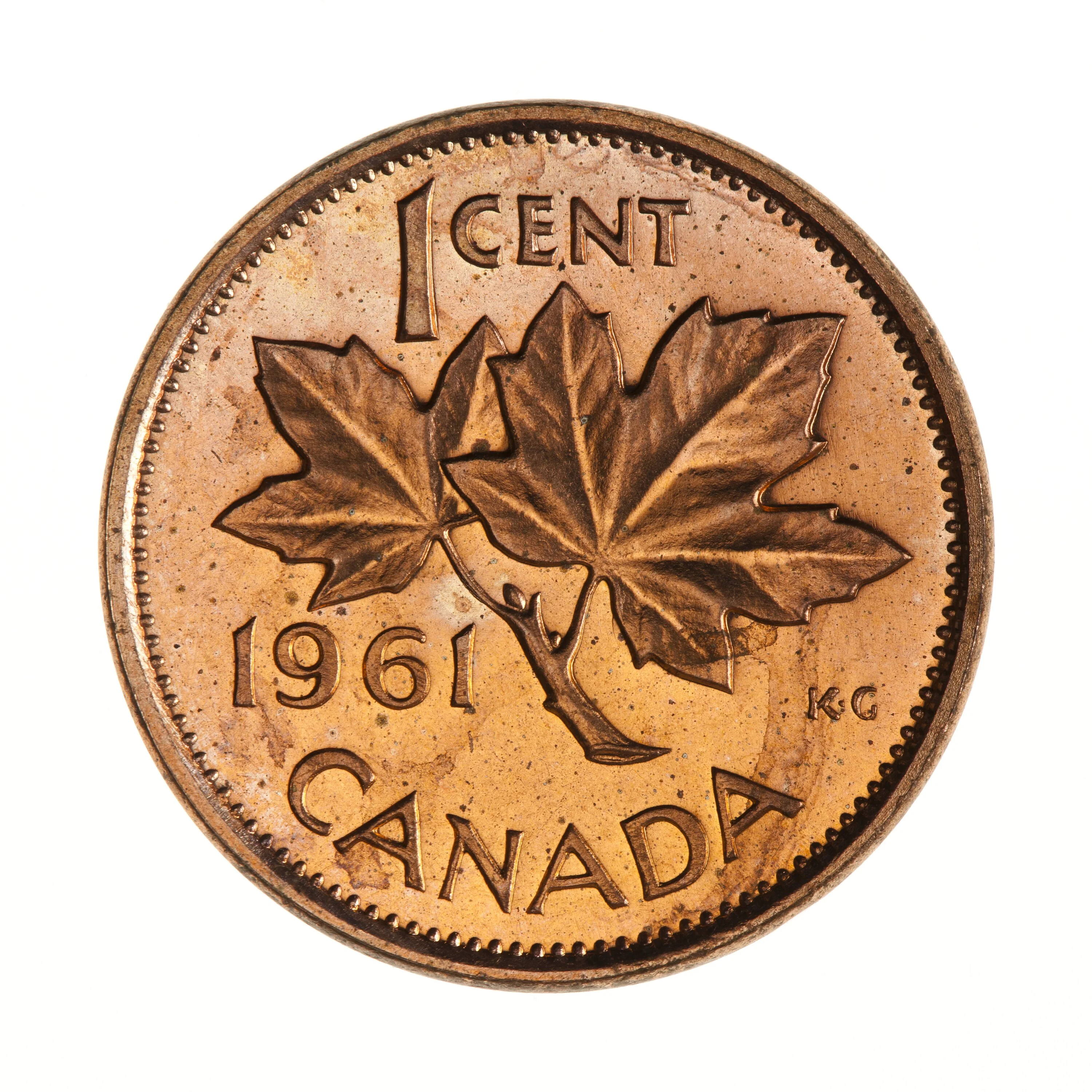
Reverse
Description:
The maple twig is encircled by the face value, "CANADA," and the date.
Inscription:
1 CENT
CANADA
1964
K·G
CANADA
1964
K·G
Script: Latin
Engraver: George Kruger Gray
Edge
Plain
Mints
| Name | Mark |
|---|---|
| Royal Canadian Mint of Ottawa | — |
Mintings
| Year | Mint Mark | Mintage | Quality | Collection |
|---|---|---|---|---|
| 1953 | — | 67,806,016 | ||
| 1953 | — | — | Prooflike | |
| 1954 | — | 22,181,760 | ||
| 1954 | — | — | Prooflike | |
| 1955 | — | — | Prooflike | |
| 1955 | — | 56,403,193 | ||
| 1956 | — | 78,685,535 | ||
| 1956 | — | — | Prooflike | |
| 1957 | — | 100,601,792 | ||
| 1957 | — | — | Prooflike | |
| 1958 | — | 59,385,679 | ||
| 1958 | — | — | Prooflike | |
| 1959 | — | 83,615,343 | ||
| 1959 | — | — | Prooflike | |
| 1960 | — | 75,772,775 | ||
| 1960 | — | — | Prooflike | |
| 1961 | — | 139,598,404 | ||
| 1961 | — | — | Prooflike | |
| 1962 | — | 227,244,069 | ||
| 1962 | — | — | Prooflike | |
| 1963 | — | 279,076,334 | ||
| 1963 | — | — | Prooflike | |
| 1964 | — | 484,655,322 | ||
| 1964 | — | 1,653,162 | Prooflike |
Historical background
In 1953, Canada's currency system was in a period of transition and national assertion, operating under the Bretton Woods system of fixed exchange rates. The Canadian dollar was pegged to the United States dollar at a floating rate, a unique arrangement established in 1950 after a brief, unsuccessful return to a fixed parity. This flexible peg allowed the currency to fluctuate within a band, giving the Bank of Canada greater control over domestic monetary policy to manage post-Korean War economic conditions, including concerns about inflation and capital inflows.
Physically, 1953 marked a significant year with the issuance of a new, distinctly Canadian banknote series—the "Canadian Landscape" series. These notes, the first to bear the portrait of the newly crowned Queen Elizabeth II, moved away from allegorical figures and instead featured iconic national scenery like the Okanagan Valley and the St. Lawrence River. This design shift was a deliberate move to foster a stronger sense of national identity and sovereignty, visually distancing Canadian currency from its previous British-influenced designs.
Economically, the year was one of stability and growth. The floating rate functioned effectively, and Canada enjoyed a robust trade surplus, driven by strong exports of natural resources to a rebuilding Europe and the United States. There was no central bank target for inflation as understood today, but price stability was maintained. This prosperous backdrop, supported by a confident monetary framework, set the stage for the decade of sustained expansion that would follow, with the currency's managed flexibility seen as a key component of Canada's economic success.
Physically, 1953 marked a significant year with the issuance of a new, distinctly Canadian banknote series—the "Canadian Landscape" series. These notes, the first to bear the portrait of the newly crowned Queen Elizabeth II, moved away from allegorical figures and instead featured iconic national scenery like the Okanagan Valley and the St. Lawrence River. This design shift was a deliberate move to foster a stronger sense of national identity and sovereignty, visually distancing Canadian currency from its previous British-influenced designs.
Economically, the year was one of stability and growth. The floating rate functioned effectively, and Canada enjoyed a robust trade surplus, driven by strong exports of natural resources to a rebuilding Europe and the United States. There was no central bank target for inflation as understood today, but price stability was maintained. This prosperous backdrop, supported by a confident monetary framework, set the stage for the decade of sustained expansion that would follow, with the currency's managed flexibility seen as a key component of Canada's economic success.
Series: 1953 Canada circulation coins
🌱 Very Common