

10 kroner – Denmark
Add to wishlist
Denmark
Context
Years: 2004–2010
Issuer: Denmark
Ruler: Margrethe II
Currency:
(since 1873)
Total mintage: 19,269,336
Material
Diameter: 23.35 mm
Weight: 7 g
Thickness: 2.3 mm
Shape: Round
Composition: Aluminium bronze
Magnetic: No
Technique: Milled
Alignment: Medal alignment
flip
References
KM: #
Numista: #1462
Value
Exchange value: 10 DKK
Inflation-adjusted value: 14.60 DKK
Obverse
Description:
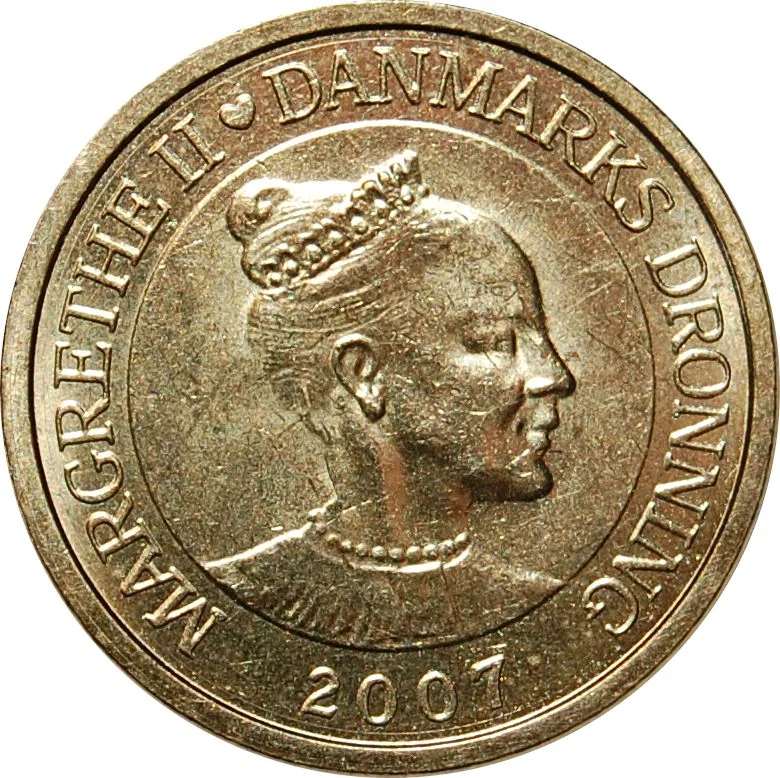
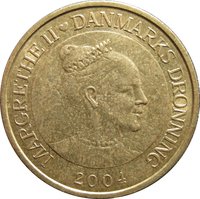
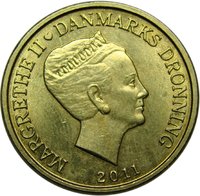
Queen Margrethe II facing right, above date.
Inscription:
MARGRETHE II DANMARKS DRONNING
2007
2007
Translation:
Margrethe II Denmark's Queen
2007
2007
Script: Latin
Language: Danish
Engraver: Mogens Møller
Reverse
Description:
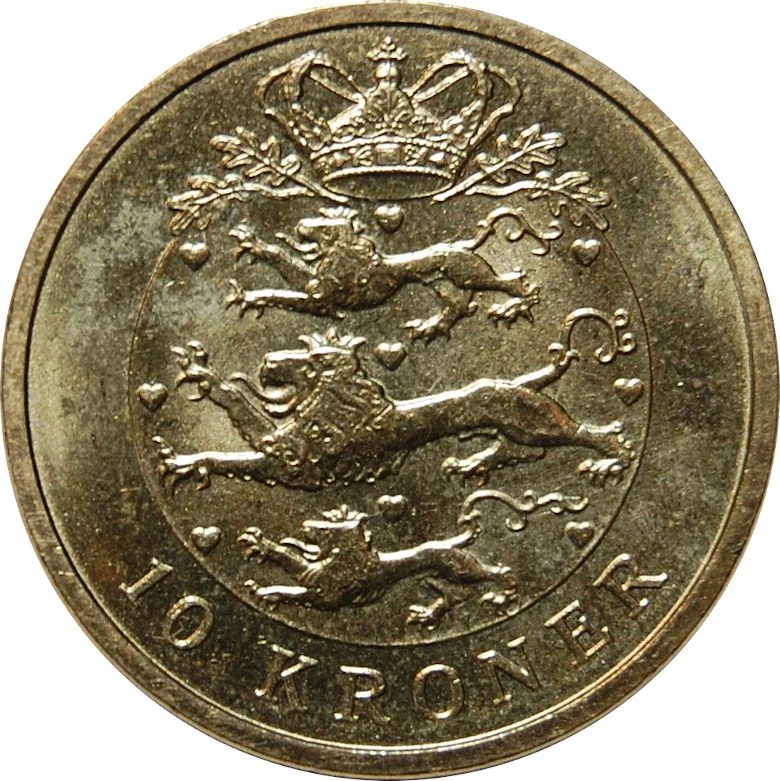
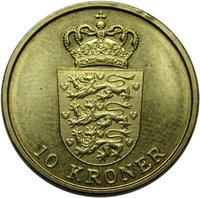
Danish coat of arms in a circle, crowned and decorated with four oak leaves.
Inscription:
10 KRONER
Script: Latin
Engraver: Mogens Møller
Edge
Plain
Mints
| Name | Mark |
|---|---|
| Royal Danish Mint | — |
Mintings
| Year | Mint Mark | Mintage | Quality | Collection |
|---|---|---|---|---|
| 2004 | — | 5,835,426 | ||
| 2004 | — | 3,000 | Proof | |
| 2005 | — | 2,614,000 | ||
| 2005 | — | 2,650 | Proof | |
| 2006 | — | 3,530,000 | ||
| 2006 | — | 1,800 | Proof | |
| 2007 | — | 1,400 | Proof | |
| 2007 | — | 3,294,000 | ||
| 2008 | — | 2,258,000 | ||
| 2008 | — | 1,000 | Proof | |
| 2009 | — | 1,701,000 | ||
| 2009 | — | 1,050 | Proof | |
| 2010 | — | 1,010 | Proof | |
| 2010 | — | 25,000 | In sets |
Historical background
In 2004, Denmark's currency situation was defined by its long-standing and politically deliberate participation in the European Exchange Rate Mechanism II (ERM II). Having rejected the adoption of the euro in a 2000 referendum, the Danish krone (DKK) was nonetheless pegged to the euro within a narrow band of ±2.25%. This arrangement, managed by the independent Danmarks Nationalbank, required the central bank to intervene in foreign exchange markets to maintain the fixed exchange rate, effectively shadowing the interest rate decisions of the European Central Bank to ensure currency stability.
The system functioned smoothly throughout 2004, providing the small, open Danish economy with the exchange rate stability crucial for its trade with the Eurozone, its largest trading partner. This stability was a key economic priority, outweighing the potential monetary policy autonomy sacrificed by the fixed peg. Domestically, the political debate about eventually joining the euro remained subdued, as the post-referendum "national compromise" had settled on the current arrangement, which delivered the benefits of euro stability without formal adoption.
Therefore, the 2004 currency landscape was one of successful and uneventful maintenance. The krone-euro peg was a cornerstone of economic policy, operating as a technical success for the central bank while the broader political question of full euro membership was intentionally placed on hold. This period represented a stable equilibrium, allowing Denmark to enjoy integrated European trade while retaining its distinctive national currency.
The system functioned smoothly throughout 2004, providing the small, open Danish economy with the exchange rate stability crucial for its trade with the Eurozone, its largest trading partner. This stability was a key economic priority, outweighing the potential monetary policy autonomy sacrificed by the fixed peg. Domestically, the political debate about eventually joining the euro remained subdued, as the post-referendum "national compromise" had settled on the current arrangement, which delivered the benefits of euro stability without formal adoption.
Therefore, the 2004 currency landscape was one of successful and uneventful maintenance. The krone-euro peg was a cornerstone of economic policy, operating as a technical success for the central bank while the broader political question of full euro membership was intentionally placed on hold. This period represented a stable equilibrium, allowing Denmark to enjoy integrated European trade while retaining its distinctive national currency.
🌱 Very Common