

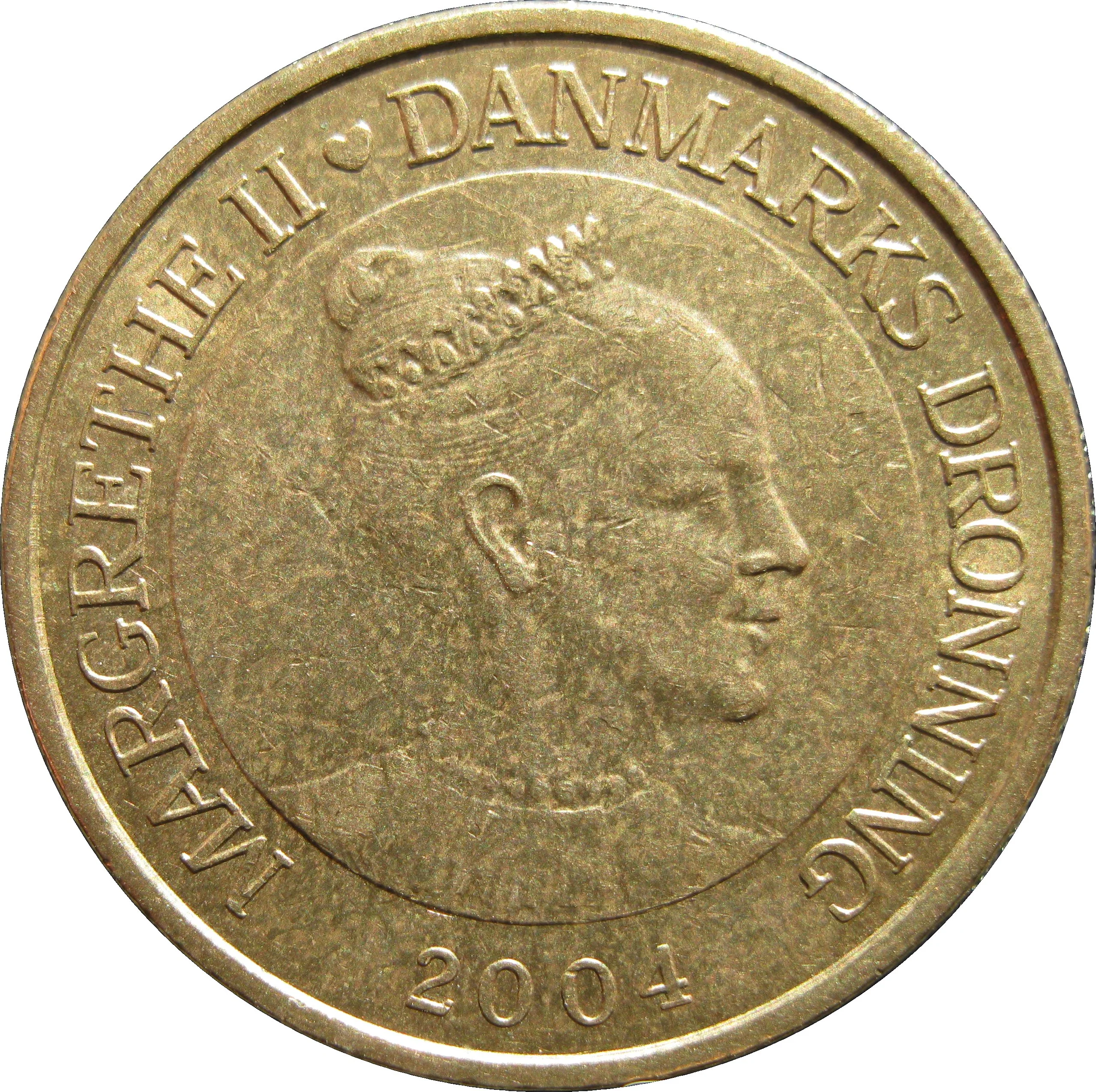
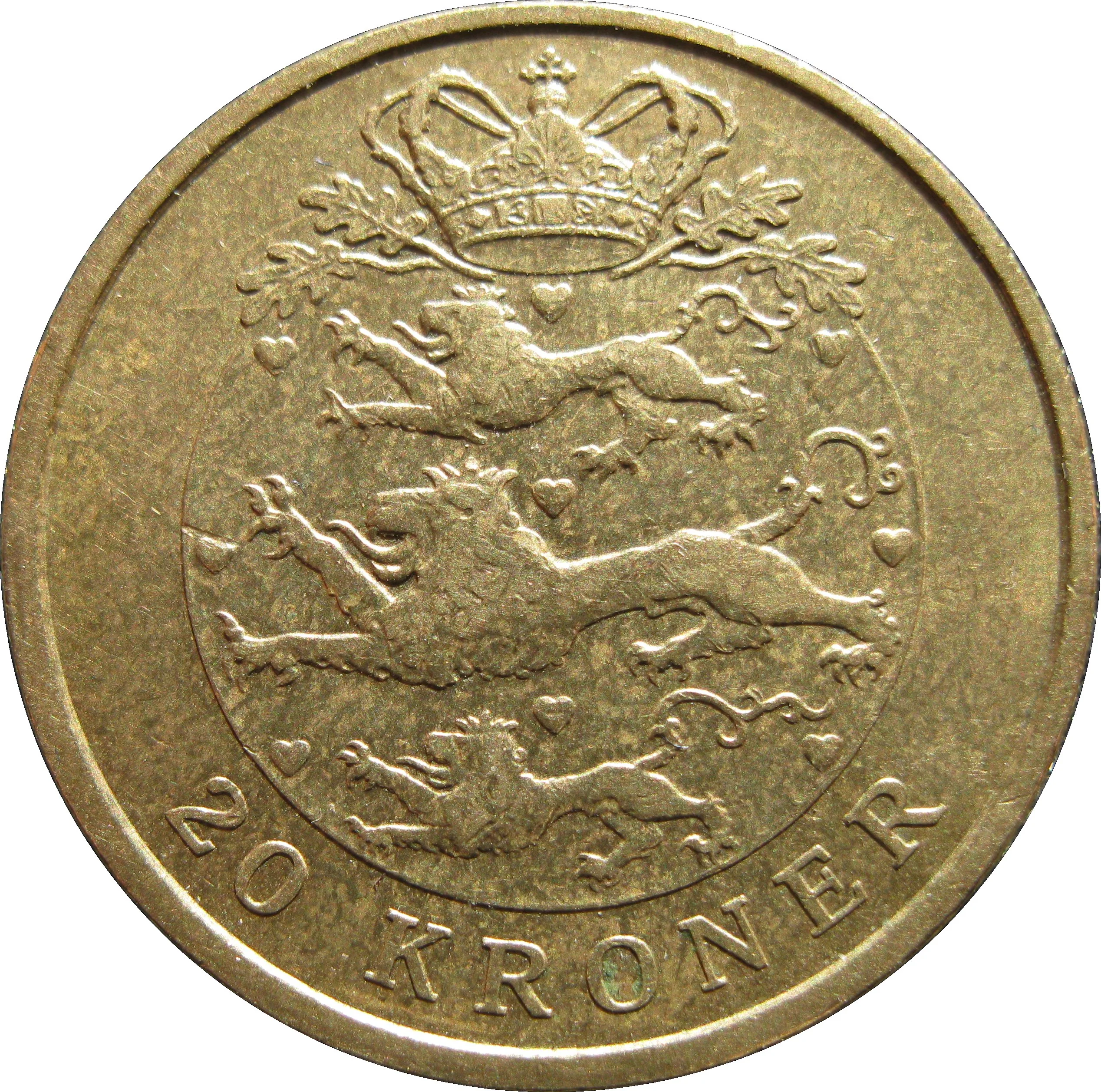
20 kroner – Denmark
Add to wishlist
Denmark
Context
Years: 2003–2010
Issuer: Denmark
Ruler: Margrethe II
Currency:
(since 1873)
Total mintage: 26,323,482
Material
Diameter: 27 mm
Weight: 9.3 g
Thickness: 2.35 mm
Shape: Round
Composition: Aluminium bronze
Magnetic: No
Technique: Milled
Alignment: Medal alignment
flip
References
KM: #
Numista: #1463
Value
Exchange value: 20 DKK
Inflation-adjusted value: 29.81 DKK
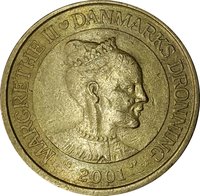
Obverse
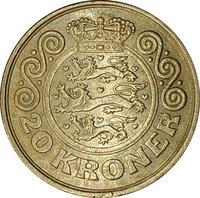
Reverse
Edge
Alternating smooth and reeded segments
Mints
| Name | Mark |
|---|---|
| Royal Danish Mint | — |
Mintings
| Year | Mint Mark | Mintage | Quality | Collection |
|---|---|---|---|---|
| 2003 | — | 5,720,000 | ||
| 2004 | — | 6,922,182 | ||
| 2004 | — | — | Proof | |
| 2005 | — | 4,194,000 | ||
| 2005 | — | — | Proof | |
| 2006 | — | 3,051,000 | ||
| 2006 | — | — | Proof | |
| 2007 | — | 2,409,000 | ||
| 2007 | — | — | Proof | |
| 2008 | — | 1,982,000 | ||
| 2008 | — | — | Proof | |
| 2009 | — | 2,021,000 | ||
| 2009 | — | — | Proof | |
| 2010 | — | 24,300 | ||
| 2010 | — | — | Proof |
Historical background
In 2003, Denmark's currency situation was defined by its long-standing and stable participation in the European Exchange Rate Mechanism II (ERM II). Following the rejection of the Maastricht Treaty in a 1992 referendum, Denmark had secured an opt-out from adopting the euro. However, to maintain monetary stability with its largest trading partners, it unilaterally pegged the Danish krone (DKK) to the Deutsche Mark and later, upon its launch, to the euro. This formalised into ERM II membership in 1999, with a central parity of 7.46038 krone per euro and a very narrow fluctuation band of ±2.25%.
This policy, managed by the independent Danmarks Nationalbank, was the cornerstone of Danish economic policy. The primary objective was not merely exchange rate stability for its own sake, but to provide a firm anchor for low inflation and interest rates, closely mirroring those of the European Central Bank. Throughout 2003, this system functioned smoothly. The krone traded stably near its central parity, requiring minimal and routine intervention from the central bank, as market confidence in the peg remained high due to Denmark's consistent fiscal discipline and strong external balance.
Consequently, the domestic political debate about abandoning the opt-out and joining the euro, which had been reignited by the 2000 referendum that again resulted in a "no" vote, was relatively subdued in 2003. The economy operated effectively with its hybrid model: enjoying the stability benefits of the eurozone's monetary policy without formal membership. The year thus represented a period of consolidation for Denmark's currency framework, demonstrating the success and sustainability of its fixed exchange rate policy within the European context, even without full adoption of the single currency.
This policy, managed by the independent Danmarks Nationalbank, was the cornerstone of Danish economic policy. The primary objective was not merely exchange rate stability for its own sake, but to provide a firm anchor for low inflation and interest rates, closely mirroring those of the European Central Bank. Throughout 2003, this system functioned smoothly. The krone traded stably near its central parity, requiring minimal and routine intervention from the central bank, as market confidence in the peg remained high due to Denmark's consistent fiscal discipline and strong external balance.
Consequently, the domestic political debate about abandoning the opt-out and joining the euro, which had been reignited by the 2000 referendum that again resulted in a "no" vote, was relatively subdued in 2003. The economy operated effectively with its hybrid model: enjoying the stability benefits of the eurozone's monetary policy without formal membership. The year thus represented a period of consolidation for Denmark's currency framework, demonstrating the success and sustainability of its fixed exchange rate policy within the European context, even without full adoption of the single currency.
🌱 Very Common