

20 kroner (Queen Margrethe II) – Denmark
Add to wishlist
Circulating commemorative coins
Commemoration: 60th birthday of Queen Margrethe II
Denmark
Context
Material
Diameter: 27 mm
Weight: 9.36 g
Thickness: 2.35 mm
Shape: Round
Composition: Aluminium bronze
Magnetic: No
Technique: Milled
References
KM: #
Numista: #14558
Value
Exchange value: 20 DKK
Inflation-adjusted value: 32.15 DKK
Obverse
Description:
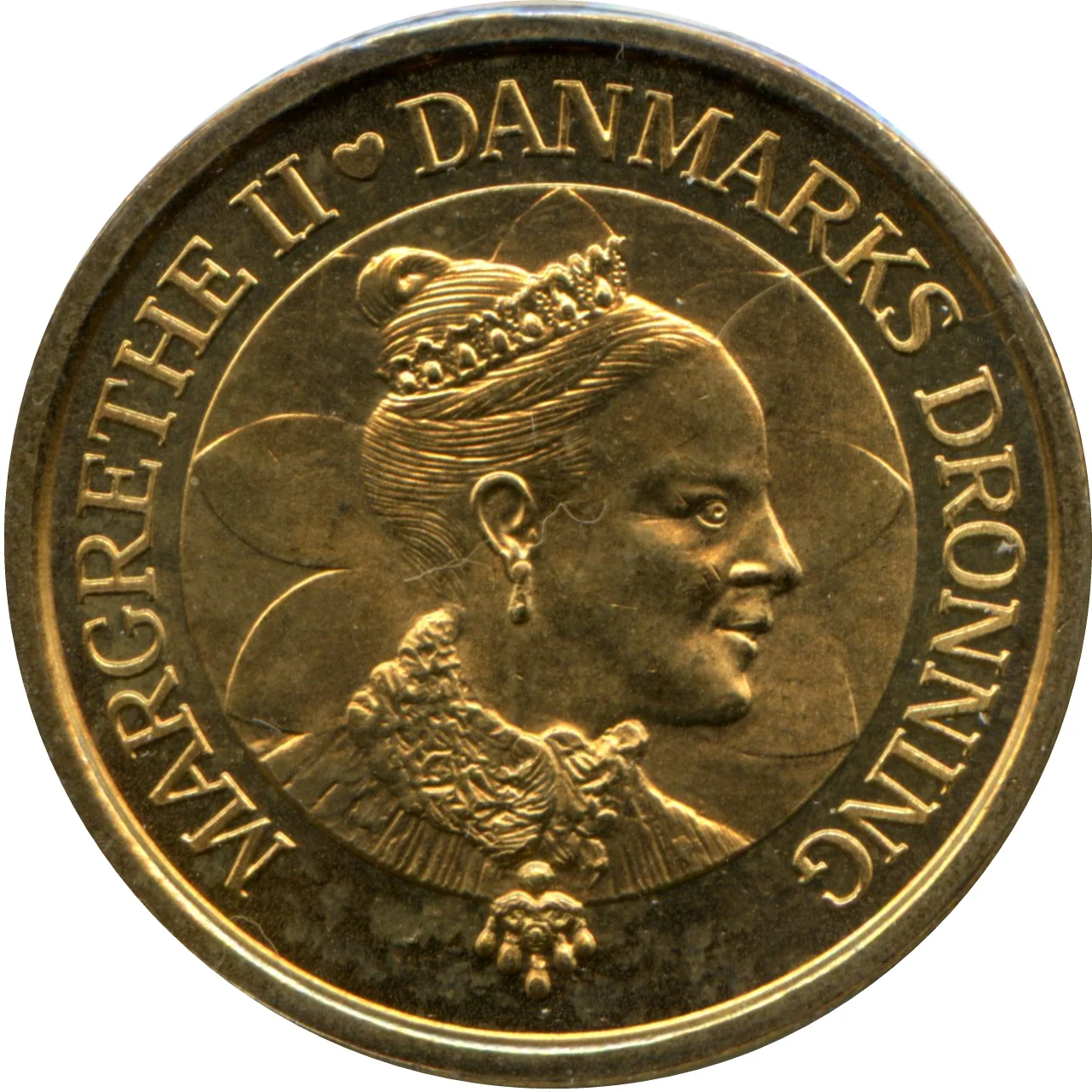
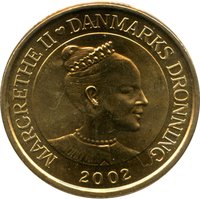
The Queen facing right against a marguerite background.
Inscription:
MARGRETHE II ♥ DANMARKS DRONNING
Translation:
MARGRETHE II ♥ QUEEN OF DENMARK
Script: Latin
Language: Danish
Engraver: Mogens Møller
Reverse
Edge
Alternating smooth and reeded segments.
Categories
| Event> Birth anniversary |
Mints
| Name | Mark |
|---|---|
| Royal Danish Mint | — |
Mintings
| Year | Mint Mark | Mintage | Quality | Collection |
|---|---|---|---|---|
| 2000 | LG | 1,000,000 |
Historical background
In the year 2000, Denmark's currency situation was defined by its unique position within the European Union. While the euro was officially launched in 1999 and entered physical circulation in 2002, Denmark had secured an opt-out from the common currency following the Maastricht Treaty referendum in 1992. Consequently, the country maintained its national currency, the Danish krone (DKK), but operated under a fixed exchange rate policy known as ERM II (Exchange Rate Mechanism II).
This policy pegged the krone tightly to the euro at a central rate of 7.46038 DKK per euro, with a very narrow fluctuation band of ±2.25%. The primary objective was to ensure monetary stability by anchoring the krone to the low-inflation policies of the European Central Bank. This arrangement was a political and economic compromise, allowing Denmark to enjoy the benefits of exchange rate stability for trade and investment with the eurozone, while formally retaining its monetary sovereignty and the Danish central bank's (Nationalbanken) control over interest rates.
The system functioned smoothly in 2000, supported by Denmark's strong economic fundamentals and a broad political consensus. Interest rates were set autonomously by Nationalbanken but were closely aligned with the ECB's rates to maintain the peg. This stability was seen as successful, shielding the small, open economy from speculative volatility while the debate over eventual euro adoption remained a dormant, long-term political question rather than an immediate policy priority.
This policy pegged the krone tightly to the euro at a central rate of 7.46038 DKK per euro, with a very narrow fluctuation band of ±2.25%. The primary objective was to ensure monetary stability by anchoring the krone to the low-inflation policies of the European Central Bank. This arrangement was a political and economic compromise, allowing Denmark to enjoy the benefits of exchange rate stability for trade and investment with the eurozone, while formally retaining its monetary sovereignty and the Danish central bank's (Nationalbanken) control over interest rates.
The system functioned smoothly in 2000, supported by Denmark's strong economic fundamentals and a broad political consensus. Interest rates were set autonomously by Nationalbanken but were closely aligned with the ECB's rates to maintain the peg. This stability was seen as successful, shielding the small, open economy from speculative volatility while the debate over eventual euro adoption remained a dormant, long-term political question rather than an immediate policy priority.
🌱 Fairly Common