

50 centimes – Morocco
Add to wishlist
Morocco
Context
Year: 1945
Islamic (Hijri) Year:: 1364
Issuer: Morocco
Ruler: Mohammed V
Currency:
(1910—1959)
Demonetized: Yes
Total mintage: 24,000,000
Material
Diameter: 18 mm
Weight: 2 g
Thickness: 1.45 mm
Shape: Round
Composition: Aluminium bronze
Magnetic: No
Technique: Milled
Alignment: Coin alignment
flip
References
Y: #
Numista: #4251
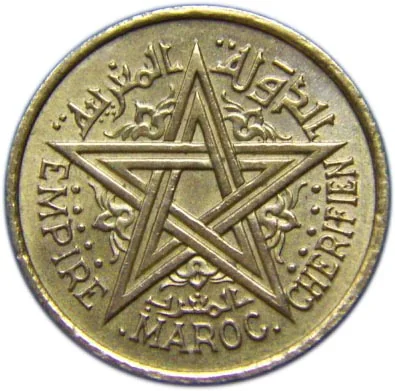
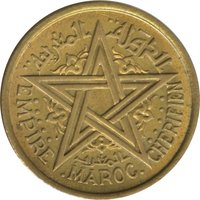
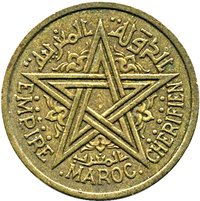
Obverse
Description:
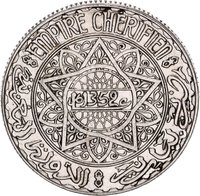
Five-pointed star with ornate patterns, country name below.
Inscription:
الدولة المغربية
المغرب
EMPIRE .MAROC. CHERIFIEN
المغرب
EMPIRE .MAROC. CHERIFIEN
Translation:
The Moroccan State
Morocco
Cherifien Empire .Morocco.
Morocco
Cherifien Empire .Morocco.
Engraver: J. Hainaut
Reverse
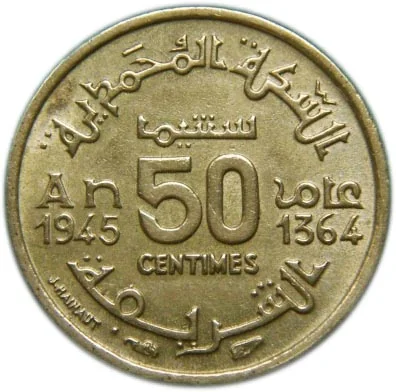
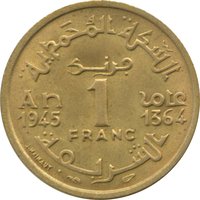
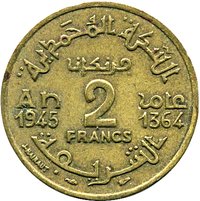
Description:
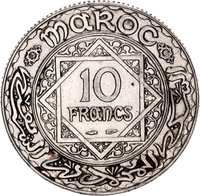
Date-bracketed value
Inscription:
السكة المحمدية
سنتيما
50
CENTIMES
AN 1945
1364 عام
الشريفة
J.HAINAUT
سنتيما
50
CENTIMES
AN 1945
1364 عام
الشريفة
J.HAINAUT
Translation:
The Muhammadan Coin
Centimes
50
CENTIMES
Year 1945
Year 1364
The Noble
J. Hainaut
Centimes
50
CENTIMES
Year 1945
Year 1364
The Noble
J. Hainaut
Engraver: J.Hainault
Edge
Plain
Mints
| Name | Mark |
|---|---|
| Monnaie de Paris | — |
Mintings
| Year | Mint Mark | Mintage | Quality | Collection |
|---|---|---|---|---|
| 1945 | — | 24,000,000 |
Historical background
In 1945, Morocco's currency situation was a direct reflection of its complex political status as a protectorate divided between French and Spanish zones, with the international city of Tangier operating under a separate administration. The primary circulating currency was the Moroccan franc, which was pegged at par to the French franc and issued by a state-controlled bank, Banque d'État du Maroc, under French oversight. This currency dominated the French zone and was integrated into the Franc Zone, meaning its value and monetary policy were ultimately dictated by France, tying Morocco's economy closely to that of its protectorate power.
Simultaneously, a distinct currency, the Spanish peseta, circulated officially in the smaller northern Spanish protectorate zone and the southern territory of Tarfaya. Furthermore, the special international status of Tangier led to a mixed monetary environment where multiple currencies, including the Moroccan franc, Spanish peseta, and even British pounds and U.S. dollars, were used in commerce. This fragmentation created practical challenges for trade and movement within the country, underscoring the lack of a unified national monetary system.
The post-World War II period placed significant strain on this arrangement. The French franc, and by extension the Moroccan franc, was weak and unstable, suffering from inflation and the economic devastation of the war. This prompted discussions about monetary reform, including a potential move to a new, more stable currency independent of the French franc—a debate that would eventually lead to the introduction of the Moroccan dirham in 1960, five years after the nation's independence. Thus, the currency landscape of 1945 was one of colonial division and economic dependency, poised on the brink of the nationalist movement that would demand financial sovereignty.
Simultaneously, a distinct currency, the Spanish peseta, circulated officially in the smaller northern Spanish protectorate zone and the southern territory of Tarfaya. Furthermore, the special international status of Tangier led to a mixed monetary environment where multiple currencies, including the Moroccan franc, Spanish peseta, and even British pounds and U.S. dollars, were used in commerce. This fragmentation created practical challenges for trade and movement within the country, underscoring the lack of a unified national monetary system.
The post-World War II period placed significant strain on this arrangement. The French franc, and by extension the Moroccan franc, was weak and unstable, suffering from inflation and the economic devastation of the war. This prompted discussions about monetary reform, including a potential move to a new, more stable currency independent of the French franc—a debate that would eventually lead to the introduction of the Moroccan dirham in 1960, five years after the nation's independence. Thus, the currency landscape of 1945 was one of colonial division and economic dependency, poised on the brink of the nationalist movement that would demand financial sovereignty.
🌱 Very Common