

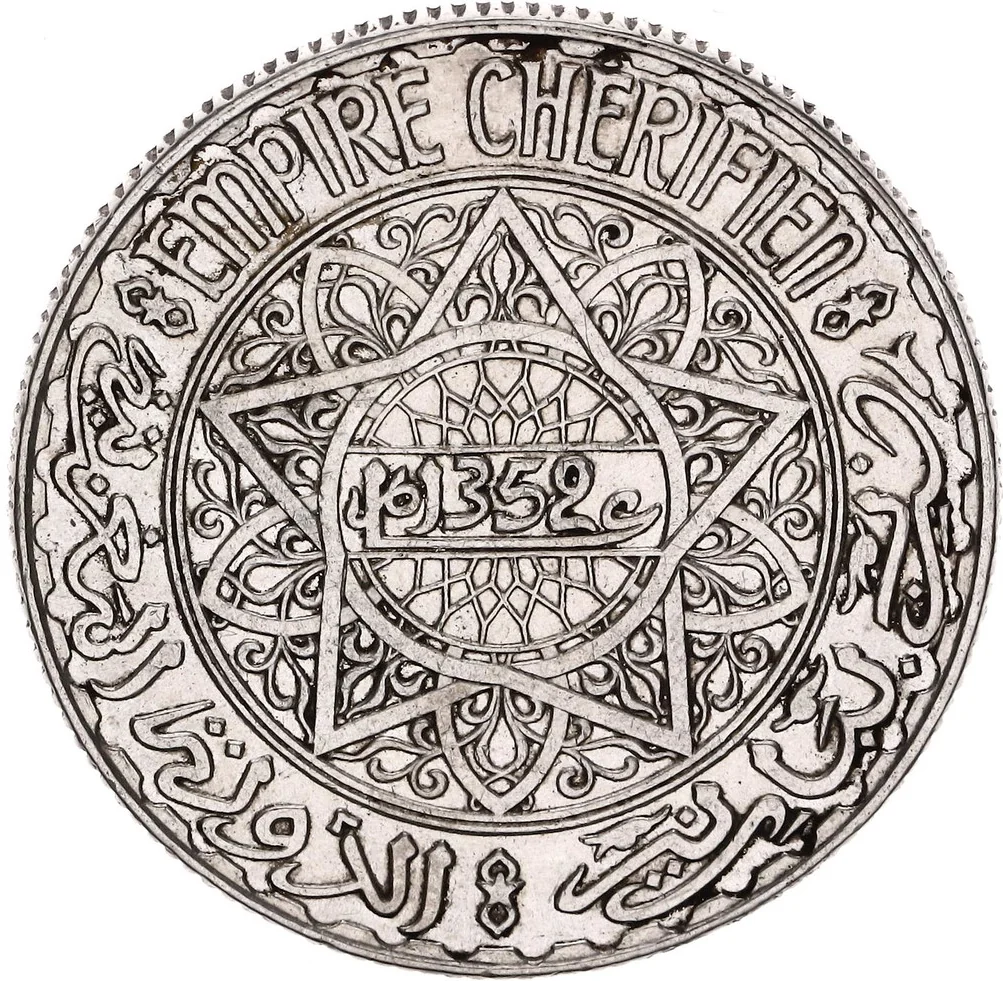
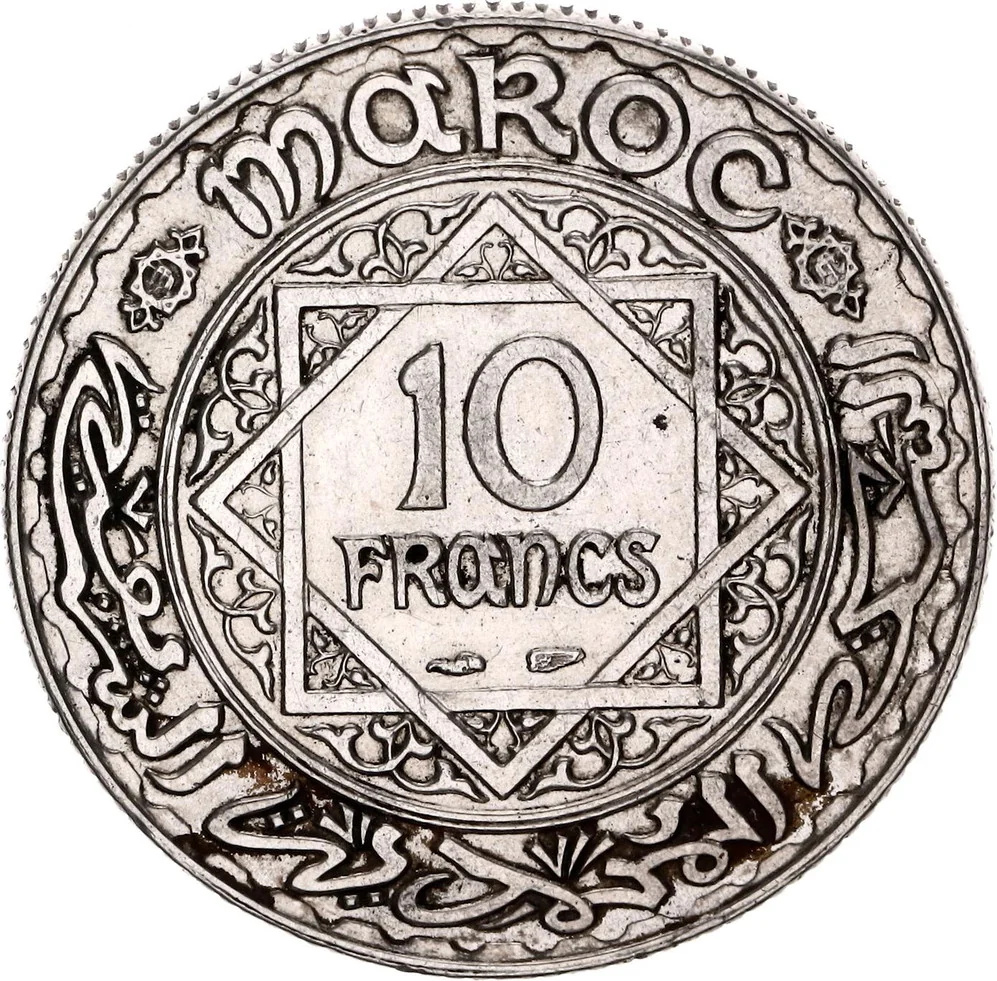
10 Francs – Morocco
Morocco
Context
Years: 1929–1934
Issuer: Morocco 
Ruler: Mohammed V
Currency:
(1910—1959)
Demonetized: Yes
Total mintage: 4,500,000
Material
References
Y: #Click to copy to clipboard38
Numista: #2324
Value
Bullion value: $19.14
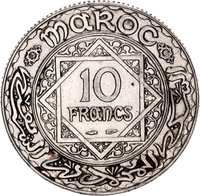
Obverse
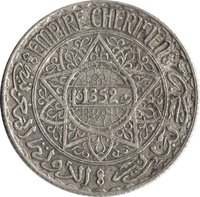
Reverse
Edge
Reeded
Mints
| Name | Mark |
|---|---|
| Monnaie de Paris | — |
Mintings
| Year | Mint Mark | Mintage | Quality | Collection |
|---|---|---|---|---|
| 1929 | — | 1,600,000 | ||
| 1934 | — | 2,900,000 |
Historical background
In 1929, Morocco's currency situation was defined by its status as a French and Spanish protectorate, established in 1912. The country operated under a dual monetary system, a legacy of pre-colonial trade and European imposition. The official currency was the Moroccan franc, introduced by the French in 1921 and pegged at par to the French franc, placing Morocco firmly within the Franc Zone. This gave France direct control over monetary policy and tied Morocco's economy to that of its protectorate power. However, alongside this, the traditional Moroccan rial (or mazuna) and the Spanish peseta also circulated, particularly in the northern Spanish zone and in certain commercial transactions, reflecting the fragmented political control.
The global onset of the Great Depression in 1929 presented immediate challenges, but Morocco's currency peg initially provided a buffer from the wild exchange rate fluctuations seen elsewhere. The primary economic pressure stemmed from a collapse in export demand for key commodities like phosphates and agricultural products. This led to a sharp decline in state revenue and trade imbalances. While the fixed exchange rate offered stability, it also meant Morocco imported France's deflationary pressures, exacerbating domestic economic hardship and unemployment without the tool of independent currency devaluation to stimulate exports.
Consequently, the currency situation in 1929 was one of imposed stability masking growing economic vulnerability. The system prioritized the financial integration of the protectorate with France over autonomous responses to the emerging global crisis. This rigidity, combined with the decline of the rural agricultural economy and social unrest brewing in the years that followed, highlighted how the colonial monetary framework was ill-equipped to absorb a shock of the Depression's magnitude, setting the stage for a decade of significant economic difficulty.
The global onset of the Great Depression in 1929 presented immediate challenges, but Morocco's currency peg initially provided a buffer from the wild exchange rate fluctuations seen elsewhere. The primary economic pressure stemmed from a collapse in export demand for key commodities like phosphates and agricultural products. This led to a sharp decline in state revenue and trade imbalances. While the fixed exchange rate offered stability, it also meant Morocco imported France's deflationary pressures, exacerbating domestic economic hardship and unemployment without the tool of independent currency devaluation to stimulate exports.
Consequently, the currency situation in 1929 was one of imposed stability masking growing economic vulnerability. The system prioritized the financial integration of the protectorate with France over autonomous responses to the emerging global crisis. This rigidity, combined with the decline of the rural agricultural economy and social unrest brewing in the years that followed, highlighted how the colonial monetary framework was ill-equipped to absorb a shock of the Depression's magnitude, setting the stage for a decade of significant economic difficulty.
🌱 Fairly Common