

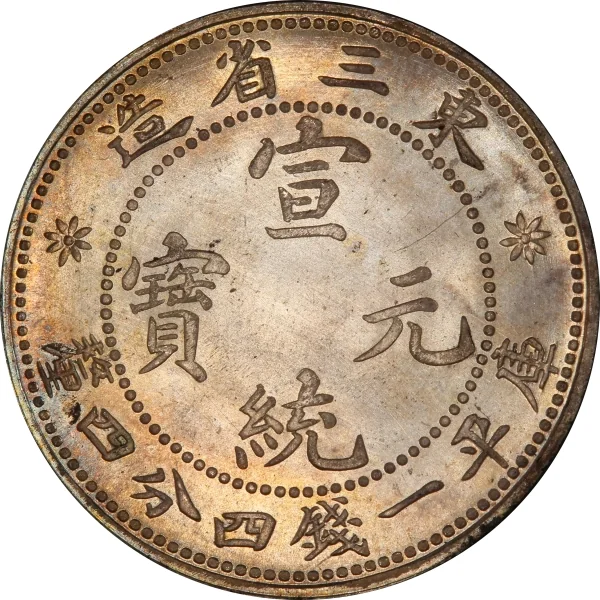
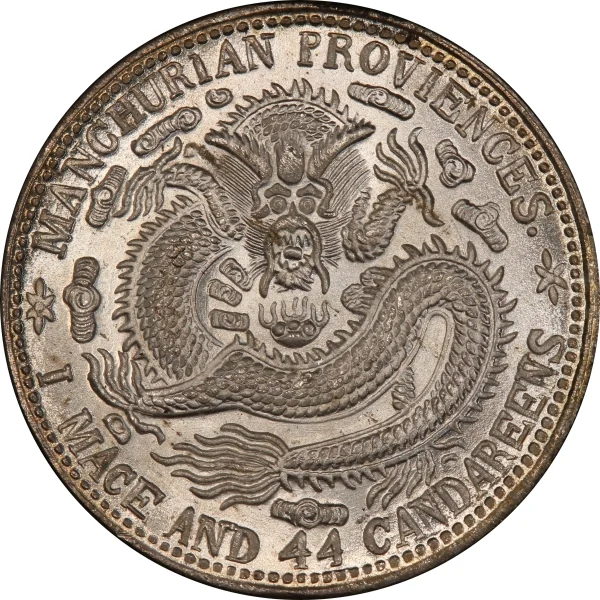
20 Fen – Manchurian Provinces
China
Context
Years: 1912–1913
Country: China 
Issuer: Manchurian Provinces
Ruler: Xuantong
Currency:
(1907—1931)
Demonetized: Yes
Material
References
Y: #Click to copy to clipboard213a.4-6
Numista: #42495
Value
Bullion value: $10.30
Obverse
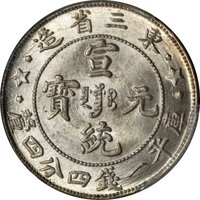
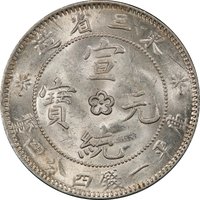
Description:
Four Chinese ideograms, read top to bottom and right to left, surrounded by more ideograms.
Inscription:
造省三東
宣
寶元
統
釐四分四錢一平庫
宣
寶元
統
釐四分四錢一平庫
Translation:
Made at the Board of Revenue, Eastern Foundry.
Xuan
Baoyuan
Tong
Li, Four Fen, Four Qian, One Ping, Treasury.
Xuan
Baoyuan
Tong
Li, Four Fen, Four Qian, One Ping, Treasury.
Language: Classical Chinese
Reverse
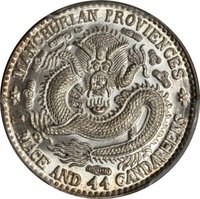
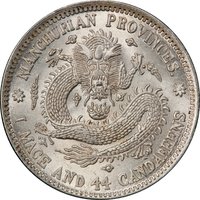
Description:
Dragon encircling a pearl, surrounded by English text.
Inscription:
MANCHURIAN PROVIENCES
1 MACE AND 4.4 CANDAREENS
1 MACE AND 4.4 CANDAREENS
Edge
Reeded.
Categories
| Mythology> Fantastic animal |
Mintings
| Year | Mint Mark | Mintage | Quality | Collection |
|---|---|---|---|---|
| 1912 | — | — | ||
| 1913 | — | — |
Historical background
In 1912, the currency situation in the Manchurian provinces (Fengtian, Jilin, and Heilongjiang) was one of profound complexity and instability, reflecting the region's contested political status. Following the collapse of the Qing Dynasty, the area was nominally under the control of the nascent Republic of China, but in reality, it was a sphere of intense foreign influence, particularly from Japan and Russia. This geopolitical struggle was mirrored in the monetary sphere, where no single, authoritative currency prevailed. Instead, a chaotic mix of old Qing silver sycee and copper cash, newly minted Republican silver and copper coins, and various local banknotes circulated alongside Japanese Yen (especially from the Yokohama Specie Bank) and Russian Rubles, particularly along the Chinese Eastern Railway zone.
The primary medium for larger transactions was silver, but the lack of standardization was crippling. Silver circulated by weight and purity (taels), with major cities like Harbin, Fengtian (Shenyang), and Changchun all using different tael standards, requiring conversion for inter-city trade. To facilitate commerce, numerous local "official" banks, mercantile firms, and even pawnshops issued their own private banknotes (tiepiao), which were only credible within a specific locality or business network. This created a fragile and inflationary system, as the value and redeemability of these notes depended entirely on the solvency of the issuing entity, which often fluctuated.
This monetary fragmentation severely hampered economic integration and development, creating opportunities for arbitrage and fraud. The situation was a direct consequence of weak central authority and would become a tool for further foreign encroachment. In the coming years, Japanese financial institutions, backed by their growing military presence, would aggressively expand their note issuance, deliberately undermining Chinese currency to increase economic dependency. Thus, the currency chaos of 1912 was not merely an economic inconvenience but a symptom and accelerator of the region's descent toward the establishment of the Japanese puppet state of Manchukuo two decades later.
The primary medium for larger transactions was silver, but the lack of standardization was crippling. Silver circulated by weight and purity (taels), with major cities like Harbin, Fengtian (Shenyang), and Changchun all using different tael standards, requiring conversion for inter-city trade. To facilitate commerce, numerous local "official" banks, mercantile firms, and even pawnshops issued their own private banknotes (tiepiao), which were only credible within a specific locality or business network. This created a fragile and inflationary system, as the value and redeemability of these notes depended entirely on the solvency of the issuing entity, which often fluctuated.
This monetary fragmentation severely hampered economic integration and development, creating opportunities for arbitrage and fraud. The situation was a direct consequence of weak central authority and would become a tool for further foreign encroachment. In the coming years, Japanese financial institutions, backed by their growing military presence, would aggressively expand their note issuance, deliberately undermining Chinese currency to increase economic dependency. Thus, the currency chaos of 1912 was not merely an economic inconvenience but a symptom and accelerator of the region's descent toward the establishment of the Japanese puppet state of Manchukuo two decades later.
💎 Very Rare