

20 Fen – Manchurian Provinces
China
Context
Years: 1914–1915
Country: China 
Issuer: Manchurian Provinces
Ruler: Xuantong
Currency:
(1907—1931)
Demonetized: Yes
Material
References
Y: #Click to copy to clipboard213a.1-3
Numista: #275296
Value
Bullion value: $10.30
Obverse
Description:
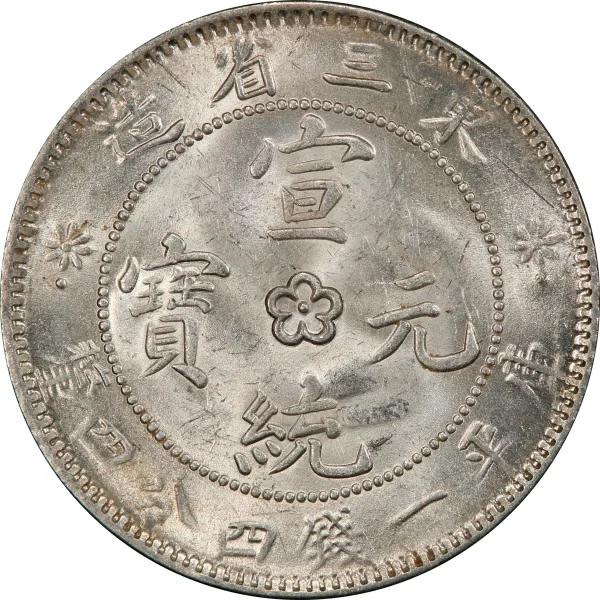
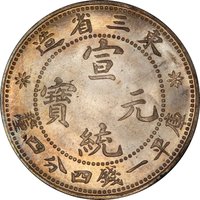
Four Chinese ideograms read vertically, centered on a flower, surrounded by more characters.
Inscription:
造省三東
宣
寶元
統
釐四分四錢一平庫
宣
寶元
統
釐四分四錢一平庫
Translation:
Made at the Board of Revenue, Eastern Foundry.
Xuan
Baoyuan
Tong
Li, Four Fen, Four Qian, One Ping, Treasury.
Xuan
Baoyuan
Tong
Li, Four Fen, Four Qian, One Ping, Treasury.
Language: Classical Chinese
Reverse
Description:
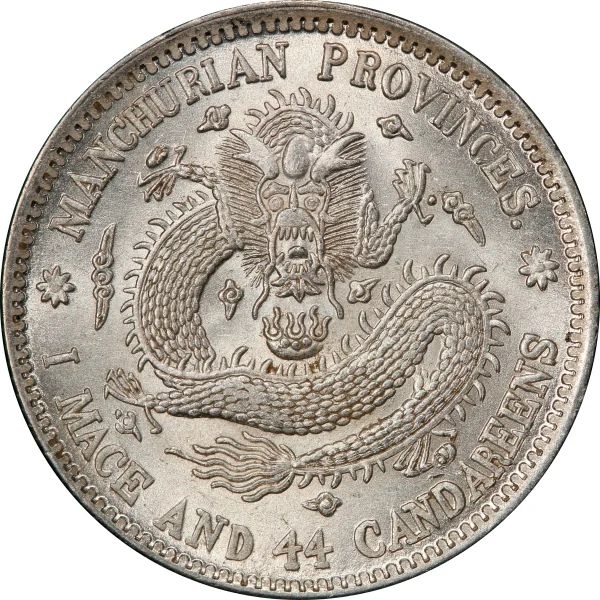
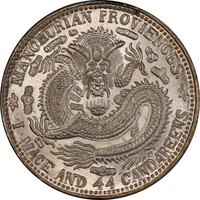
Dragon encircling a pearl, surrounded by English text.
Inscription:
MANCHURIAN PROVINCES
1 MACE AND 4.4 CANDAREENS
1 MACE AND 4.4 CANDAREENS
Edge
Reeded.
Categories
| Mythology> Fantastic animal |
Mintings
| Year | Mint Mark | Mintage | Quality | Collection |
|---|---|---|---|---|
| — | — | — |
Historical background
In 1914, the currency situation in China's Manchurian provinces (Fengtian, Jilin, and Heilongjiang) was a complex and fragmented system, reflecting the region's unique political and economic pressures. The primary circulating medium was the silver tael, valued by weight and purity, with the Fengtian tael being the most important local standard. However, a vast array of silver and copper subsidiary coins, along with paper notes issued by multiple authorities, created a chaotic environment. Crucially, the dominant paper currency was not Chinese but the Japanese-sponsored Korean Bank (Chosen Bank) yen notes, which circulated widely due to Japan's entrenched economic and railway interests in the southern Liaodong Peninsula following the Russo-Japanese War (1904-1905). The Russian Ruble also retained influence, particularly in northern Manchuria along the Chinese Eastern Railway zone.
This monetary fragmentation was exacerbated by the weak central control of the nascent Republic of China, established in 1912. Provincial authorities, official banks like the Bank of the Three Eastern Provinces, and countless private native banks (qianzhuang) all issued their own silver-denominated notes, convertible to varying degrees. These issues were often inadequately backed, leading to frequent discounts and regional disparities in value. The system was inherently unstable, burdening trade with exchange risks and complicating tax collection, as different currencies fluctuated against the silver tael standard.
The year 1914 itself was a point of impending change within this instability. While World War I began in Europe, diverting foreign attention, it did not immediately alter Manchuria's monetary landscape. However, the year saw the new Chinese government in Beijing making its first serious attempt to impose monetary uniformity nationally, promulgating the "Currency Regulations of the Republic of China" which advocated a silver dollar standard. In Manchuria, this policy faced immense practical obstacles against the entrenched interests of local issuers and the powerful circulating foreign currencies. Thus, the situation remained a contested and multi-layered system, setting the stage for the intensified economic rivalry and currency wars that would characterize the region in the following decades.
This monetary fragmentation was exacerbated by the weak central control of the nascent Republic of China, established in 1912. Provincial authorities, official banks like the Bank of the Three Eastern Provinces, and countless private native banks (qianzhuang) all issued their own silver-denominated notes, convertible to varying degrees. These issues were often inadequately backed, leading to frequent discounts and regional disparities in value. The system was inherently unstable, burdening trade with exchange risks and complicating tax collection, as different currencies fluctuated against the silver tael standard.
The year 1914 itself was a point of impending change within this instability. While World War I began in Europe, diverting foreign attention, it did not immediately alter Manchuria's monetary landscape. However, the year saw the new Chinese government in Beijing making its first serious attempt to impose monetary uniformity nationally, promulgating the "Currency Regulations of the Republic of China" which advocated a silver dollar standard. In Manchuria, this policy faced immense practical obstacles against the entrenched interests of local issuers and the powerful circulating foreign currencies. Thus, the situation remained a contested and multi-layered system, setting the stage for the intensified economic rivalry and currency wars that would characterize the region in the following decades.
💎 Very Rare