

20 fen – Manchurian Provinces
Add to wishlist
China
Context
Year: 1911
Country: China
Issuer: Manchurian Provinces
Ruler: Xuantong
Currency:
(1907—1931)
Demonetized: Yes
Material
References
Y: #
Numista: #275295
Value
Bullion value: $11.62
Obverse
Description:
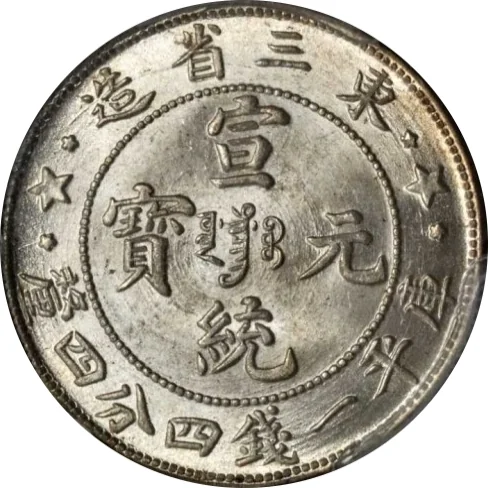
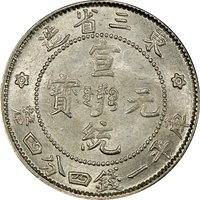
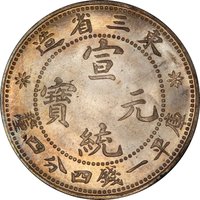
Chinese ideograms read vertically, right to left, with Manchu text in the center, all encircled by more Chinese characters.
Inscription:
造省三東
宣
寶 ᠶᡠᠸᠠᠨ ᡩᠠᡳᠴᡳᠩ ᠪᠣᠣ 元
統
釐四分四錢一平庫
宣
寶 ᠶᡠᠸᠠᠨ ᡩᠠᡳᠴᡳᠩ ᠪᠣᠣ 元
統
釐四分四錢一平庫
Translation:
Made in the Eastern Provinces
Xuan
Yuan Bao (Silver Coin) of the Great Qing Dynasty
Tong
One Ping Ku (Treasury) Tael, One Mace, Four Candareens, and Four Cent
Xuan
Yuan Bao (Silver Coin) of the Great Qing Dynasty
Tong
One Ping Ku (Treasury) Tael, One Mace, Four Candareens, and Four Cent
Scripts: Chinese, Mongolian / Manchu
Languages: Manchu, Classical Chinese
Reverse
Description:
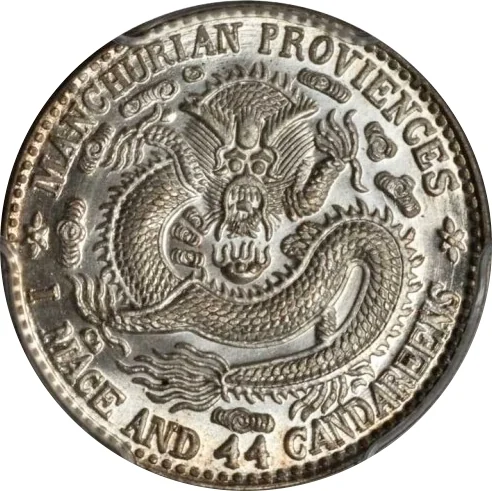
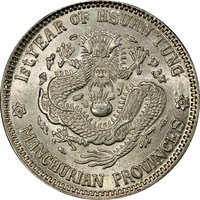
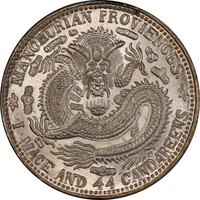
Dragon encircling a pearl, surrounded by English text.
Inscription:
MANCHURIAN PROVIENCES
1 MACE AND 4.4 CANDAREENS
1 MACE AND 4.4 CANDAREENS
Script: Latin
Edge
Reeded.
Categories
| Mythology> Fantastic animal |
Mintings
| Year | Mint Mark | Mintage | Quality | Collection |
|---|---|---|---|---|
| 1911 | — | — |
Historical background
In 1911, the currency situation in the three northeastern provinces of China known as Manchuria was a complex and fragmented system, reflecting the region's unique political and economic position. The primary circulating medium was the silver tael, a unit of weight rather than a standardized coin, which led to significant local variation and inefficiency. Alongside this, a multitude of currencies circulated simultaneously: Imperial Chinese copper cash for small transactions, provincial banknotes from local note-issuing banks, and a growing influx of foreign currencies, most notably the Japanese yen and Russian ruble, due to heavy foreign investment and the spheres of influence established after the Russo-Japanese War (1904-1905).
This monetary fragmentation was exacerbated by the region's rapid economic development, driven by railway construction, soybean exports, and migration from north China. The demand for a reliable medium of exchange outstripped the capacity of the Qing dynasty's faltering central authority to impose a unified system. Consequently, various provincial authorities, merchant guilds, and even large companies issued their own paper notes, leading to widespread problems with counterfeiting, fluctuating exchange rates between different note issuers, and frequent bank failures that eroded public confidence.
Therefore, on the eve of the 1911 Revolution that would topple the Qing dynasty, Manchuria's currency landscape was one of decentralized chaos. It was a system straining under the pressures of modernization and foreign encroachment, lacking any central guarantor of value. This instability would create significant economic challenges for the region in the ensuing decades of warlord rule, Japanese occupation, and continued monetary competition.
This monetary fragmentation was exacerbated by the region's rapid economic development, driven by railway construction, soybean exports, and migration from north China. The demand for a reliable medium of exchange outstripped the capacity of the Qing dynasty's faltering central authority to impose a unified system. Consequently, various provincial authorities, merchant guilds, and even large companies issued their own paper notes, leading to widespread problems with counterfeiting, fluctuating exchange rates between different note issuers, and frequent bank failures that eroded public confidence.
Therefore, on the eve of the 1911 Revolution that would topple the Qing dynasty, Manchuria's currency landscape was one of decentralized chaos. It was a system straining under the pressures of modernization and foreign encroachment, lacking any central guarantor of value. This instability would create significant economic challenges for the region in the ensuing decades of warlord rule, Japanese occupation, and continued monetary competition.
💎 Extremely Rare