

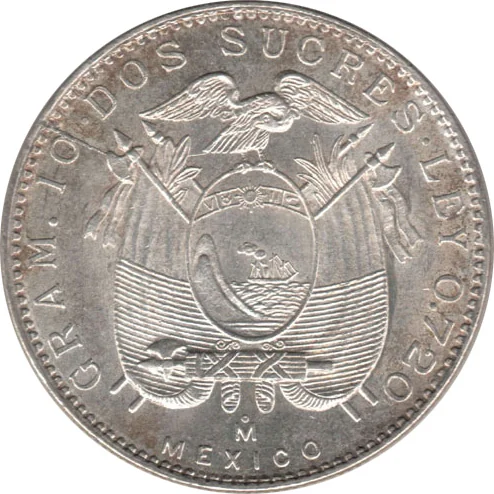
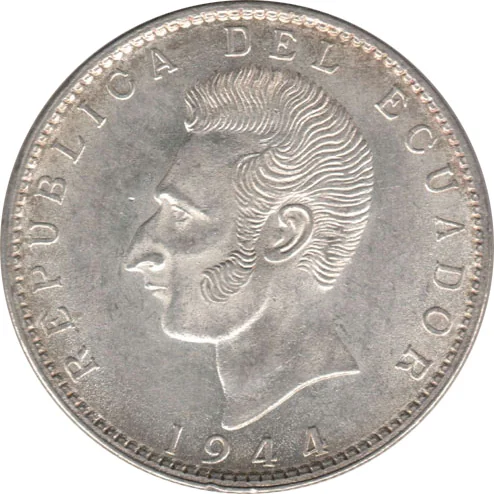
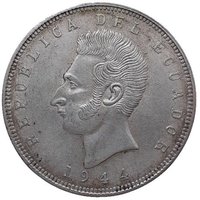
Obverse
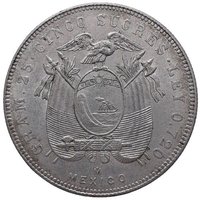
Reverse
Edge
Reeded
Categories
| Symbols> Coat of Arms |
| Person> Politician |
Mints
| Name | Mark |
|---|---|
| Mexican Mint | Mo |
Mintings
| Year | Mint Mark | Mintage | Quality | Collection |
|---|---|---|---|---|
| 1944 | Mo | 1,000,000 |
Historical background
In 1944, Ecuador's currency situation was characterized by instability and transition, deeply influenced by the political and economic upheavals of the era. The country was emerging from the disruptive 1941 border war with Peru and the subsequent 1942 Rio Protocol, which had drained national resources and destabilized the government. The official currency was the Ecuadorian sucre, but its value was weak and subject to inflation, partly due to wartime deficits and a reliance on agricultural exports like cocoa and coffee, which faced volatile international markets. The monetary system was managed by the Central Bank of Ecuador (founded in 1927), which struggled with limited foreign exchange reserves.
This period also saw a significant dollarization of certain transactions, particularly in coastal commercial centers like Guayaquil. The U.S. dollar circulated informally alongside the sucre, used in major international trade and by wealthy elites as a more stable store of value. This unofficial dual-currency system highlighted a lack of confidence in the national currency and tied Ecuador's economic health closely to external forces, namely the United States, whose presence grew during World War II due to strategic military and economic agreements.
The political context of 1944 was pivotal, with the Glorious Revolution of May overthrowing President Carlos Arroyo del Río and bringing José María Velasco Ibarra to power for the second time. While immediate, radical currency reform was not his first act, the new government inherited a pressing need to address monetary policy. The economic agenda for the coming years would focus on asserting greater state control over the banking system and addressing the sucre's instability, setting the stage for the nationalist and interventionist financial policies that would define Velasco Ibarra's subsequent administrations.
This period also saw a significant dollarization of certain transactions, particularly in coastal commercial centers like Guayaquil. The U.S. dollar circulated informally alongside the sucre, used in major international trade and by wealthy elites as a more stable store of value. This unofficial dual-currency system highlighted a lack of confidence in the national currency and tied Ecuador's economic health closely to external forces, namely the United States, whose presence grew during World War II due to strategic military and economic agreements.
The political context of 1944 was pivotal, with the Glorious Revolution of May overthrowing President Carlos Arroyo del Río and bringing José María Velasco Ibarra to power for the second time. While immediate, radical currency reform was not his first act, the new government inherited a pressing need to address monetary policy. The economic agenda for the coming years would focus on asserting greater state control over the banking system and addressing the sucre's instability, setting the stage for the nationalist and interventionist financial policies that would define Velasco Ibarra's subsequent administrations.
🌱 Fairly Common