

1 Yuan – Szechuan Province
China
Context
Years: 1909–1911
Country: China 
Issuer: Szechuan Province
Ruler: Xuantong
Currency:
(1897—1949)
Demonetized: Yes
Material
References
Y: #Click to copy to clipboard243
Numista: #42199
Value
Bullion value: $62.69
Obverse
Description:
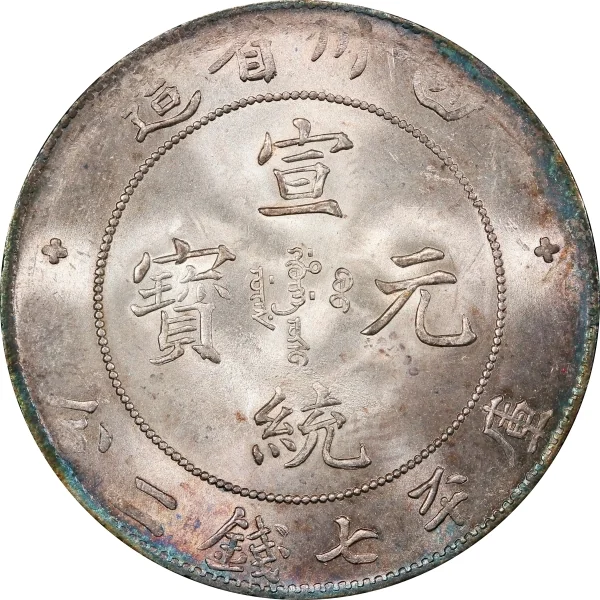
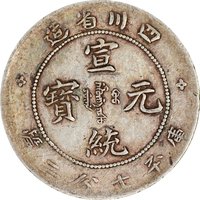
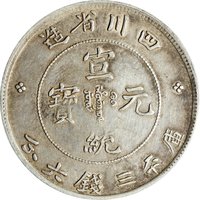
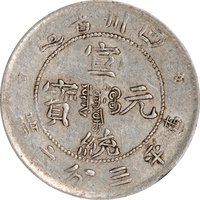
Chinese ideograms read vertically, right to left, with Manchu text in the center, all encircled by more Chinese characters.
Inscription:
造省川四
宣
ᡤᡝᡥᡠᠩᡤᡝ
寶 ᠶᡠᠸᠠᠨ ᠪᠣᠣ 元
ᠶᠣᠰᠣ
統
分一錢七平庫
宣
ᡤᡝᡥᡠᠩᡤᡝ
寶 ᠶᡠᠸᠠᠨ ᠪᠣᠣ 元
ᠶᠣᠰᠣ
統
分一錢七平庫
Translation:
Made by the Board of Public Works.
Xuan Tong
Gehungge Yowan Boo
One Mace and Seven Candareens
Standard Treasury
Xuan Tong
Gehungge Yowan Boo
One Mace and Seven Candareens
Standard Treasury
Scripts: Chinese, Mongolian / Manchu
Languages: Manchu, Classical Chinese
Reverse
Description:
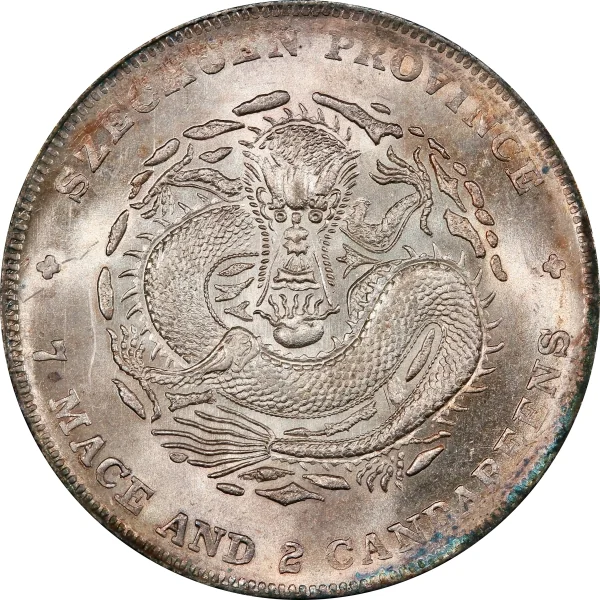
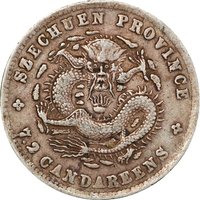
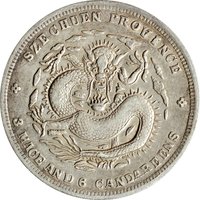
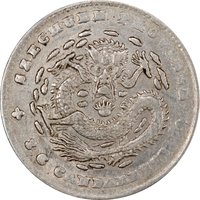
Dragon encircling a pearl, surrounded by English text.
Inscription:
SZECHUEN PROVINCE
7 MACE AND 2 CANDAREENS
7 MACE AND 2 CANDAREENS
Script: Latin
Edge
Reeded.
Categories
| Mythology> Fantastic animal |
Mintings
| Year | Mint Mark | Mintage | Quality | Collection |
|---|---|---|---|---|
| — | — | — |
Historical background
In 1909, the currency situation in Sichuan Province was one of profound complexity and instability, characteristic of the late Qing dynasty's fragmented financial system. The monetary landscape was a chaotic mix of official and unofficial currencies circulating simultaneously. These included imperial silver sycees (measured in taels), copper cash coins (both official tongyuan and local zhiqian), and, most problematically, a vast array of privately issued paper notes known as qianpiao. Nearly every major merchant, pawnshop, and native bank (qianzhuang) issued its own qianpiao, leading to a severe lack of standardization and widespread counterfeiting.
This proliferation of local paper was driven by a chronic shortage of standardized central coinage, which crippled large-scale commerce and tax collection. The value of these notes was highly localized and fluctuated based on the reputation of the issuer, leading to frequent discounting and merchant disputes. Furthermore, the intrinsic value of copper cash itself was unstable, as its market ratio to silver could swing dramatically, hurting peasants who paid taxes in silver but earned in copper. This monetary disorder stifled economic development, facilitated corruption, and eroded public trust in the financial system.
Recognizing the crisis, Qing authorities in Sichuan were attempting reform, part of a broader, last-ditch effort to centralize China's monetary system before the dynasty's fall. In 1909, the newly established provincial Bank of Sichuan (Sichuan Yinhang) began issuing official silver-backed banknotes in a bid to supplant the chaotic qianpiao. However, these efforts faced immense resistance from local interests and were undermined by a lack of sufficient silver reserves. The situation remained volatile, setting the stage for the further financial turmoil that would accompany the revolutionary upheavals of 1911, which began in Sichuan over railway nationalization and currency issues.
This proliferation of local paper was driven by a chronic shortage of standardized central coinage, which crippled large-scale commerce and tax collection. The value of these notes was highly localized and fluctuated based on the reputation of the issuer, leading to frequent discounting and merchant disputes. Furthermore, the intrinsic value of copper cash itself was unstable, as its market ratio to silver could swing dramatically, hurting peasants who paid taxes in silver but earned in copper. This monetary disorder stifled economic development, facilitated corruption, and eroded public trust in the financial system.
Recognizing the crisis, Qing authorities in Sichuan were attempting reform, part of a broader, last-ditch effort to centralize China's monetary system before the dynasty's fall. In 1909, the newly established provincial Bank of Sichuan (Sichuan Yinhang) began issuing official silver-backed banknotes in a bid to supplant the chaotic qianpiao. However, these efforts faced immense resistance from local interests and were undermined by a lack of sufficient silver reserves. The situation remained volatile, setting the stage for the further financial turmoil that would accompany the revolutionary upheavals of 1911, which began in Sichuan over railway nationalization and currency issues.

💎 Very Rare