

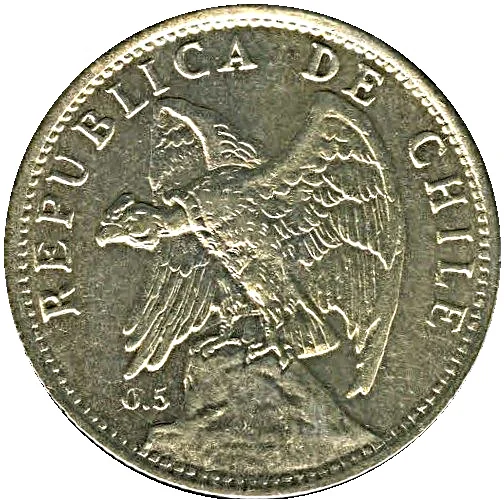
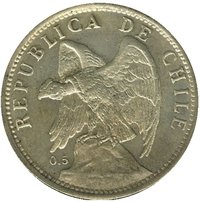
Obverse
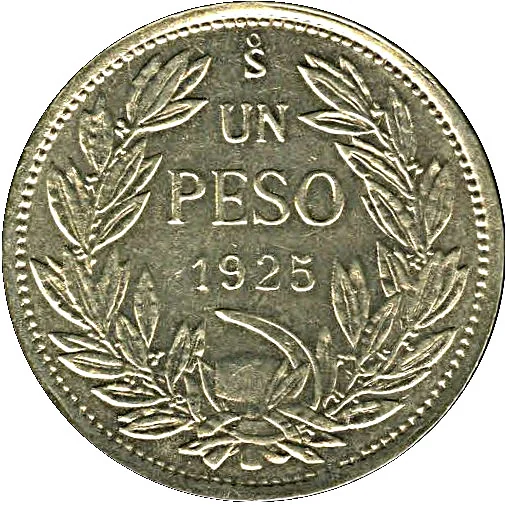
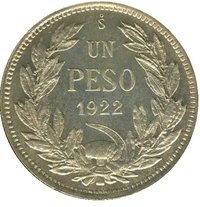
Reverse
Edge
Reeded
Categories
| Animal> Bird |
| Symbol> Hammer and sickle |
Mints
| Name | Mark |
|---|---|
| Casa de Moneda de Chile | (So) |
Mintings
| Year | Mint Mark | Mintage | Quality | Collection |
|---|---|---|---|---|
| 1924 | So | — | ||
| 1925 | So | — |
Historical background
By 1924, Chile's currency situation was characterized by significant instability and inflationary pressures, rooted in the economic policies of the previous decade. The country operated on a gold exchange standard, but this system had been severely strained. During the First World War and its aftermath, Chile suspended gold convertibility, leading to a period of significant paper money (peso) issuance to finance public spending, particularly under the administration of President Arturo Alessandri. This expansion of the money supply, not backed by gold reserves, resulted in a sharp depreciation of the peso against foreign currencies and eroded domestic purchasing power, creating widespread economic discontent.
The core of the crisis was fiscal. The government faced chronic budget deficits, funded by borrowing from the state-owned Banco Central de Chile (established in 1925, but its precursor was effectively the treasury's financier). This direct financing created a vicious cycle: deficits led to money printing, which caused inflation and currency devaluation, which in turn made imports more expensive and destabilized the economy further. The situation was exacerbated by a post-war drop in the price of nitrate, Chile's key export, which reduced foreign exchange earnings and weakened the country's ability to defend its currency.
This monetary and fiscal turmoil became a central catalyst for the political crisis of 1924. The inflation severely impacted the salaries of the middle class and the military, whose fixed incomes were devastated by the rising cost of living. This economic distress directly fueled the military intervention of September 1924, where officers demanded, among political reforms, a solution to the currency crisis. The resulting pressure led to the establishment of the Kemmerer Mission in 1925, a group of foreign financial experts whose recommendations would lead to the creation of an independent Central Bank and a return to the gold standard, aiming to impose discipline and restore stability to Chile's currency.
The core of the crisis was fiscal. The government faced chronic budget deficits, funded by borrowing from the state-owned Banco Central de Chile (established in 1925, but its precursor was effectively the treasury's financier). This direct financing created a vicious cycle: deficits led to money printing, which caused inflation and currency devaluation, which in turn made imports more expensive and destabilized the economy further. The situation was exacerbated by a post-war drop in the price of nitrate, Chile's key export, which reduced foreign exchange earnings and weakened the country's ability to defend its currency.
This monetary and fiscal turmoil became a central catalyst for the political crisis of 1924. The inflation severely impacted the salaries of the middle class and the military, whose fixed incomes were devastated by the rising cost of living. This economic distress directly fueled the military intervention of September 1924, where officers demanded, among political reforms, a solution to the currency crisis. The resulting pressure led to the establishment of the Kemmerer Mission in 1925, a group of foreign financial experts whose recommendations would lead to the creation of an independent Central Bank and a return to the gold standard, aiming to impose discipline and restore stability to Chile's currency.
🌱 Fairly Common