

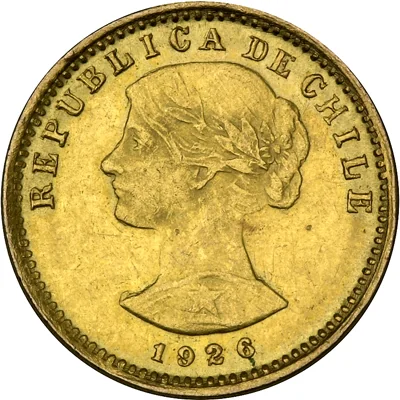

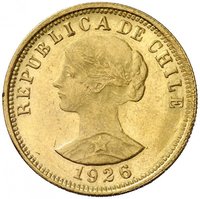
Obverse
Description:
Date below, head left.
Inscription:
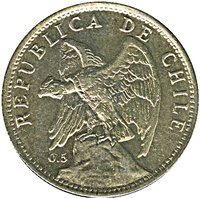
REPUBLICA DE CHILE
1926
1926
Translation:
REPUBLIC OF CHILE
1926
1926
Script: Latin
Language: Spanish
Engraver: Oscar Roty (1846 -1911)
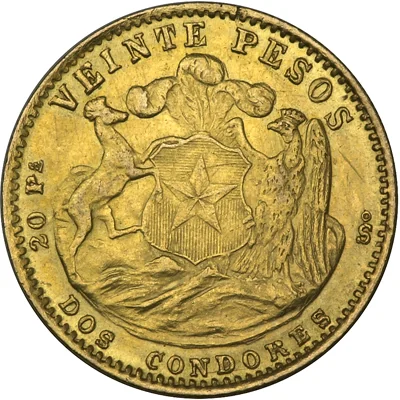
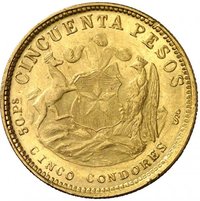
Reverse
Description:
Arms with supporters encircled by denomination in three formats.
Inscription:
VEINTE PESOS
20 Ps So
DOS CONDORES
20 Ps So
DOS CONDORES
Script: Latin
Edge
Mints
| Name | Mark |
|---|---|
| Casa de Moneda de Chile | (So) |
Mintings
| Year | Mint Mark | Mintage | Quality | Collection |
|---|---|---|---|---|
| 1926 | So | 85,000 | ||
| 1958 | So | 500 | ||
| 1959 | So | 25,000 | ||
| 1961 | So | 20,000 | ||
| 1964 | So | — | ||
| 1976 | So | 99,000 | ||
| 1977 | So | 38,000 | ||
| 1979 | So | 30,000 | ||
| 1980 | So | 30,000 |
Historical background
In 1926, Chile was in the final stages of a profound monetary transition, moving from a chaotic system of multiple, depreciated paper currencies to a single, stable currency backed by gold. This process was the culmination of the work of the Kemmerer Missions, a group of American financial experts led by Edwin Kemmerer, invited by the government to restore fiscal and monetary order. Their recommendations, implemented from 1925 onward, established the Central Bank of Chile (Banco Central de Chile) as the sole issuer of currency, a critical step in ending decades of inflationary financing by private banks and the treasury.
The immediate pre-1926 situation was defined by the existence of the "peso peso" and the "peso currency." The "peso peso" was a theoretical gold peso, while the "peso currency" was the actual, heavily depreciated paper money in circulation, which had lost substantial value. The Kemmerer reforms legally defined a new monetary unit, the "condor" (equal to 10 gold pesos or 20 paper pesos), and pegged it to the British pound sterling, effectively placing Chile on a gold-exchange standard. By 1926, the newly created Central Bank was actively withdrawing the old heterogeneous paper notes and replacing them with a unified, convertible currency, aiming to instill domestic and international confidence.
This stabilization, however, occurred within a specific economic context. Chile's public finances were overwhelmingly dependent on nitrate exports, a volatile commodity subject to global price swings. The new currency regime of 1926 brought welcome stability and modernized the financial system, but it also tied Chile's monetary health to its export earnings and its fixed link to gold. While hailed as a success at the time, this rigid structure would later be severely tested by the collapse of the nitrate market during the Great Depression, leading to the eventual abandonment of the gold standard in 1932.
The immediate pre-1926 situation was defined by the existence of the "peso peso" and the "peso currency." The "peso peso" was a theoretical gold peso, while the "peso currency" was the actual, heavily depreciated paper money in circulation, which had lost substantial value. The Kemmerer reforms legally defined a new monetary unit, the "condor" (equal to 10 gold pesos or 20 paper pesos), and pegged it to the British pound sterling, effectively placing Chile on a gold-exchange standard. By 1926, the newly created Central Bank was actively withdrawing the old heterogeneous paper notes and replacing them with a unified, convertible currency, aiming to instill domestic and international confidence.
This stabilization, however, occurred within a specific economic context. Chile's public finances were overwhelmingly dependent on nitrate exports, a volatile commodity subject to global price swings. The new currency regime of 1926 brought welcome stability and modernized the financial system, but it also tied Chile's monetary health to its export earnings and its fixed link to gold. While hailed as a success at the time, this rigid structure would later be severely tested by the collapse of the nitrate market during the Great Depression, leading to the eventual abandonment of the gold standard in 1932.
⭐ Rare