

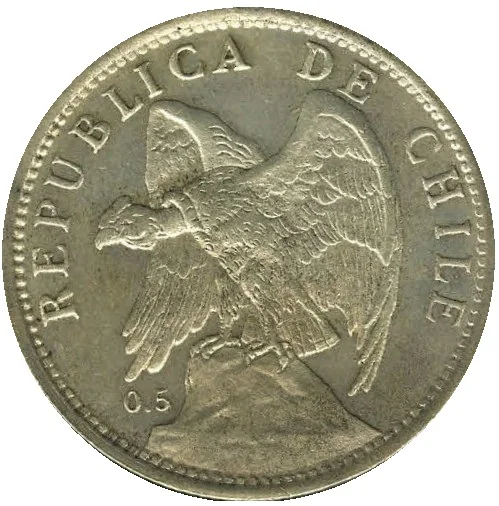
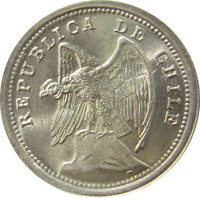
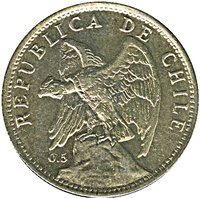
Obverse
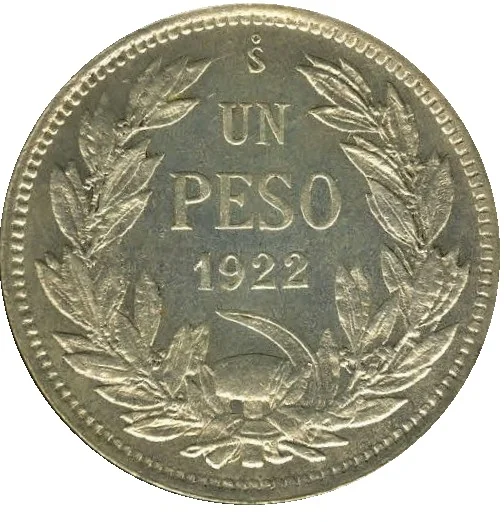
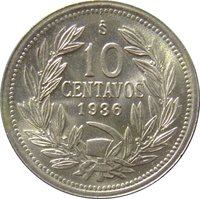
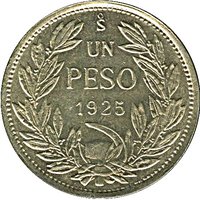
Reverse
Edge
Reeded
Categories
| Animal> Bird |
| Symbol> Hammer and sickle |
Mints
| Name | Mark |
|---|---|
| Casa de Moneda de Chile | (So) |
Mintings
| Year | Mint Mark | Mintage | Quality | Collection |
|---|---|---|---|---|
| 1921 | So | 2,287,000 | ||
| 1922 | So | 2,718,000 |
Historical background
In 1921, Chile's currency situation was characterized by significant instability and inflationary pressure, a direct legacy of the economic policies enacted during the First World War. To finance public spending and cushion the impact of disrupted international trade, the government had substantially increased the money supply, leading to a sharp depreciation of the Chilean peso against gold and foreign currencies. This period saw the effective suspension of the gold standard, as the Central Bank of Chile (established in 1925) did not yet exist, and paper money issuance was not fully backed by metallic reserves, creating a climate of uncertainty for both domestic and international commerce.
The primary currency in circulation was the peso, which existed in both paper (billete) and metallic forms, with their values often diverging. The government faced a severe fiscal deficit, funded by borrowing from the Caja de Crédito Hipotecario and the printing of more banknotes by private banks under government authorization. This rapid expansion of the monetary base fueled inflation, eroding purchasing power and causing social discontent, particularly among urban workers and salaried employees whose incomes did not keep pace with rising prices. The situation was exacerbated by a post-war slump in the price of nitrate, Chile's key export, which reduced foreign exchange earnings and strained the balance of payments.
Consequently, 1921 stands as a critical juncture of monetary disorder that set the stage for major reforms later in the decade. The persistent inflation and fiscal crises of the early 1920s highlighted the urgent need for institutional change, ultimately leading to the creation of the Central Bank of Chile in 1925 and the return to a gold standard in 1926. Thus, the currency situation of 1921 was the symptomatic crisis that precipitated the modernization of Chile's monetary and banking systems.
The primary currency in circulation was the peso, which existed in both paper (billete) and metallic forms, with their values often diverging. The government faced a severe fiscal deficit, funded by borrowing from the Caja de Crédito Hipotecario and the printing of more banknotes by private banks under government authorization. This rapid expansion of the monetary base fueled inflation, eroding purchasing power and causing social discontent, particularly among urban workers and salaried employees whose incomes did not keep pace with rising prices. The situation was exacerbated by a post-war slump in the price of nitrate, Chile's key export, which reduced foreign exchange earnings and strained the balance of payments.
Consequently, 1921 stands as a critical juncture of monetary disorder that set the stage for major reforms later in the decade. The persistent inflation and fiscal crises of the early 1920s highlighted the urgent need for institutional change, ultimately leading to the creation of the Central Bank of Chile in 1925 and the return to a gold standard in 1926. Thus, the currency situation of 1921 was the symptomatic crisis that precipitated the modernization of Chile's monetary and banking systems.
🌱 Fairly Common