

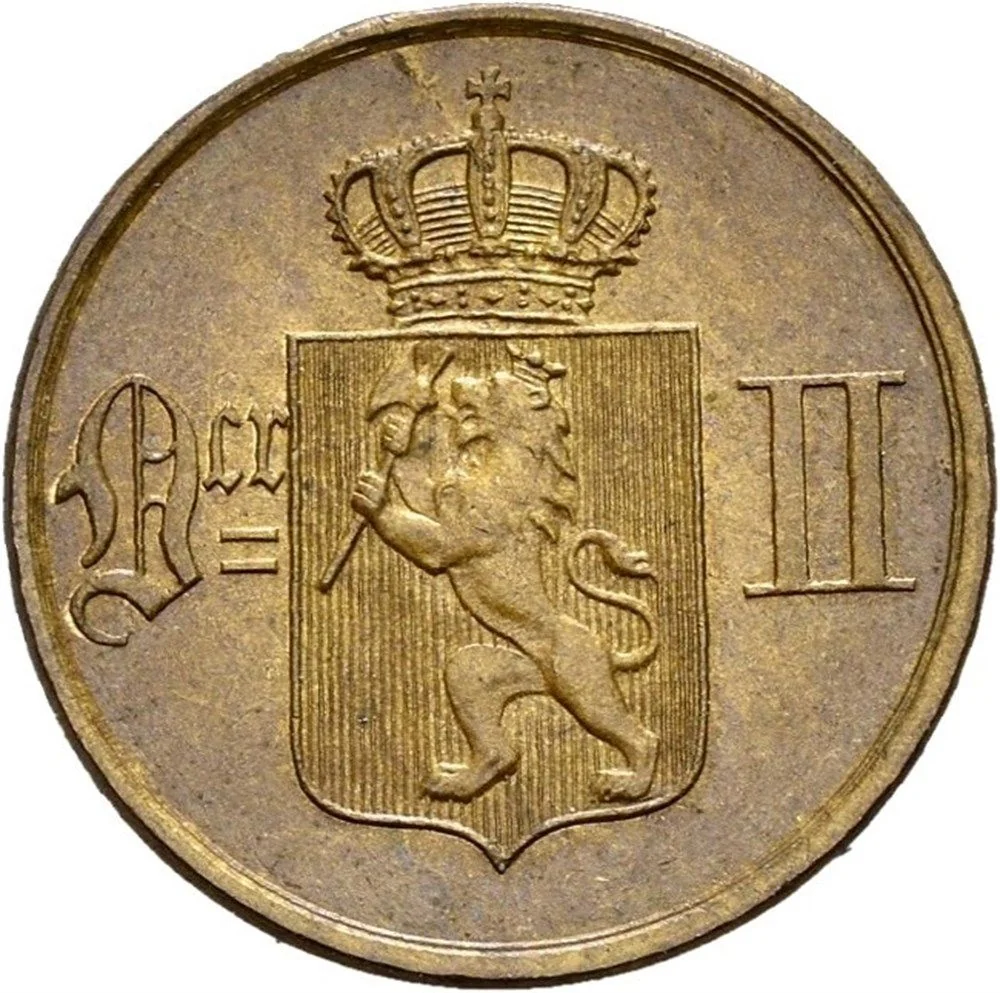
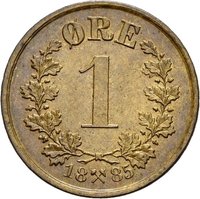
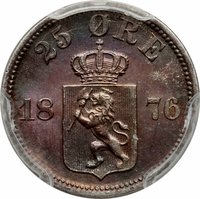
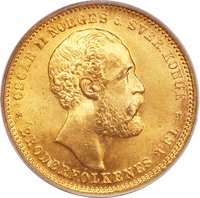
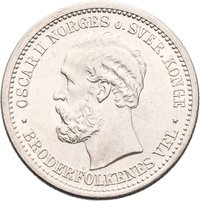
Obverse
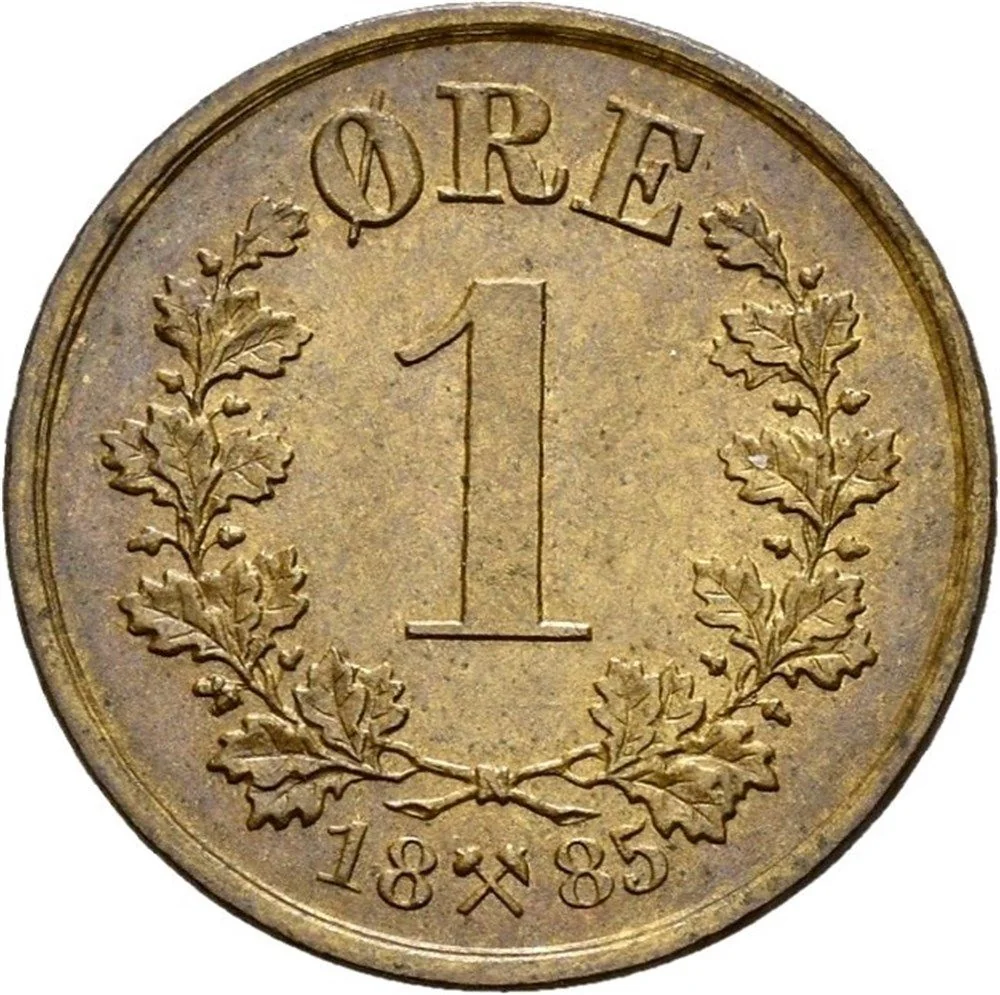
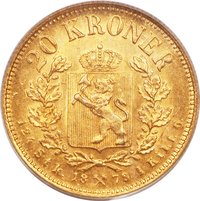
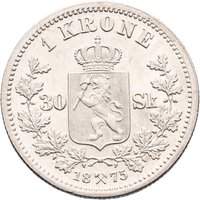
Reverse
Edge
Plain
Categories
| Symbols> Coat of Arms |
| Symbol> Wreath |
Mints
| Name | Mark |
|---|---|
| Norwegian Mint | — |
Mintings
| Year | Mint Mark | Mintage | Quality | Collection |
|---|---|---|---|---|
| 1876 | — | 8,000,000 | ||
| 1877 | — | 2,166,000 | ||
| 1878 | — | 1,834,000 | ||
| 1884 | — | 3,378,000 | ||
| 1885 | — | 622,000 | ||
| 1889 | — | 3,000,000 | ||
| 1891 | — | 3,000,000 | ||
| 1893 | — | 3,000,000 | ||
| 1897 | — | 3,000,000 | ||
| 1899 | — | 4,500,000 | ||
| 1902 | — | 4,500,000 |
Historical background
In the decades leading up to 1876, Norway's currency system was complex and fragmented. Since 1816, the country had officially used the speciedaler, a silver-based currency, but in practice, the monetary landscape was messy. Alongside the silver coins, a separate system of "bank notes" and "current daler" existed, which were not fully convertible to silver and often traded at a discount. This created a confusing dual system of "good" silver money and "weaker" paper money, hindering trade and economic calculation, especially as Norway industrialized and its international commerce grew.
The need for modernization and integration with key trading partners became urgent. The Scandinavian Monetary Union, formed with Sweden and Denmark in 1873, provided the decisive framework. This agreement established a common gold standard, replacing the silver standard, and defined new currency units: the Norwegian krone and øre, pegged to gold and fully interchangeable with the Swedish krona and Danish krone. Norway formally passed the necessary legislation in 1873, but the full transition was set for 1876.
Thus, 1876 marked the culmination of this reform process. It was the year the old speciedaler was officially demonetized and the new gold-based Norwegian krone became the sole legal tender. This move stabilized the currency, simplified domestic finance, and deeply integrated Norway into the Scandinavian and wider European economic sphere. The reform of 1876 is therefore seen as a foundational moment in modern Norwegian economic history, creating a stable and unified monetary system that supported the country's rapid industrial development in the late 19th century.
The need for modernization and integration with key trading partners became urgent. The Scandinavian Monetary Union, formed with Sweden and Denmark in 1873, provided the decisive framework. This agreement established a common gold standard, replacing the silver standard, and defined new currency units: the Norwegian krone and øre, pegged to gold and fully interchangeable with the Swedish krona and Danish krone. Norway formally passed the necessary legislation in 1873, but the full transition was set for 1876.
Thus, 1876 marked the culmination of this reform process. It was the year the old speciedaler was officially demonetized and the new gold-based Norwegian krone became the sole legal tender. This move stabilized the currency, simplified domestic finance, and deeply integrated Norway into the Scandinavian and wider European economic sphere. The reform of 1876 is therefore seen as a foundational moment in modern Norwegian economic history, creating a stable and unified monetary system that supported the country's rapid industrial development in the late 19th century.
Series: 1876 Norway circulation coins
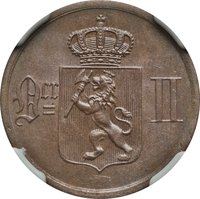
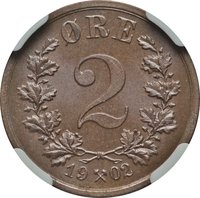
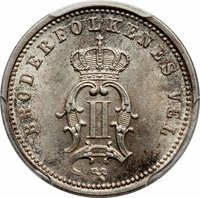
🌱 Common