

2½ gulden – Netherlands
Add to wishlist
Netherlands
Context
Years: 1959–1966
Issuer: Netherlands
Ruler: Juliana
Currency:
(1817—2001)
Demonetized: Yes
Total mintage: 46,800,000
Material
References
KM: #
Numista: #4130
Value
Exchange value: 2.5 NLG
Bullion value: $27.11
Obverse
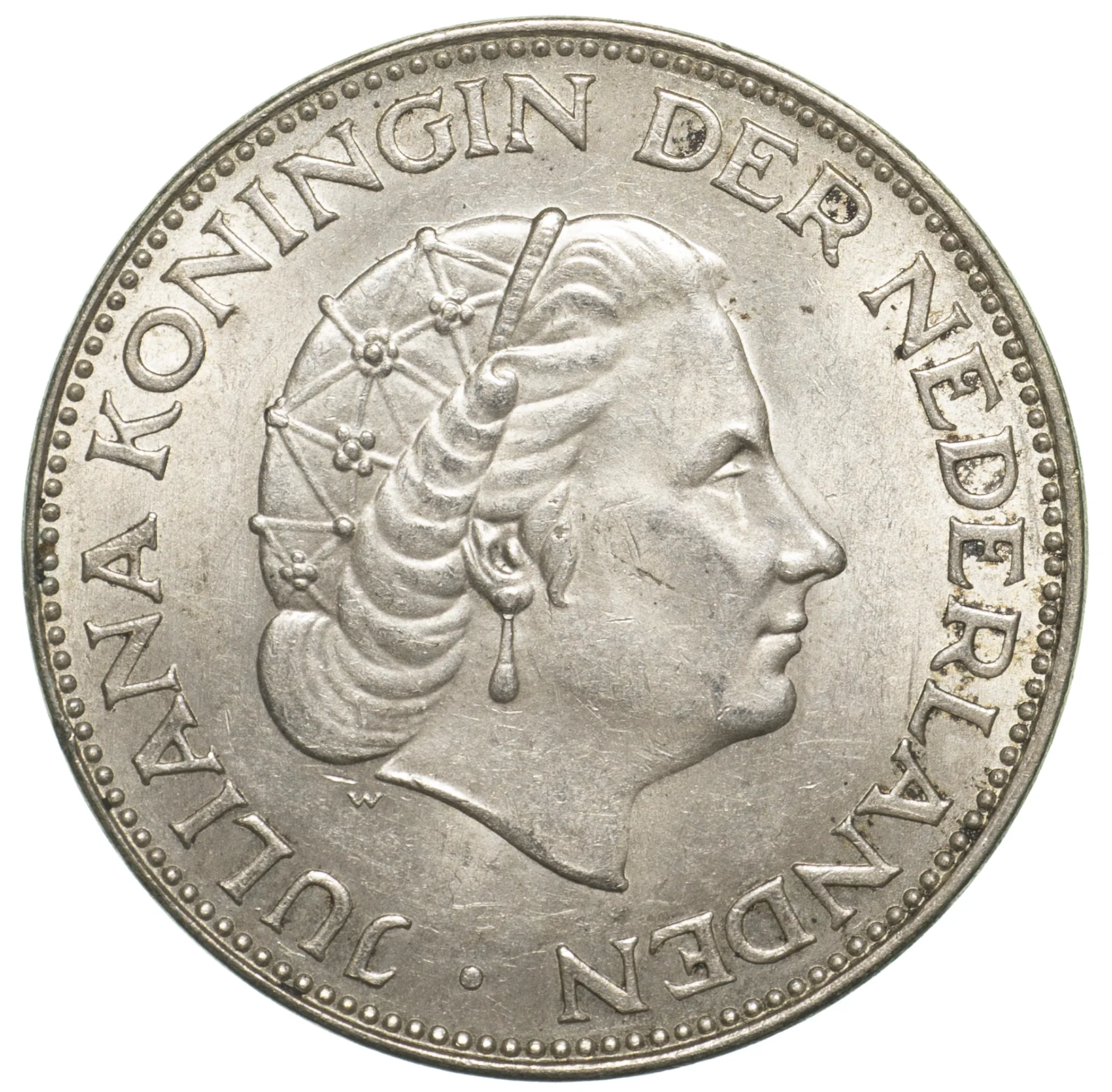
Description:
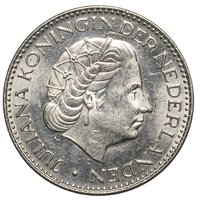
Queen Juliana facing right, encircled by legend.
Inscription:
JULIANA KONINGIN DER NEDERLANDEN
W
W
Translation:
Juliana Queen of the Netherlands
Script: Latin
Language: Dutch
Engraver: Ludwig Oswald Wenckebach
Reverse
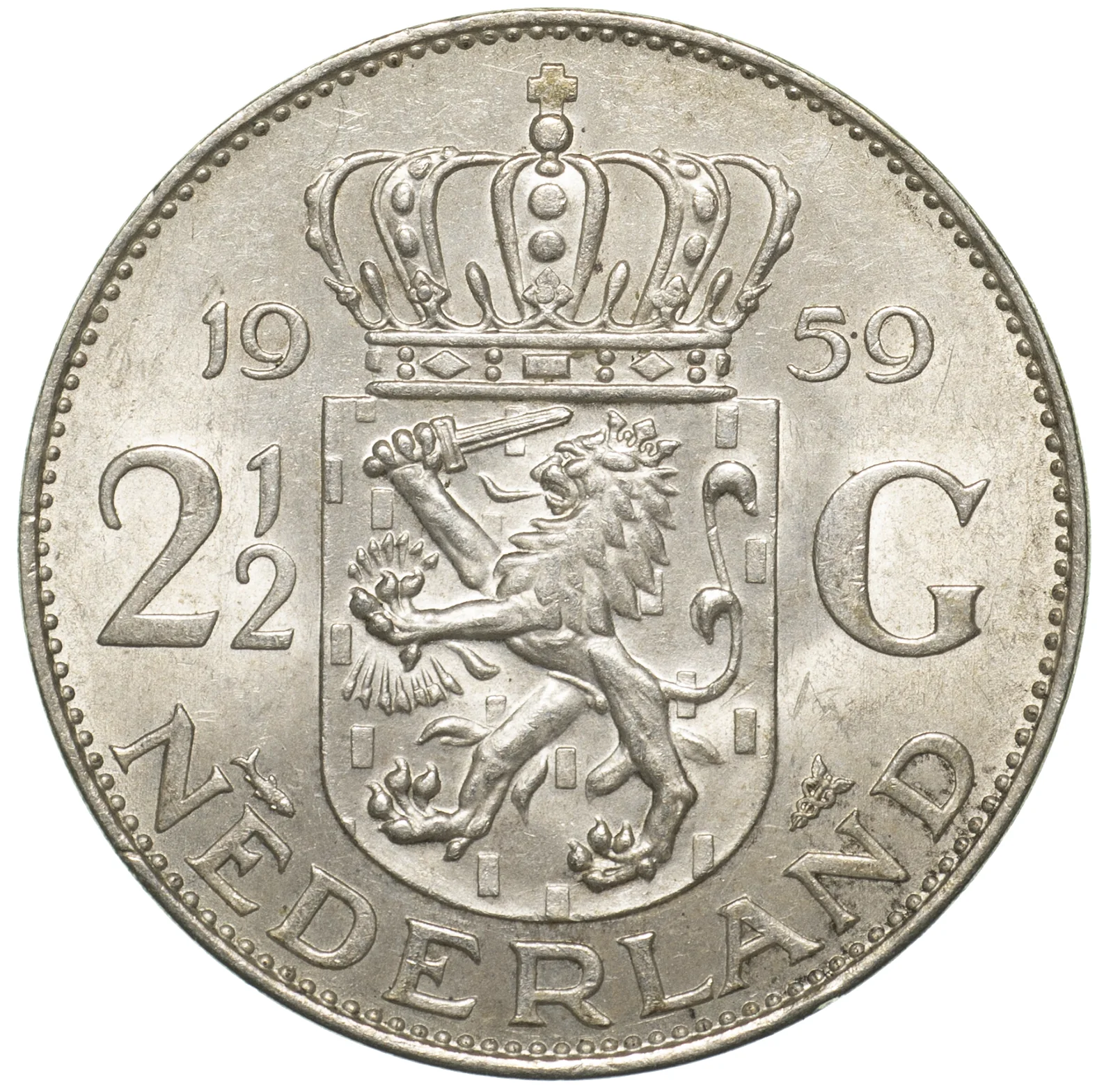
Description:
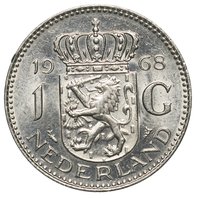
Dutch shield with crown separates date and value.
Inscription:
1961
2 1/2 G
NEDERLAND
2 1/2 G
NEDERLAND
Translation:
1961
2 1/2 Guilders
NETHERLANDS
2 1/2 Guilders
NETHERLANDS
Script: Latin
Engraver: Ludwig Oswald Wenckebach
Edge
Plain with incuse lettering
Legend:
★ GOD ★ ZIJ ★ MET ★ ONS
Translation:
God be with us
Language: Dutch
Categories
| Object> Hat |
| Symbols> Coat of Arms |
Mints
| Name | Mark |
|---|---|
| Royal Dutch Mint | — |
Mintings
| Year | Mint Mark | Mintage | Quality | Collection |
|---|---|---|---|---|
| 1959 | — | 7,200,000 | ||
| 1959 | — | — | Proof | |
| 1960 | — | 12,800,000 | ||
| 1960 | — | — | Proof | |
| 1961 | — | 10,000,000 | ||
| 1961 | — | — | Proof | |
| 1962 | — | 5,000,000 | ||
| 1962 | — | — | Proof | |
| 1963 | — | — | Proof | |
| 1963 | — | 4,000,000 | ||
| 1964 | — | 2,800,000 | ||
| 1964 | — | — | Proof | |
| 1966 | — | 5,000,000 | ||
| 1966 | — | — | Proof |
Historical background
In 1959, the Netherlands operated within the framework of the Bretton Woods system, which pegged its currency, the Dutch guilder, to the US dollar at a fixed exchange rate. This rate was set at 3.80 guilders to one dollar, a parity that had been established in 1946 and was maintained with strict monetary discipline by De Nederlandsche Bank (DNB). The guilder was considered a strong and stable "hard currency," a reputation earned through the country's conservative fiscal policies and its rapid post-war industrial and export-led recovery, often called the "Dutch economic miracle."
Domestically, the currency was stable, with low inflation. However, the fixed exchange rate regime required constant intervention to maintain the parity. The Netherlands was a founding member of the European Payments Union (1950) and was actively engaged in the early stages of European economic integration, which included discussions on monetary cooperation. The Benelux Economic Union, formed with Belgium and Luxembourg, further coordinated financial and economic policies, creating a precursor to broader European monetary initiatives.
Looking ahead, 1959 was a year of quiet stability but also a point on the path toward significant change. The robust economy and strong guilder would soon face new pressures in the 1960s, including wage inflation and the eventual strains on the Bretton Woods system itself. The policies and stability of this period, however, laid the essential groundwork for the Netherlands' later pivotal role in the creation of the European Monetary System and ultimately the euro.
Domestically, the currency was stable, with low inflation. However, the fixed exchange rate regime required constant intervention to maintain the parity. The Netherlands was a founding member of the European Payments Union (1950) and was actively engaged in the early stages of European economic integration, which included discussions on monetary cooperation. The Benelux Economic Union, formed with Belgium and Luxembourg, further coordinated financial and economic policies, creating a precursor to broader European monetary initiatives.
Looking ahead, 1959 was a year of quiet stability but also a point on the path toward significant change. The robust economy and strong guilder would soon face new pressures in the 1960s, including wage inflation and the eventual strains on the Bretton Woods system itself. The policies and stability of this period, however, laid the essential groundwork for the Netherlands' later pivotal role in the creation of the European Monetary System and ultimately the euro.
🌱 Very Common