

1 gulden – Netherlands
Add to wishlist
Netherlands
Context
Years: 1954–1968
Issuer: Netherlands
Ruler: Juliana
Currency:
(1817—2001)
Demonetized: Yes
Total mintage: 187,000,000
Material
References
KM: #
Numista: #737
Value
Exchange value: 1 NLG
Bullion value: $11.75
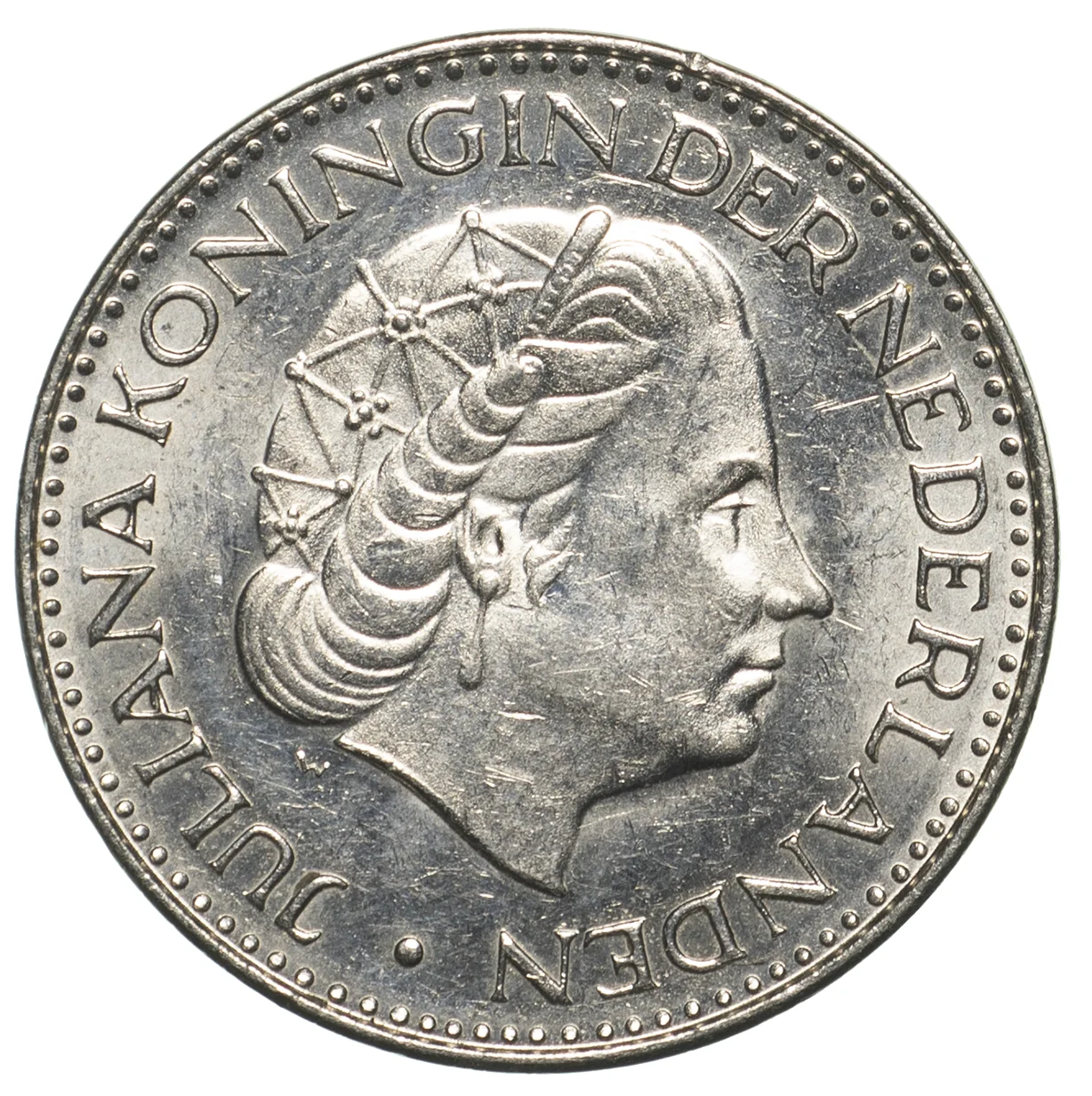
Obverse
Description:
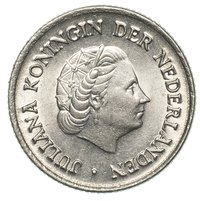
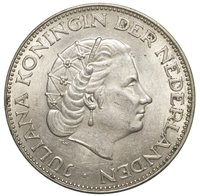
Queen Juliana of the Netherlands, facing right.
Inscription:
JULIANA KONINGIN DER NEDERLANDEN ·
W
W
Translation:
Juliana Queen of the Netherlands ·
Script: Latin
Language: Dutch
Engraver: Ludwig Oswald Wenckebach
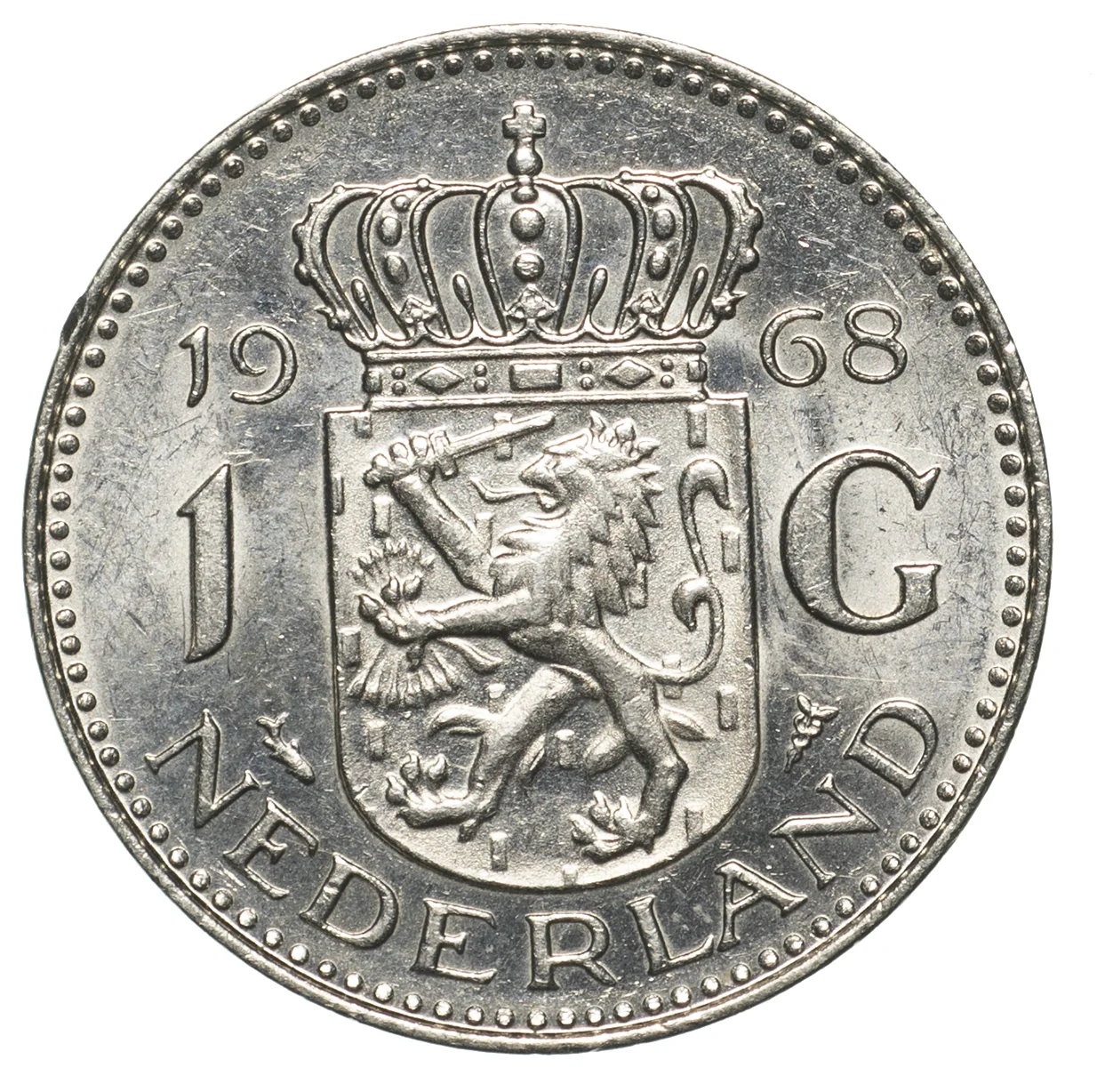
Reverse
Edge
Smooth with inscriptions
Legend:
GOD ★ ZIJ ★ MET ★ ONS ★
Translation:
God be with us
Language: Dutch
Mints
| Name | Mark |
|---|---|
| Royal Dutch Mint | — |
Mintings
| Year | Mint Mark | Mintage | Quality | Collection |
|---|---|---|---|---|
| 1954 | — | 6,600,000 | ||
| 1954 | — | — | Proof | |
| 1955 | — | 37,500,000 | ||
| 1955 | — | — | Proof | |
| 1956 | — | 38,900,000 | ||
| 1956 | — | — | Proof | |
| 1957 | — | 27,000,000 | ||
| 1957 | — | — | Proof | |
| 1958 | — | 30,000,000 | ||
| 1958 | — | — | Proof | |
| 1963 | — | 5,000,000 | ||
| 1963 | — | — | Proof | |
| 1964 | — | 9,000,000 | ||
| 1964 | — | — | Proof | |
| 1965 | — | 21,000,000 | ||
| 1965 | — | — | Proof | |
| 1966 | — | 5,000,000 | ||
| 1966 | — | — | Proof | |
| 1967 | — | 7,000,000 | ||
| 1967 | — | — | Proof | |
| 1968 | — | — |
Historical background
In 1954, the Netherlands operated under the established framework of the Dutch guilder (gulden), a currency managed with notable conservatism by De Nederlandsche Bank (DNB). The post-war period was characterized by strict capital controls and a fixed exchange rate regime, essential tools for rebuilding the war-ravaged economy and managing the balance of payments. The guilder was pegged to the US dollar at a rate of 3.80 guilders per dollar, a parity set in 1949 and maintained through the Bretton Woods system, which provided international monetary stability by linking major currencies to the dollar, itself convertible to gold.
Domestically, the currency situation reflected the broader "wederopbouw" (reconstruction) effort, with policy focused on controlling inflation and fostering industrial recovery. The memory of wartime occupation and the financial instability it brought, including separate occupation currency, reinforced a national preference for monetary discipline. This prudent approach was evident in the Bank's policies, which prioritized guilder stability to encourage investment and trade, particularly within the emerging European Coal and Steel Community, a precursor to the European Economic Community.
The year 1954 itself was not marked by a monetary crisis or major reform, but rather by consolidation within this stable system. Importantly, the Charter for the Kingdom of the Netherlands was signed in 1954, reforming the relationship between the Netherlands, Suriname, and the Netherlands Antilles. While this political milestone granted the overseas territories internal autonomy, the currency arrangement remained unchanged: the guilder remained the sole legal tender in the European Netherlands, with the Caribbean territories continuing to use their own distinct versions of the guilder (the Antillean guilder and the Surinamese guilder), which were maintained at par with the metropolitan guilder.
Domestically, the currency situation reflected the broader "wederopbouw" (reconstruction) effort, with policy focused on controlling inflation and fostering industrial recovery. The memory of wartime occupation and the financial instability it brought, including separate occupation currency, reinforced a national preference for monetary discipline. This prudent approach was evident in the Bank's policies, which prioritized guilder stability to encourage investment and trade, particularly within the emerging European Coal and Steel Community, a precursor to the European Economic Community.
The year 1954 itself was not marked by a monetary crisis or major reform, but rather by consolidation within this stable system. Importantly, the Charter for the Kingdom of the Netherlands was signed in 1954, reforming the relationship between the Netherlands, Suriname, and the Netherlands Antilles. While this political milestone granted the overseas territories internal autonomy, the currency arrangement remained unchanged: the guilder remained the sole legal tender in the European Netherlands, with the Caribbean territories continuing to use their own distinct versions of the guilder (the Antillean guilder and the Surinamese guilder), which were maintained at par with the metropolitan guilder.
🌱 Very Common