

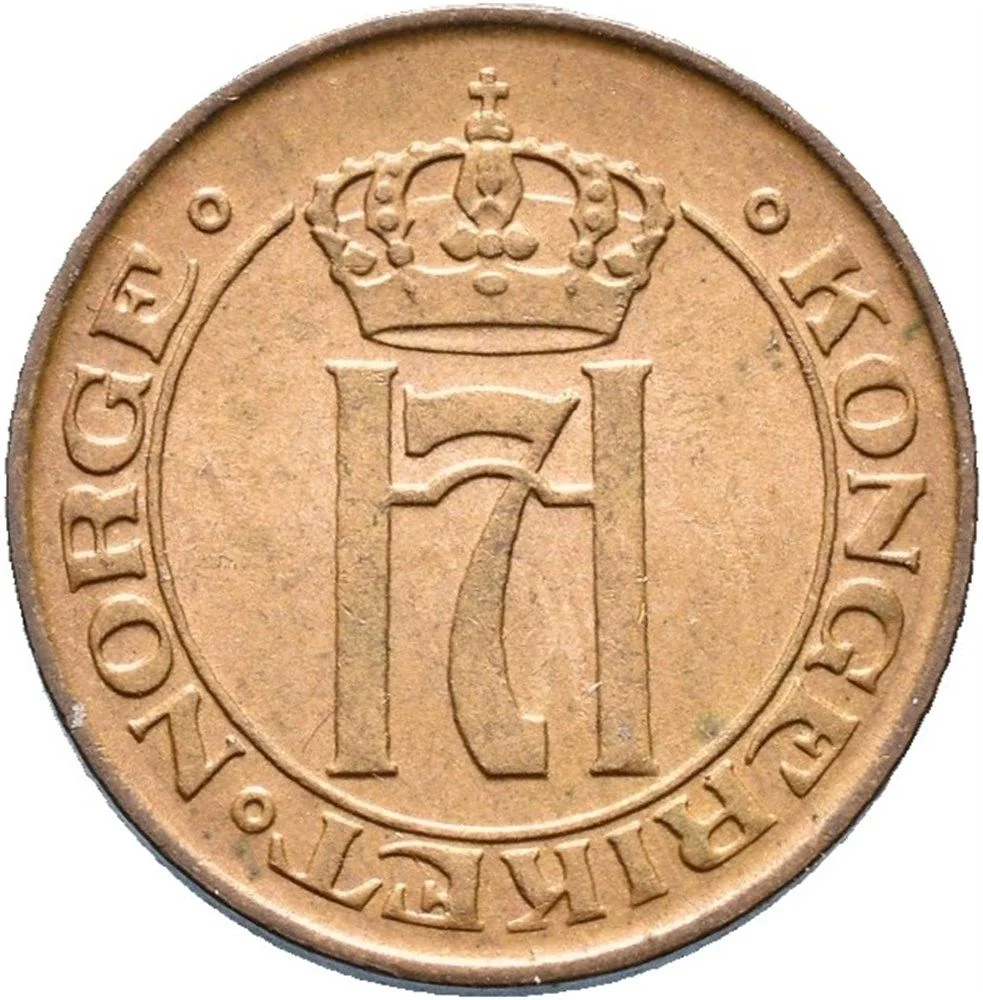
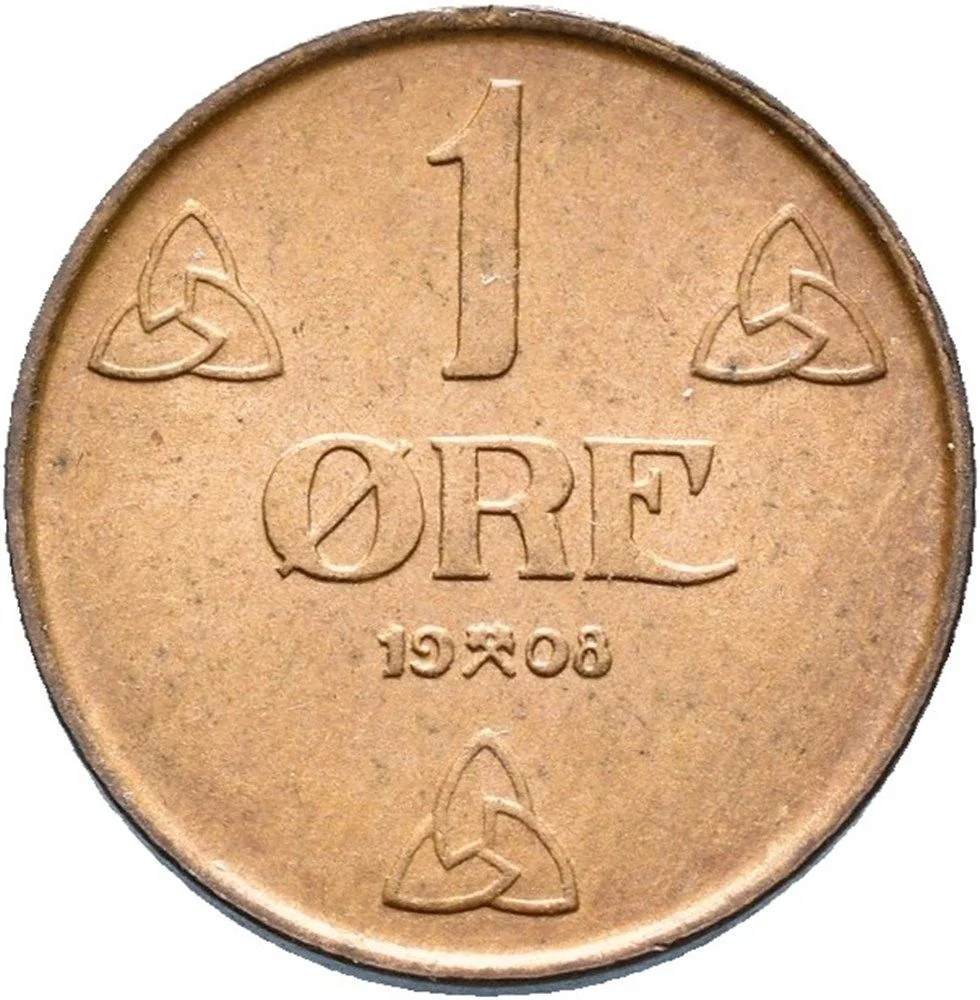
1 øre – Norway
Add to wishlist
Norway
Context
Years: 1908–1952
Issuer: Norway
Ruler: Haakon VII
Currency:
(since 1875)
Demonetization: 1 January 1975
Total mintage: 126,245,000
Material
References
KM: #
Numista: #4127
Value
Exchange value: 0.01 NOK
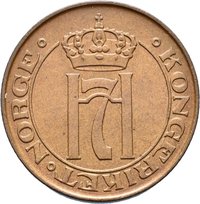
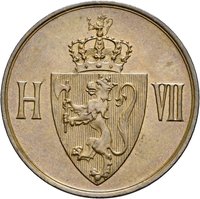
Obverse
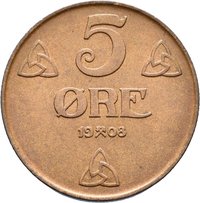
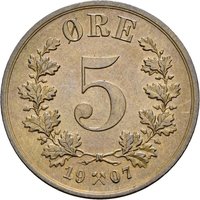
Reverse
Edge
Plain
Mints
| Name | Mark |
|---|---|
| Norwegian Mint | — |
Mintings
| Year | Mint Mark | Mintage | Quality | Collection |
|---|---|---|---|---|
| 1908 | — | 1,450,000 | ||
| 1910 | — | 2,480,000 | ||
| 1911 | — | 3,270,000 | ||
| 1912 | — | 2,850,000 | ||
| 1913 | — | 2,840,000 | ||
| 1914 | — | 5,020,000 | ||
| 1915 | — | 1,540,000 | ||
| 1921 | — | 3,805,000 | ||
| 1922 | — | — | ||
| 1923 | — | 770,000 | ||
| 1925 | — | 3,000,000 | ||
| 1926 | — | 2,200,000 | ||
| 1927 | — | 800,000 | ||
| 1928 | — | 3,000,000 | ||
| 1929 | — | — | ||
| 1930 | — | — | ||
| 1931 | — | 2,000,000 | ||
| 1932 | — | 2,500,000 | ||
| 1933 | — | 2,000,000 | ||
| 1934 | — | 2,000,000 | ||
| 1935 | — | 5,495,000 | ||
| 1936 | — | 6,855,000 | ||
| 1937 | — | 6,020,000 | ||
| 1938 | — | 4,920,000 | ||
| 1939 | — | 2,500,000 | ||
| 1940 | — | 5,010,000 | ||
| 1941 | — | 12,260,000 | ||
| 1946 | — | 2,200,000 | ||
| 1947 | — | 4,870,000 | ||
| 1948 | — | 9,405,000 | ||
| 1949 | — | 2,785,000 | ||
| 1950 | — | 5,730,000 | ||
| 1951 | — | 16,670,000 | ||
| 1952 | — | — |
Historical background
In 1908, Norway’s currency situation was defined by its membership in the Scandinavian Monetary Union (SMU), established in 1873 with Denmark and joined by Sweden in 1875. This union created a fixed exchange rate and free circulation of coins between the member countries, effectively making the Norwegian krone (crown) equal to the Danish and Swedish kronor. By 1908, the system was still formally operational, and Norwegian coins circulated freely alongside Swedish and Danish coins within all three nations, facilitated by a shared gold standard that provided stability and international credibility.
However, the union was under significant strain by this time. The outbreak of World War I in 1914 is often cited as its end, but the foundations had been weakening for years. A key issue was the lack of a central supranational authority to manage policy; each country issued its own banknotes, which were not legally required to be accepted across borders, though coins were. Economic disparities and differing responses to international financial pressures led to tensions. While 1908 itself was not a year of crisis, it existed in a period where the practical unity was fading, and Norway was increasingly acting with monetary independence within the weakening framework.
Domestically, Norway was in a period of robust economic growth driven by shipping, hydropower, and early industrialization. This growth required a reliable and stable currency, which the gold-backed krone provided. The Norges Bank, Norway's central bank, managed the currency with the primary goal of maintaining its gold convertibility. Therefore, the currency situation in 1908 can be characterized as one of outward stability under the SMU's umbrella, but with underlying fragilities that would lead to the union's dissolution a few years later as nations prioritized their own sovereign monetary policies in the face of global upheaval.
However, the union was under significant strain by this time. The outbreak of World War I in 1914 is often cited as its end, but the foundations had been weakening for years. A key issue was the lack of a central supranational authority to manage policy; each country issued its own banknotes, which were not legally required to be accepted across borders, though coins were. Economic disparities and differing responses to international financial pressures led to tensions. While 1908 itself was not a year of crisis, it existed in a period where the practical unity was fading, and Norway was increasingly acting with monetary independence within the weakening framework.
Domestically, Norway was in a period of robust economic growth driven by shipping, hydropower, and early industrialization. This growth required a reliable and stable currency, which the gold-backed krone provided. The Norges Bank, Norway's central bank, managed the currency with the primary goal of maintaining its gold convertibility. Therefore, the currency situation in 1908 can be characterized as one of outward stability under the SMU's umbrella, but with underlying fragilities that would lead to the union's dissolution a few years later as nations prioritized their own sovereign monetary policies in the face of global upheaval.
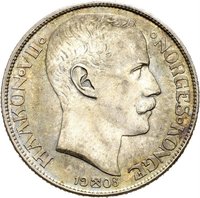
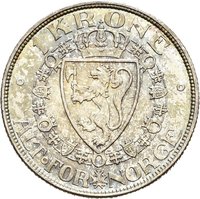
Series: 1908 Norway circulation coins
🌱 Very Common