

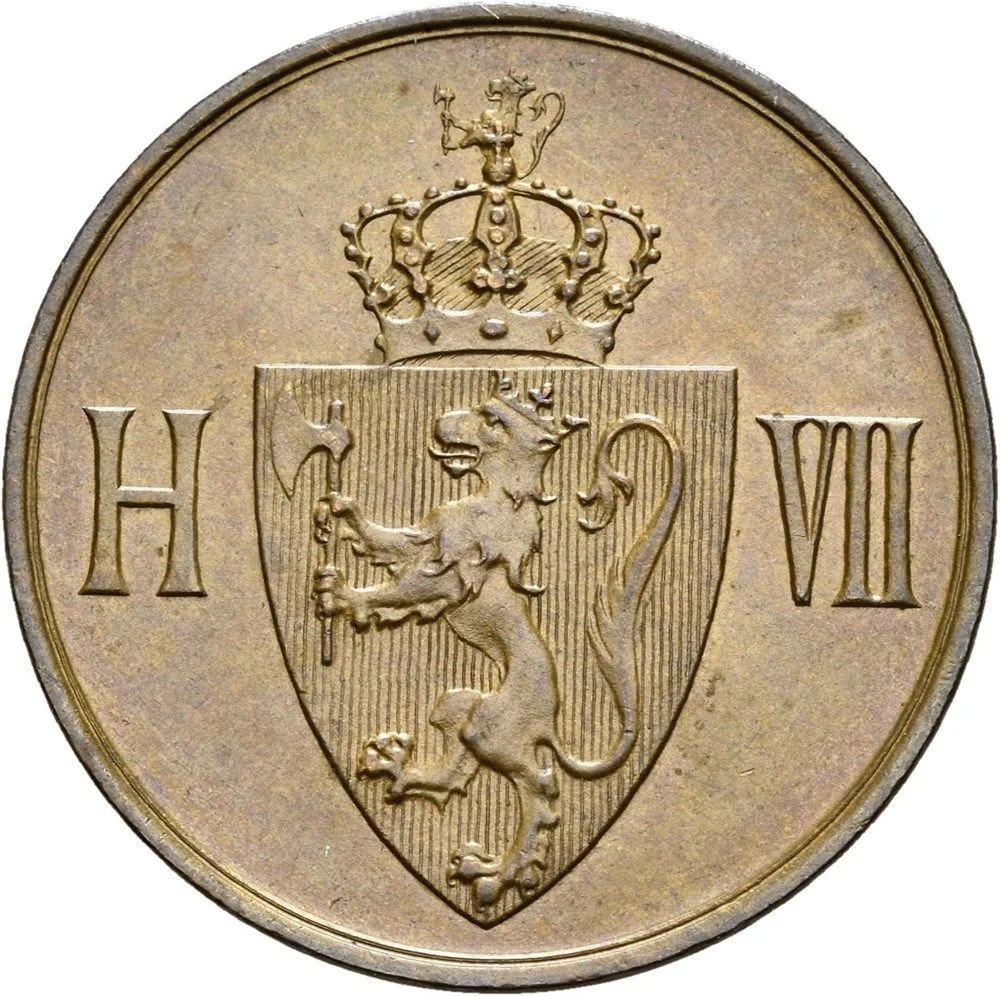
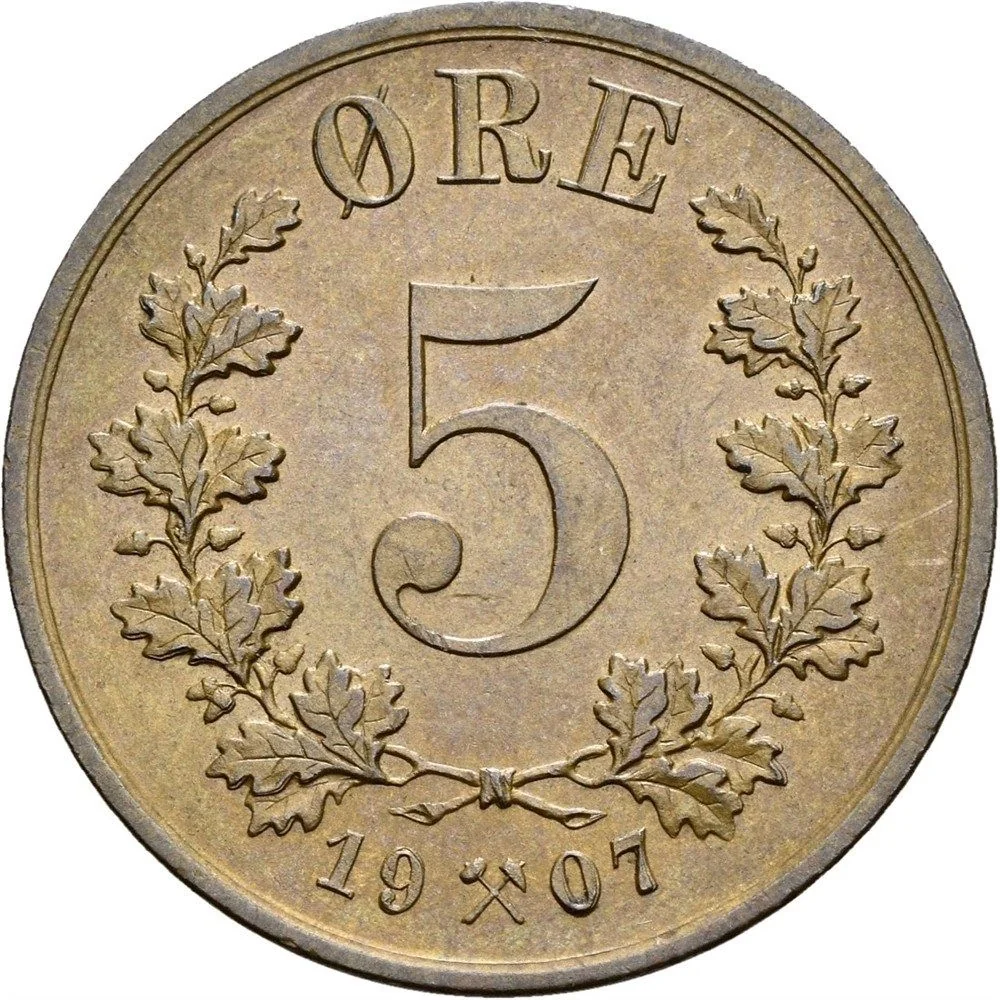
5 øre – Norway
Add to wishlist
Norway
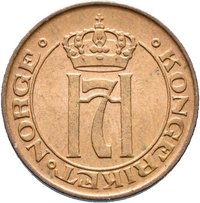
Obverse
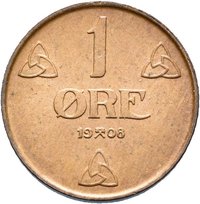
Reverse
Edge
Plain
Mints
| Name | Mark |
|---|---|
| Norwegian Mint | — |
Mintings
| Year | Mint Mark | Mintage | Quality | Collection |
|---|---|---|---|---|
| 1907 | — | 200,000 |
Historical background
In 1907, Norway's currency situation was defined by its membership in the Scandinavian Monetary Union (SMU), established with Sweden in 1875 and joined by Denmark in 1873. This union created a common gold standard, where the Norwegian krone was pegged to gold and was legally interchangeable with the Swedish krona and Danish krone at par value. The system facilitated seamless cross-border trade and monetary stability, with coins circulating freely across all three nations. By 1907, the union was functioning smoothly in practice, though the formal treaty had not been renewed since its initial expiration in 1905, the year of Norway's peaceful dissolution of its union with Sweden.
Domestically, Norway's currency was managed by Norges Bank, the central bank, which was obligated to exchange banknotes for gold upon demand. This gold anchor provided strong confidence in the krone's value and controlled inflation. However, the system's rigidity also meant the country's money supply and interest rates were heavily influenced by international gold flows and economic conditions in its SMU partners. The period was one of economic expansion and heavy investment in Norway's industrial infrastructure, particularly hydroelectric power, which required a stable and reliable currency to attract foreign capital.
Despite the outward stability, underlying strains were present. The monetary union lacked a central governing body or mechanisms to coordinate policy during crises. Furthermore, the political separation from Sweden in 1905 introduced an element of uncertainty about the long-term viability of the shared monetary arrangement. While 1907 itself was not a year of crisis, these structural weaknesses would later be exposed during World War I, when all three nations suspended gold convertibility, effectively ending the practical function of the union. Thus, 1907 represents the twilight of a seemingly robust and integrated system, operating on inherited trust and soon to be challenged by a new century's geopolitical and economic upheavals.
Domestically, Norway's currency was managed by Norges Bank, the central bank, which was obligated to exchange banknotes for gold upon demand. This gold anchor provided strong confidence in the krone's value and controlled inflation. However, the system's rigidity also meant the country's money supply and interest rates were heavily influenced by international gold flows and economic conditions in its SMU partners. The period was one of economic expansion and heavy investment in Norway's industrial infrastructure, particularly hydroelectric power, which required a stable and reliable currency to attract foreign capital.
Despite the outward stability, underlying strains were present. The monetary union lacked a central governing body or mechanisms to coordinate policy during crises. Furthermore, the political separation from Sweden in 1905 introduced an element of uncertainty about the long-term viability of the shared monetary arrangement. While 1907 itself was not a year of crisis, these structural weaknesses would later be exposed during World War I, when all three nations suspended gold convertibility, effectively ending the practical function of the union. Thus, 1907 represents the twilight of a seemingly robust and integrated system, operating on inherited trust and soon to be challenged by a new century's geopolitical and economic upheavals.
🌱 Fairly Common