

5 cents – Canada
Add to wishlist
Circulating commemorative coins
Commemoration: Supporting the War Effort
Canada
Context
Material
Diameter: 21.23 mm
Weight: 4.54 g
Thickness: 1.7 mm
Shape: Dodecagonal
Technique: Milled
Alignment: Medal alignment
flip
References
KM: #
Numista: #410
Value
Exchange value: 0.05 CAD
Inflation-adjusted value: 0.90 CAD
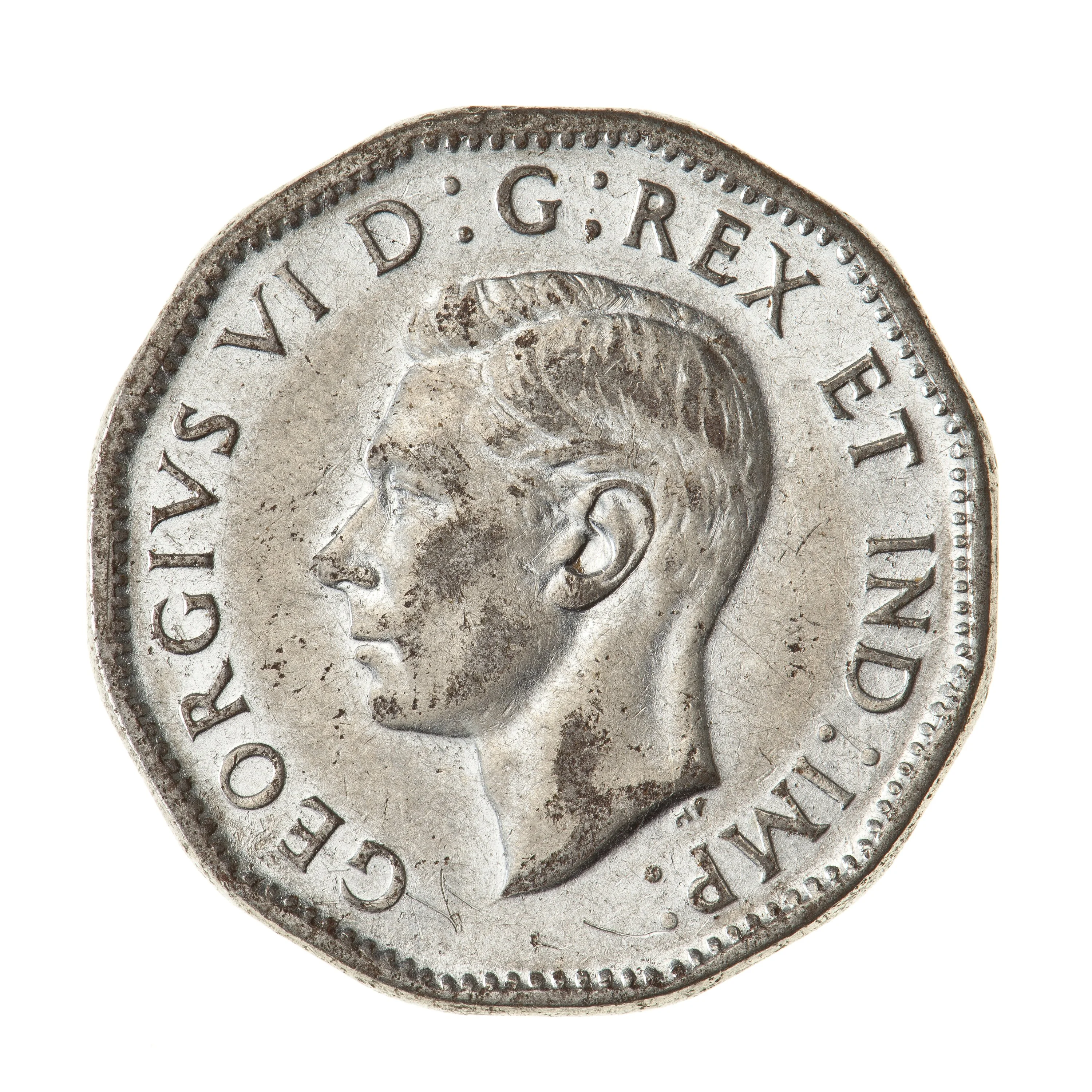
Obverse
Description:
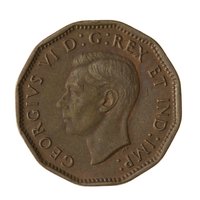
King George VI left-facing portrait.
Inscription:
GEORGIVS VI D:G:REX ET IND:IMP:
HP
HP
Translation:
George VI by the Grace of God King and Emperor of India.
Script: Latin
Language: Latin
Engraver: Thomas Shingles
Designer: Thomas Humphrey Paget
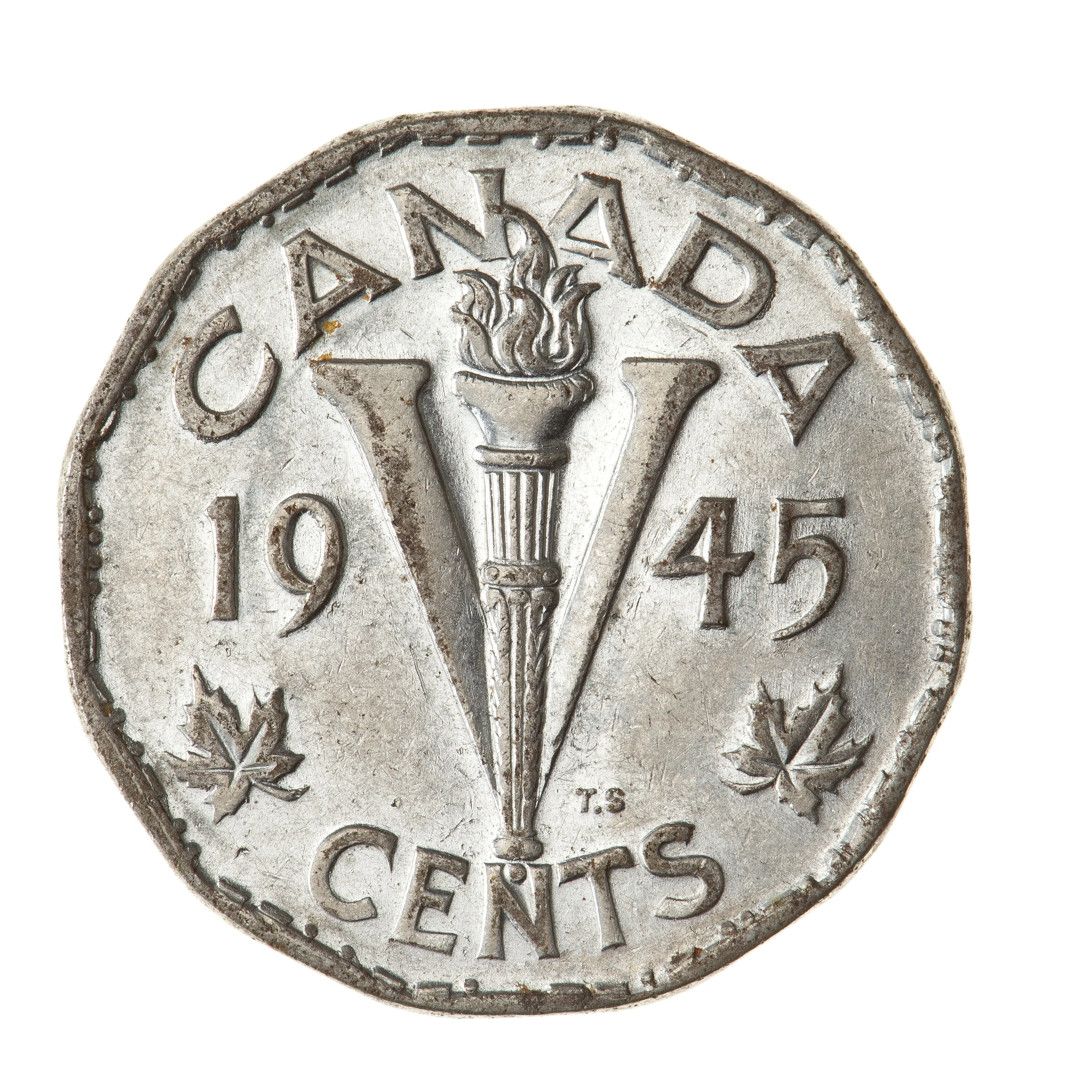
Reverse
Description:
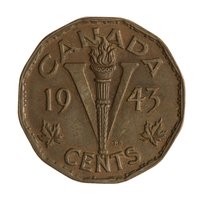
This design promotes the war effort with a central "V" for victory and value, flanked by maple leaves and a torch. It includes the year and country name, with a Morse code message around the rim.
Inscription:
CANADA
19 V 44
CENTS
T.S
.-- . .-- .. -. .-- .... . -. .-- . .-- --- .-. -.- .-- .. .-.. .-.. .. -. --. .-.. -.--
19 V 44
CENTS
T.S
.-- . .-- .. -. .-- .... . -. .-- . .-- --- .-. -.- .-- .. .-.. .-.. .. -. --. .-.. -.--
Translation:
CANADA
19 V 44
CENTS
T.S
WE WIN WHEN WE WORK WILLINGLY
19 V 44
CENTS
T.S
WE WIN WHEN WE WORK WILLINGLY
Designer: Thomas Shingles
Edge
Plain
Mints
| Name | Mark |
|---|---|
| Royal Canadian Mint of Ottawa | — |
Mintings
| Year | Mint Mark | Mintage | Quality | Collection |
|---|---|---|---|---|
| 1944 | — | 11,532,784 | ||
| 1945 | — | 18,893,216 |
Historical background
In 1944, Canada’s currency situation was fundamentally shaped by the extraordinary pressures of total war. The nation’s economy was under strict federal control, operating under the War Measures Act and guided by the Wartime Prices and Trade Board. To prevent the inflation that had plagued the First World War, a comprehensive system of wage and price controls had been implemented in 1941, successfully stabilizing the cost of living. This control, combined with rationing of key goods, meant that the purchasing power and circulation of Canadian dollars were heavily managed, with the primary economic goal being to direct maximum resources toward the Allied war effort.
Financially, the war was being funded through a mix of high taxation, domestic war bond campaigns (notably "Victory Bonds"), and careful monetary policy. The Bank of Canada, nationalized in 1938, maintained low interest rates to keep government borrowing costs manageable. Crucially, Canada's foreign exchange was under a fixed regime, with the Canadian dollar pegged at a value of 90.9 U.S. cents (or US$0.909) since September 1939. This "fixed peg" was maintained by the Foreign Exchange Control Board, established that same year, which held a monopoly over all foreign currency transactions to conserve U.S. dollar reserves for essential war purchases.
Looking ahead, 1944 was a year of planning for the postwar monetary order. Canadian officials, including the influential Deputy Minister of Finance, W. C. Clark, and his deputy, John Deutsch, were actively involved in the international Bretton Woods Conference in July. There, Canada helped shape the agreements that would establish the International Monetary Fund and the World Bank, committing to a system of fixed but adjustable exchange rates. While the wartime peg to the U.S. dollar would remain until 1946, the groundwork was being laid for Canada's future, more independent, and sometimes volatile, approach to currency valuation in the coming decades.
Financially, the war was being funded through a mix of high taxation, domestic war bond campaigns (notably "Victory Bonds"), and careful monetary policy. The Bank of Canada, nationalized in 1938, maintained low interest rates to keep government borrowing costs manageable. Crucially, Canada's foreign exchange was under a fixed regime, with the Canadian dollar pegged at a value of 90.9 U.S. cents (or US$0.909) since September 1939. This "fixed peg" was maintained by the Foreign Exchange Control Board, established that same year, which held a monopoly over all foreign currency transactions to conserve U.S. dollar reserves for essential war purchases.
Looking ahead, 1944 was a year of planning for the postwar monetary order. Canadian officials, including the influential Deputy Minister of Finance, W. C. Clark, and his deputy, John Deutsch, were actively involved in the international Bretton Woods Conference in July. There, Canada helped shape the agreements that would establish the International Monetary Fund and the World Bank, committing to a system of fixed but adjustable exchange rates. While the wartime peg to the U.S. dollar would remain until 1946, the groundwork was being laid for Canada's future, more independent, and sometimes volatile, approach to currency valuation in the coming decades.
🌱 Very Common