

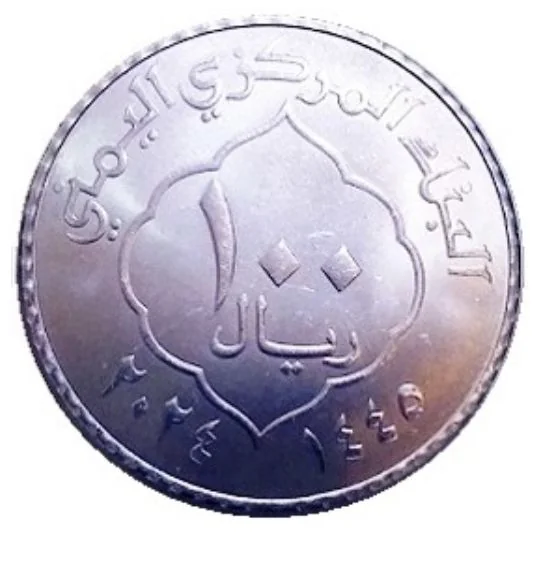

100 rials – Yemen
Add to wishlist
Yemen
Context
Year: 2024
Islamic (Hijri) Year:: 1445
Issuer: Yemen
Issuing organization: Central Bank of Yemen
Period:
(since 1990)
Currency:
(since 1990)
Material


References
Numista: #408843
Value
Exchange value: 100 YER
Obverse
Reverse
Edge
Reeded
Mints
| Name | Mark |
|---|---|
| Tehran | — |
Mintings
| Year | Mint Mark | Mintage | Quality | Collection |
|---|---|---|---|---|
| 2024 | — | — |
Historical background
In 2024, Yemen remains trapped in a severe and complex currency crisis, a direct consequence of nearly a decade of civil war and the country's de facto partition. The nation operates with two competing currencies: the internationally recognized Yemeni rial (YER), printed by the Aden-based central bank loyal to the Saudi-backed Presidential Leadership Council, and the rival Yemeni rial issued by the Houthi-controlled central bank in Sana'a. This parallel issuance, without coordination, has led to a massive oversupply of banknotes, fueling hyperinflation and a catastrophic depreciation of the currency, particularly in Houthi-held areas where the rial has lost over 90% of its pre-war value.
The economic divide is stark. In the south, the Aden-based authority struggles with depleted foreign reserves, limited revenue from oil exports, and reliance on Saudi financial injections to stabilize its rial and fund essential imports. In the north, the Houthi authorities fund their administration by printing vast quantities of new currency without economic backing, leading to a vastly weaker exchange rate and making basic goods prohibitively expensive for ordinary citizens. This monetary fragmentation severely disrupts trade and payments within Yemen itself, crippling the already devastated economy and humanitarian situation.
International efforts, including a Saudi-led financial support package for the Aden government, provide only temporary relief. The fundamental drivers—the lack of a unified monetary authority, ongoing conflict, and the collapse of formal institutions—remain unaddressed. Consequently, in 2024, Yemenis continue to suffer from one of the world's worst humanitarian crises, with the currency collapse directly translating into widespread famine, collapsed public services, and a economy where foreign hard currency, rather than the national rial, is increasingly needed for survival.
The economic divide is stark. In the south, the Aden-based authority struggles with depleted foreign reserves, limited revenue from oil exports, and reliance on Saudi financial injections to stabilize its rial and fund essential imports. In the north, the Houthi authorities fund their administration by printing vast quantities of new currency without economic backing, leading to a vastly weaker exchange rate and making basic goods prohibitively expensive for ordinary citizens. This monetary fragmentation severely disrupts trade and payments within Yemen itself, crippling the already devastated economy and humanitarian situation.
International efforts, including a Saudi-led financial support package for the Aden government, provide only temporary relief. The fundamental drivers—the lack of a unified monetary authority, ongoing conflict, and the collapse of formal institutions—remain unaddressed. Consequently, in 2024, Yemenis continue to suffer from one of the world's worst humanitarian crises, with the currency collapse directly translating into widespread famine, collapsed public services, and a economy where foreign hard currency, rather than the national rial, is increasingly needed for survival.




✨ Legendary