

20 euro (Lithuania's accession to the European Union and NATO) – Lithuania
Add to wishlist
Non-circulating coins
Commemoration: 20th anniversary of Lithuania's accession to the European Union and NATO.
Lithuania
Context
Year: 2024
Issuer: Lithuania
Issuing organization: Bank of Lithuania
Period:
(1918—1940)
Currency:
(since 2015)
Total mintage: 2,000
Material
References
KM: #
Numista: #407659
Value
Exchange value: 20 EUR
Bullion value: $65.55
Inflation-adjusted value: 20.30 EUR
Obverse
Description:
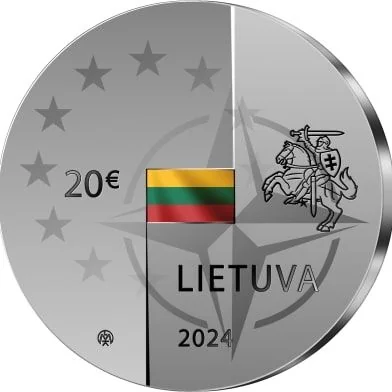
The central flag is encircled by Lithuania's Vytis coat of arms and inscriptions, with fragmented NATO and EU symbols in the background at varying relief levels.
Inscription:
20 €
LIETUVA
2024
LMK
LIETUVA
2024
LMK
Translation:
Lithuania
20 Euro
2024
Lithuanian Mint (LMK)
20 Euro
2024
Lithuanian Mint (LMK)
Script: Latin
Language: Lithuanian
Designer: Antanas Pocevičius
Reverse
Description:
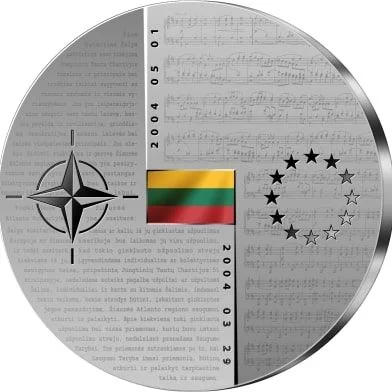
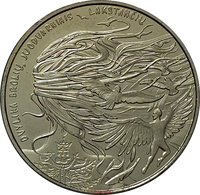
The flag is flanked by NATO and EU symbols with Lithuania's accession dates (29 March and 1 May 2004). The background features Article 5 in microtext and the musical notes of the EU anthem, *Ode to Joy*.
Inscription:
2004 03 29
2004 05 01
2004 05 01
Script: Latin
Designer: Antanas Pocevičius
Edge
Plain
Mints
| Name | Mark |
|---|---|
| Lithuanian Mint | — |
Mintings
| Year | Mint Mark | Mintage | Quality | Collection |
|---|---|---|---|---|
| 2024 | — | 2,000 |
Historical background
In 2024, Lithuania remains a fully integrated member of the Eurozone, having adopted the euro as its official currency on January 1, 2015. This move replaced the former national currency, the litas, which had been pegged to the euro since 2002. Consequently, the country's monetary policy is set by the European Central Bank (ECB), aligning Lithuania's financial stability and interest rates with the broader Eurozone framework. This integration provides benefits like reduced transaction costs, eliminated exchange rate risk within the Eurozone, and a strong symbol of Lithuania's commitment to the European project.
The primary domestic discussions around currency in 2024 are not about reverting to the litas—a move supported by only a small minority—but focus on the practical impacts of the ECB's policies. Like other Eurozone nations, Lithuania is navigating the aftermath of high inflation and the ECB's subsequent interest rate hikes. The key concerns for businesses and households are the cost of credit and the pace of disinflation, as the tight monetary policy aimed at curbing inflation also slows economic growth. These are shared Eurozone challenges, not unique Lithuanian ones.
Looking forward, Lithuania continues to actively participate in the development of the digital euro project, a key initiative for the future of the common currency. Domestically, financial technology and electronic payments are highly advanced, with a very high adoption rate of cashless transactions. Therefore, the "currency situation" is one of stable consolidation within the Eurozone, with national economic debate centered on fiscal policy, energy independence, and competitiveness, rather than on the currency itself, which is seen as a settled and foundational element of the modern Lithuanian economy.
The primary domestic discussions around currency in 2024 are not about reverting to the litas—a move supported by only a small minority—but focus on the practical impacts of the ECB's policies. Like other Eurozone nations, Lithuania is navigating the aftermath of high inflation and the ECB's subsequent interest rate hikes. The key concerns for businesses and households are the cost of credit and the pace of disinflation, as the tight monetary policy aimed at curbing inflation also slows economic growth. These are shared Eurozone challenges, not unique Lithuanian ones.
Looking forward, Lithuania continues to actively participate in the development of the digital euro project, a key initiative for the future of the common currency. Domestically, financial technology and electronic payments are highly advanced, with a very high adoption rate of cashless transactions. Therefore, the "currency situation" is one of stable consolidation within the Eurozone, with national economic debate centered on fiscal policy, energy independence, and competitiveness, rather than on the currency itself, which is seen as a settled and foundational element of the modern Lithuanian economy.

💎 Extremely Rare