


10 euro (Educational Commission of the Commonwealth of the Two Nations) – Lithuania
Add to wishlist
Non-circulating coins
Commemoration: 250th Anniversary of the Educational Commission of the Commonwealth of the Two Nations
Lithuania
Context
Material

References
KM: #
Numista: #379294
Value
Exchange value: 10 EUR
Bullion value: $52.31
Inflation-adjusted value: 11.07 EUR
Obverse
Description:
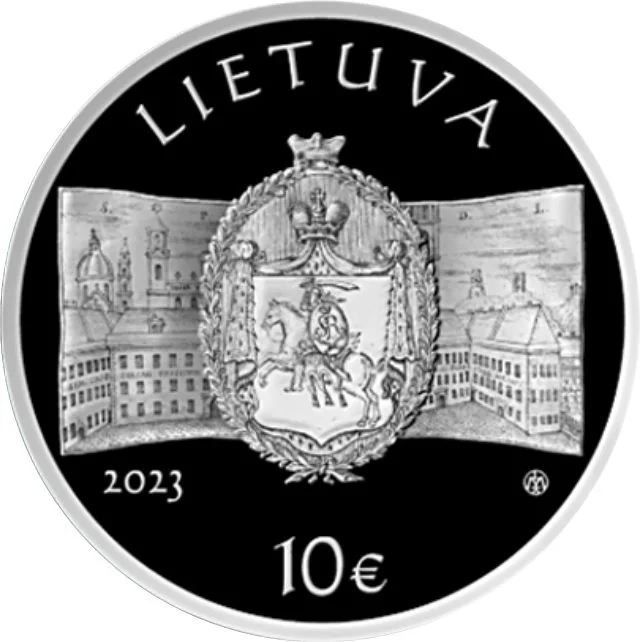
The obverse depicts Lithuania's coat of arms (Vytis) over a 1780s engraving of Vilnius University, with "Lietuva," €10, 2023, and the Lithuanian Mint mark.
Inscription:
LIETUVA
2023
10 €
2023
10 €
Translation:
LIETUVA
2023
10 €
2023
10 €
Script: Latin
Languages: Lithuanian, English
Designer: Giedrius Paulauskis
Reverse
Description:
The reverse features the seal of the Educational Commission of the Commonwealth of the Two Nations, with its Latin inscription, and a symbolic book based on a 1783 textbook from its reformed printing house. It includes the Commission's Lithuanian quote: “…jaunų žmonių lavinimas ir švietimas – vienintelė tvarios valstybių laimės sąlyga”. The surrounding inscription reads “Abiejų Tautų Respublikos Edukacinė komisija” and “250”.
Inscription:
ABIEJŲ TAUTŲ RESPUBLIKOS EDUKACINĖ KOMISIJA • 250
Translation:
ABIEJŲ TAUTŲ RESPUBLIKOS EDUKACINĖ KOMISIJA • 250
Educational Commission of the Republic of Both Nations • 250
Educational Commission of the Republic of Both Nations • 250
Script: Latin
Language: Lithuanian
Designer: Giedrius Paulauskis
Edge
1773 and a laurel branch as a separator
Legend:
1773
Categories
| Building |
| Education |
| Symbols> Coat of Arms |
Mints
| Name | Mark |
|---|---|
| Lithuanian Mint | (LMK) |
Mintings
| Year | Mint Mark | Mintage | Quality | Collection |
|---|---|---|---|---|
| 2023 | LMK | 3,000 | Proof |
Historical background
In 2023, Lithuania's currency situation was firmly anchored within the Eurozone, having adopted the euro on January 1, 2015. As a result, the country no longer had an independent monetary policy or a national currency (the former litas), with the European Central Bank (ECB) setting interest rates and overseeing price stability for the entire bloc. Lithuania's economic performance and currency stability were therefore directly tied to the euro's strength and the ECB's policy decisions, particularly its efforts to combat high inflation through a series of interest rate hikes throughout 2022 and 2023.
The primary domestic focus regarding currency was not on exchange rates but on inflation, which remained a significant economic challenge. While inflation in Lithuania peaked in 2022 and began to moderate in 2023, it consistently remained among the highest in the Eurozone. This was driven by persistent factors like elevated energy prices, strong wage growth, and robust domestic demand. Consequently, the real effective exchange rate—a measure of price competitiveness—was a point of attention, as high inflation risked making Lithuanian goods and services relatively more expensive.
Financially, 2023 was a landmark year as Lithuania solidified its position as a leading European hub for fintech, particularly with the widespread use of electronic money (e-money) institutions. The Bank of Lithuania reported that the total value of payments handled by Lithuanian-licensed e-money institutions surpassed that of traditional banks. This digital finance boom, while separate from the physical euro currency, represented a dynamic and growing segment of the nation's financial landscape, operating within the secure framework of the single currency.
The primary domestic focus regarding currency was not on exchange rates but on inflation, which remained a significant economic challenge. While inflation in Lithuania peaked in 2022 and began to moderate in 2023, it consistently remained among the highest in the Eurozone. This was driven by persistent factors like elevated energy prices, strong wage growth, and robust domestic demand. Consequently, the real effective exchange rate—a measure of price competitiveness—was a point of attention, as high inflation risked making Lithuanian goods and services relatively more expensive.
Financially, 2023 was a landmark year as Lithuania solidified its position as a leading European hub for fintech, particularly with the widespread use of electronic money (e-money) institutions. The Bank of Lithuania reported that the total value of payments handled by Lithuanian-licensed e-money institutions surpassed that of traditional banks. This digital finance boom, while separate from the physical euro currency, represented a dynamic and growing segment of the nation's financial landscape, operating within the secure framework of the single currency.


💎 Very Rare