

25 pesos (D. Faustino Sarmiento) – Argentina
Add to wishlist
Circulating commemorative coins
Commemoration: 80th Anniversary of the Death of D. Faustino Sarmiento
Argentina
Context
Year: 1968
Issuer: Argentina
Period:
(since 1861)
Currency:
(1881—1969)
Demonetization: 1 January 1970
Total mintage: 15,804,390
Material
Diameter: 25.5 mm
Weight: 6.5 g
Thickness: 2 mm
Shape: Dodecagonal
Technique: Milled
Alignment: Coin alignment
flip
References
KM: #
Numista: #5226
Value
Exchange value: 25 ARM
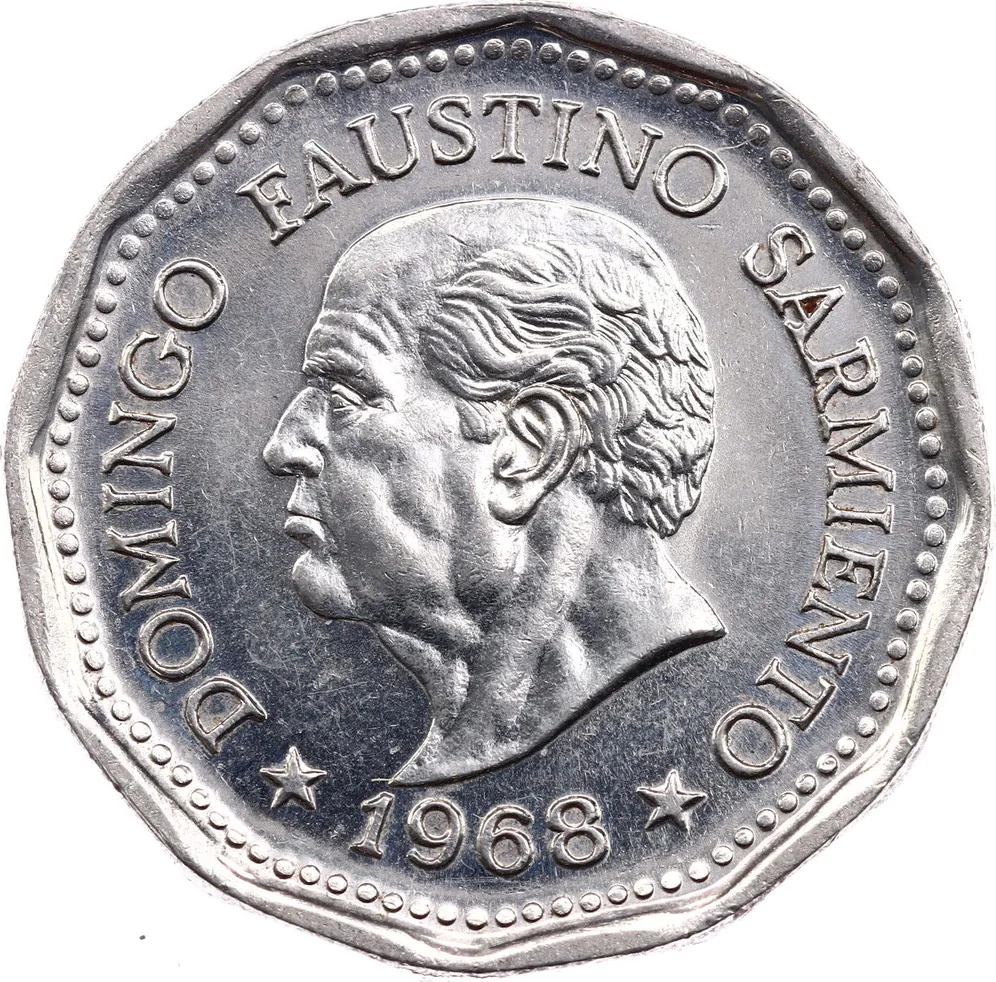
Obverse
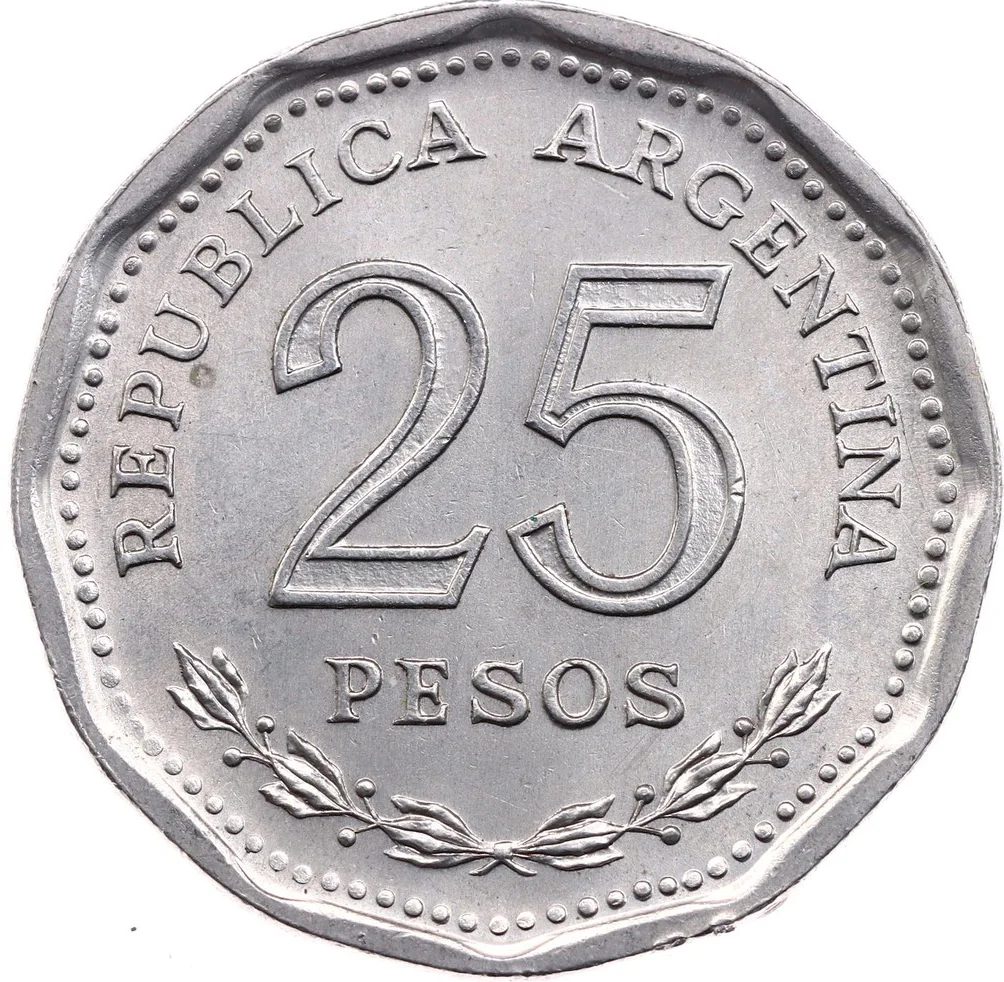
Reverse
Description:
Sarmiento's head left, date below.
Inscription:
DOMINGO FAUSTINO SARMIENTO
★ 1968 ★
★ 1968 ★
Script: Latin
Edge
Plain
Categories
| Event> Death anniversary |
| Person> Politician |
| Symbol> Wreath |
Mintings
| Year | Mint Mark | Mintage | Quality | Collection |
|---|---|---|---|---|
| 1968 | — | 15,804,390 |
Historical background
In 1968, Argentina's currency situation was characterized by the persistent instability and economic distortions that had come to define the peso moneda nacional under the military dictatorship of General Juan Carlos Onganía, who had seized power in 1966. The regime maintained a fixed and overvalued exchange rate, a policy intended to control inflation but which created severe imbalances. This overvaluation discouraged exports, made imports artificially cheap, and led to chronic trade deficits. To defend the unsustainable peg, the government relied heavily on foreign borrowing and dwindling reserves, while employing a complex system of multiple exchange rates and stringent capital controls to manage the scarcity of foreign currency.
Underneath this controlled facade, inflationary pressures—a deep-rooted structural issue in Argentina—continued to simmer. While the official exchange rate was fixed at 350 pesos per US dollar, a thriving black market for dollars (the mercado paralelo) operated at a significant premium, revealing a widespread lack of confidence in the peso and the government's economic management. This period was part of a longer cycle of "stop-and-go" economics, where periods of austerity and fixed rates (the "stop") temporarily stabilized prices at the cost of recession, only to set the stage for future balance-of-payments crises and devaluations (the "go").
Consequently, 1968 represented a calm before the storm within a deteriorating long-term trend. The rigid controls and overvaluation of the Onganía period suppressed immediate crises but worsened underlying fiscal and trade weaknesses. These accumulated distortions would eventually become unmanageable, contributing to the severe economic and political turmoil that marked the early 1970s, including major devaluations and the eventual return of Peronist policies. Thus, the currency regime of 1968 was a fragile artifact of authoritarian control, masking the profound structural problems that continued to erode the Argentine economy.
Underneath this controlled facade, inflationary pressures—a deep-rooted structural issue in Argentina—continued to simmer. While the official exchange rate was fixed at 350 pesos per US dollar, a thriving black market for dollars (the mercado paralelo) operated at a significant premium, revealing a widespread lack of confidence in the peso and the government's economic management. This period was part of a longer cycle of "stop-and-go" economics, where periods of austerity and fixed rates (the "stop") temporarily stabilized prices at the cost of recession, only to set the stage for future balance-of-payments crises and devaluations (the "go").
Consequently, 1968 represented a calm before the storm within a deteriorating long-term trend. The rigid controls and overvaluation of the Onganía period suppressed immediate crises but worsened underlying fiscal and trade weaknesses. These accumulated distortions would eventually become unmanageable, contributing to the severe economic and political turmoil that marked the early 1970s, including major devaluations and the eventual return of Peronist policies. Thus, the currency regime of 1968 was a fragile artifact of authoritarian control, masking the profound structural problems that continued to erode the Argentine economy.
🌱 Very Common