

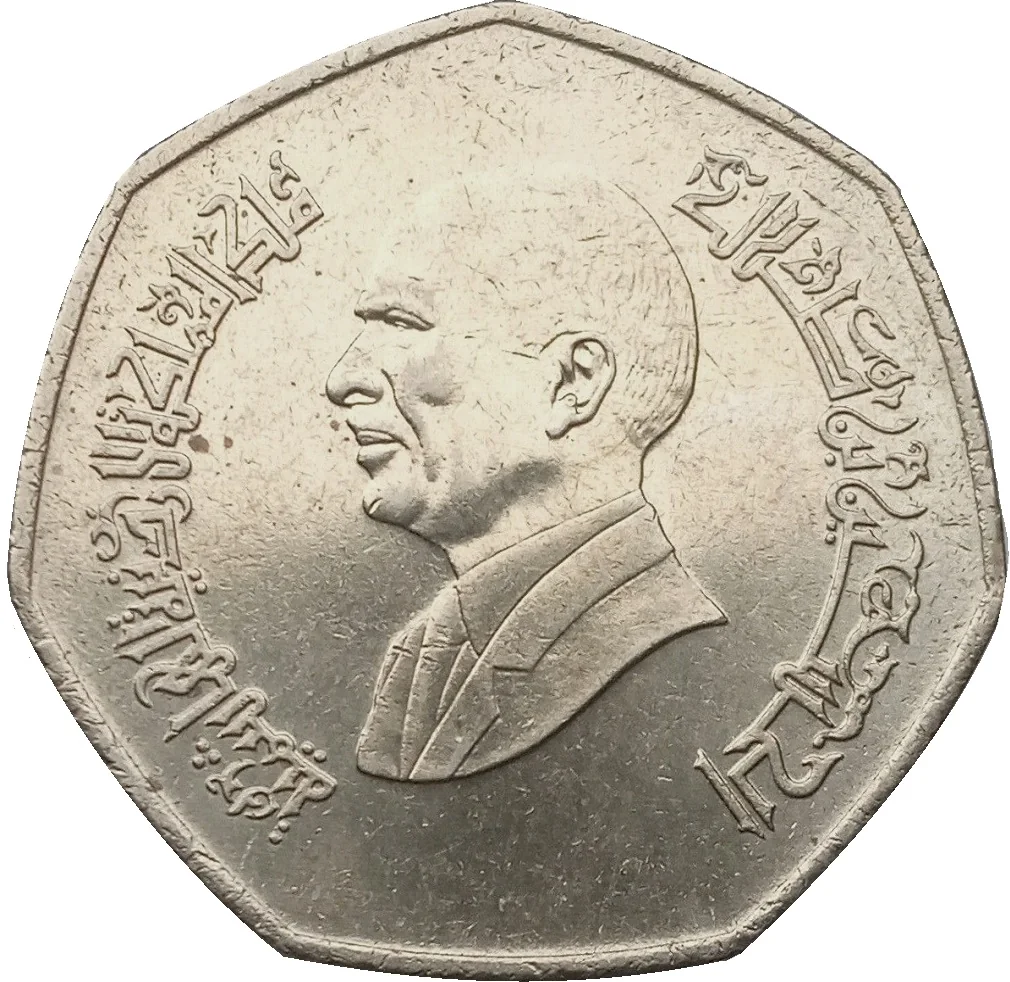
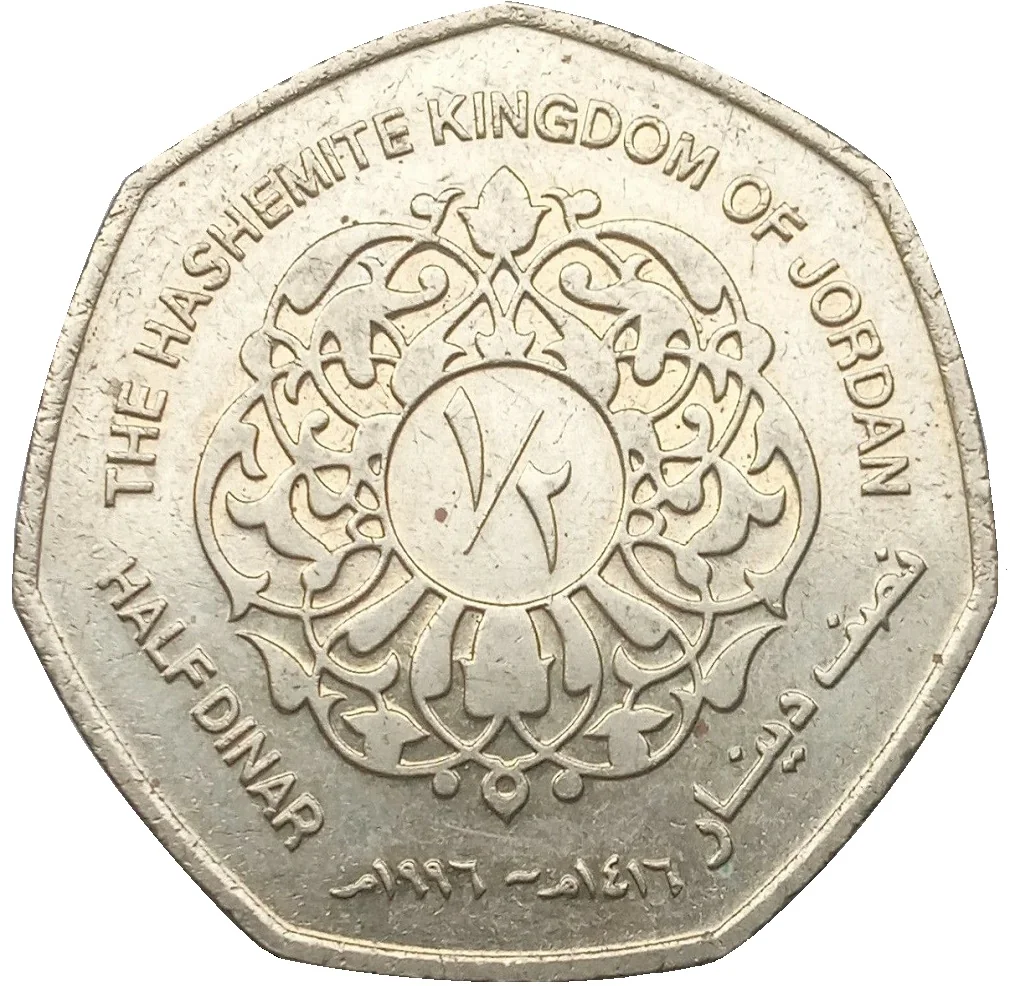
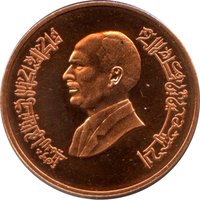
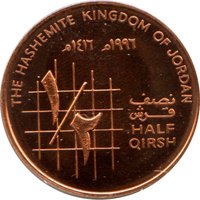
½ dinar – Jordan
Add to wishlist
Jordan
Context
Year: 1996
Islamic (Hijri) Year:: 1416
Issuer: Jordan
Ruler: Hussein bin Talal
Currency:
(since 1949)
Total mintage: 3,000
Material
Diameter: 29 mm
Weight: 9.68 g
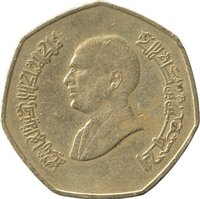
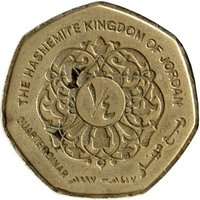
Shape: Equilateral curve heptagon
Composition: Brass
Magnetic: No
Technique: Milled
Alignment: Medal alignment
flip
References
KM: #
Numista: #3942
Value
Exchange value: ½ JOD
Obverse
Edge
Plain
Categories
| Person> Monarch |
| Mustache/Beard |
Mints
| Name | Mark |
|---|---|
| Royal Mint | — |
Mintings
| Year | Mint Mark | Mintage | Quality | Collection |
|---|---|---|---|---|
| 1996 | — | — | ||
| 1996 | — | 3,000 | Proof |
Historical background
In 1996, Jordan's currency, the dinar (JOD), was a notable pillar of stability in a region often marked by economic volatility. This stability was primarily the result of a firm peg to the U.S. dollar, established in 1995 at a fixed rate of approximately 1 JOD = 1.410 USD. This policy, championed by King Hussein's government and the Central Bank of Jordan, was a strategic tool to curb inflation, attract foreign investment, and provide a predictable environment for trade following the economic turbulence of the late 1980s.
However, this stability came at a significant cost. The strong, fixed dinar made Jordanian exports more expensive and less competitive internationally, exacerbating a persistent trade deficit. The economy faced pressure from high public debt, a burdensome public sector wage bill, and reliance on remittances and foreign aid, particularly following the 1994 peace treaty with Israel which altered regional grant dynamics. While the peg successfully controlled inflation, it limited the central bank's ability to use monetary policy to stimulate growth or address unemployment.
Overall, the 1996 currency situation reflected a deliberate trade-off: Jordan prioritized monetary credibility and price stability over exchange rate flexibility. The dinar's strength was a symbol of national pride and economic discipline, but it also highlighted underlying structural challenges. The economy was navigating a difficult transition, with the fixed exchange rate acting as both an anchor for confidence and a constraint on addressing chronic trade imbalances and fostering private sector-led growth.
However, this stability came at a significant cost. The strong, fixed dinar made Jordanian exports more expensive and less competitive internationally, exacerbating a persistent trade deficit. The economy faced pressure from high public debt, a burdensome public sector wage bill, and reliance on remittances and foreign aid, particularly following the 1994 peace treaty with Israel which altered regional grant dynamics. While the peg successfully controlled inflation, it limited the central bank's ability to use monetary policy to stimulate growth or address unemployment.
Overall, the 1996 currency situation reflected a deliberate trade-off: Jordan prioritized monetary credibility and price stability over exchange rate flexibility. The dinar's strength was a symbol of national pride and economic discipline, but it also highlighted underlying structural challenges. The economy was navigating a difficult transition, with the fixed exchange rate acting as both an anchor for confidence and a constraint on addressing chronic trade imbalances and fostering private sector-led growth.
🌱 Fairly Common