

1 qirsh – Jordan
Add to wishlist
Jordan
Context
Years: 1994–1996
Issuer: Jordan
Ruler: Hussein bin Talal
Currency:
(since 1949)
Total mintage: 3,000
Material
References
KM: #
Numista: #6587
Value
Exchange value: 0.01 JOD
Obverse
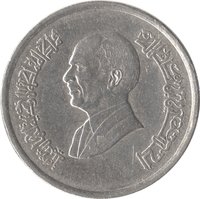
Description:
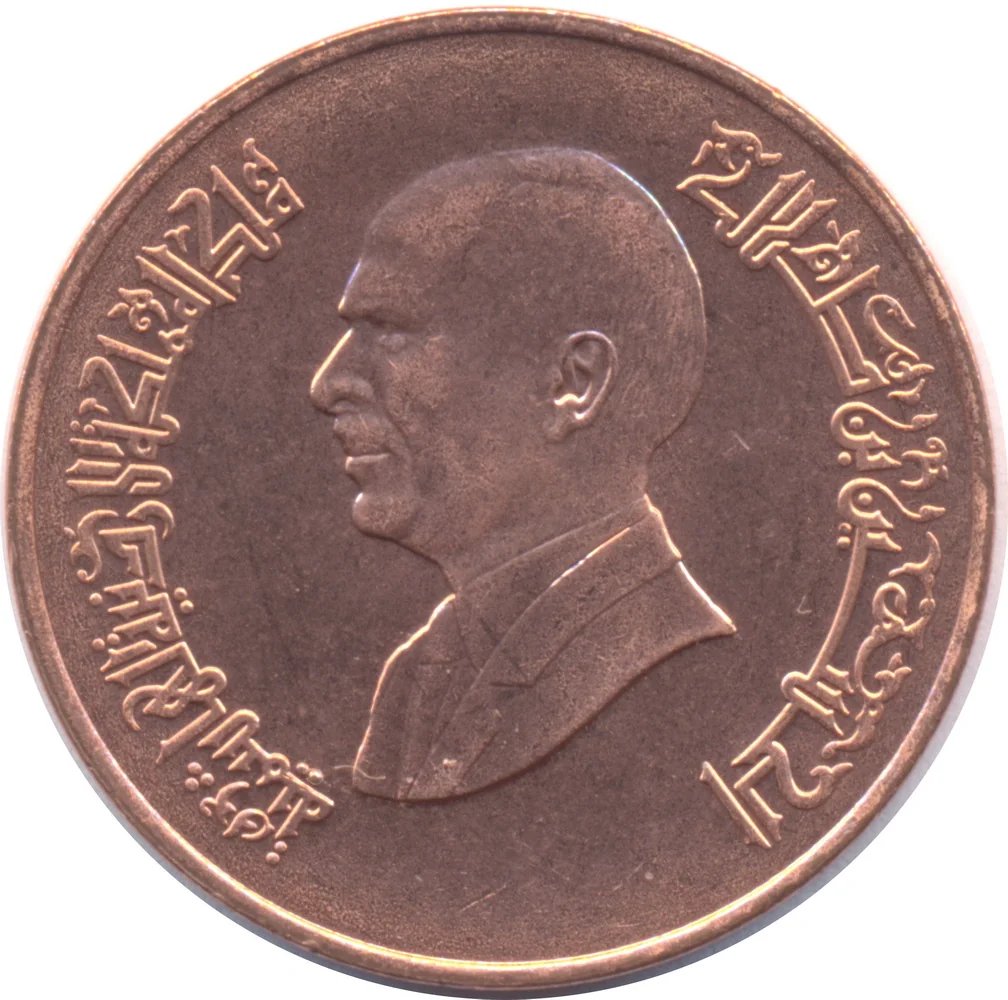
King Hussein I, profile left
Inscription:
الحسين بن طلال
ملك المملكة الأردنية الهاشمية
ملك المملكة الأردنية الهاشمية
Translation:
Hussein bin Talal
King of the Hashemite Kingdom of Jordan
King of the Hashemite Kingdom of Jordan
Language: Arabic
Reverse
Edge
Plain
Categories
| Person> Monarch |
| Mustache/Beard |
Mints
| Name | Mark |
|---|---|
| Royal Mint | — |
Mintings
| Year | Mint Mark | Mintage | Quality | Collection |
|---|---|---|---|---|
| 1994 | — | — | ||
| 1996 | — | 3,000 | Proof | |
| 1996 | — | — |
Historical background
In 1994, Jordan's currency, the dinar (JOD), was in a period of notable stability, a significant achievement given the regional and domestic economic challenges of the preceding years. This stability was underpinned by a firm peg to the U.S. dollar, established in late 1990, which replaced a previous basket peg. The fixed exchange rate of approximately 0.709 dinars per dollar (or 1 USD = 1.41 JOD) was a cornerstone of monetary policy, managed by the Central Bank of Jordan (CBJ). Its primary purpose was to anchor inflation, attract foreign investment, and provide predictability for trade, which was crucial for an import-dependent economy.
This monetary stability, however, existed alongside persistent macroeconomic difficulties. The country was grappling with the aftermath of the 1990-91 Gulf War, which had resulted in the loss of vital remittances and aid from Gulf states, a refugee influx, and disrupted trade routes. Consequently, Jordan carried a heavy burden of external debt and faced pressures on its foreign currency reserves. The government, under an ongoing structural adjustment program with the International Monetary Fund (IMF), was implementing austerity measures and economic reforms aimed at reducing deficits, liberalizing trade, and privatizing state-owned enterprises, all of which had complex social and economic repercussions.
Therefore, the 1994 currency situation presented a dual narrative: a successfully maintained strong and stable dinar externally, which bolstered confidence, contrasted with underlying internal economic strains. The peg was a critical tool for preventing currency crisis and hyperinflation, but it also limited monetary policy options for stimulating growth. The government's challenge was to continue its fiscal consolidation and reform agenda to support the currency peg over the long term, without which the stability of 1994 would have been unsustainable.
This monetary stability, however, existed alongside persistent macroeconomic difficulties. The country was grappling with the aftermath of the 1990-91 Gulf War, which had resulted in the loss of vital remittances and aid from Gulf states, a refugee influx, and disrupted trade routes. Consequently, Jordan carried a heavy burden of external debt and faced pressures on its foreign currency reserves. The government, under an ongoing structural adjustment program with the International Monetary Fund (IMF), was implementing austerity measures and economic reforms aimed at reducing deficits, liberalizing trade, and privatizing state-owned enterprises, all of which had complex social and economic repercussions.
Therefore, the 1994 currency situation presented a dual narrative: a successfully maintained strong and stable dinar externally, which bolstered confidence, contrasted with underlying internal economic strains. The peg was a critical tool for preventing currency crisis and hyperinflation, but it also limited monetary policy options for stimulating growth. The government's challenge was to continue its fiscal consolidation and reform agenda to support the currency peg over the long term, without which the stability of 1994 would have been unsustainable.
🌱 Very Common