

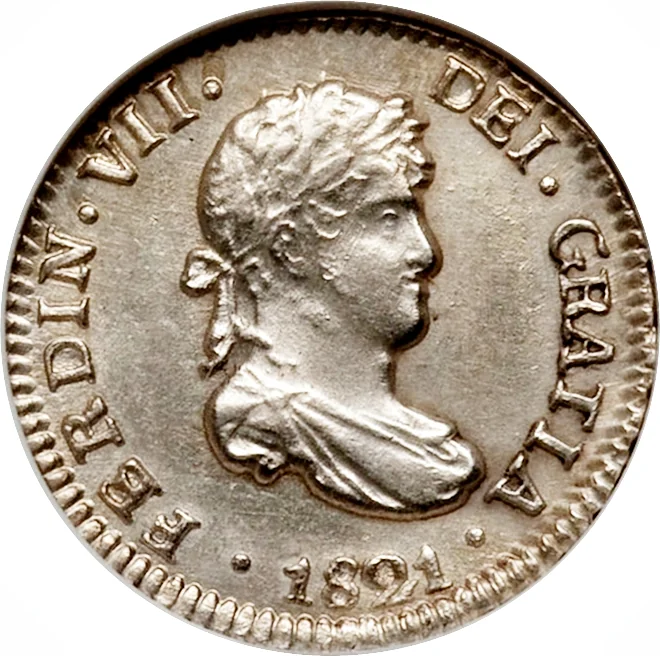
½ real – Bolivia
Add to wishlist
Bolivia
Context
Years: 1814–1825
Issuer: Bolivia
Ruler: Ferdinand VII
Currency:
(1574—1825)
Demonetized: Yes
Total mintage: 273,000
Material
References
KM: #
Numista: #39324
Value
Bullion value: $3.87
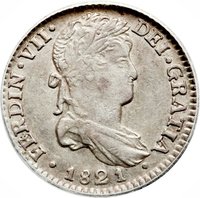
Obverse
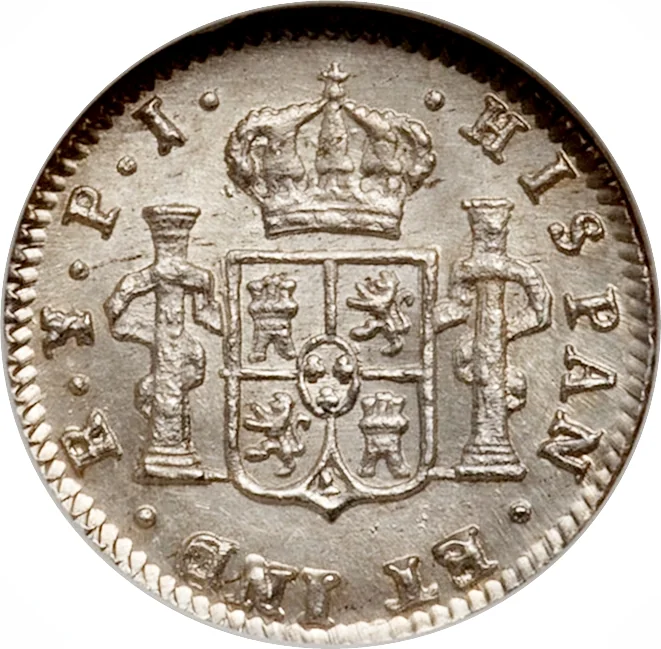
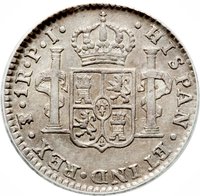
Reverse
Description:
Crowned arms flanked by pillars.
Inscription:
· HISPAN · ET IND · R · PTS · P · J ·
Script: Latin
Edge
Mintings
| Year | Mint Mark | Mintage | Quality | Collection |
|---|---|---|---|---|
| 1814 | PJ | — | ||
| 1815 | PJ | — | ||
| 1816 | PJ | 74,000 | ||
| 1817 | PJ | 93,000 | ||
| 1818 | PJ | 106,000 | ||
| 1819 | PJ | — | ||
| 1820 | PJ | — | ||
| 1821 | PJ | — | ||
| 1822 | PJ | — | ||
| 1823 | JL | — | ||
| 1823 | PJ | — | ||
| 1824 | PJ | — | ||
| 1825 | JL | — | ||
| 1825 | PJ | — |
Historical background
In 1814, Bolivia—then known as Upper Peru—was a central and chaotic theater in the Spanish American wars of independence. The region had seen significant uprisings since 1809, and by 1814, it was engulfed in the massive, though ultimately failed, Rebellion of the Republiquetas. This was a widespread insurgency led by local patriot leaders like Manuel Ascencio Padilla and Ignacio Warnes, who controlled scattered rural zones, while royalist forces held the major cities and silver mining centers like Potosí. The conflict severely disrupted the economic and administrative structures that had governed the region for centuries, placing immense strain on the existing monetary system.
The currency situation was defined by a severe shortage of circulating coinage and the coexistence of multiple, competing authorities minting money. The primary currency was still the Spanish colonial silver real, with the famous Potosí mint being a historic pillar of the global economy. However, production at Potosí was intermittently disrupted by the fighting. Both the royalist authorities, loyal to the Spanish Crown, and various patriot republiqueta leaders issued their own crude, emergency coinage to fund their military campaigns. This led to a landscape where coins of vastly different origins, intrinsic values, and legitimacy circulated simultaneously, causing confusion, inflation, and deep distrust in the monetary medium.
Consequently, the year 1814 represents a period of profound monetary fragmentation and instability. The collapse of centralized authority meant there was no single entity guaranteeing the value of currency. Transactions were often conducted through barter, especially in contested areas, while merchants and the public struggled to assess the worth of the mixed coinage in their possession. This financial chaos mirrored the broader political disintegration, underscoring how the war had shattered the colonial economic order, leaving a vacuum that would not be resolved until after independence in 1825, when Bolivia would establish its own national currency.
The currency situation was defined by a severe shortage of circulating coinage and the coexistence of multiple, competing authorities minting money. The primary currency was still the Spanish colonial silver real, with the famous Potosí mint being a historic pillar of the global economy. However, production at Potosí was intermittently disrupted by the fighting. Both the royalist authorities, loyal to the Spanish Crown, and various patriot republiqueta leaders issued their own crude, emergency coinage to fund their military campaigns. This led to a landscape where coins of vastly different origins, intrinsic values, and legitimacy circulated simultaneously, causing confusion, inflation, and deep distrust in the monetary medium.
Consequently, the year 1814 represents a period of profound monetary fragmentation and instability. The collapse of centralized authority meant there was no single entity guaranteeing the value of currency. Transactions were often conducted through barter, especially in contested areas, while merchants and the public struggled to assess the worth of the mixed coinage in their possession. This financial chaos mirrored the broader political disintegration, underscoring how the war had shattered the colonial economic order, leaving a vacuum that would not be resolved until after independence in 1825, when Bolivia would establish its own national currency.
⭐ Somewhat Rare