

1 øre – Norway
Add to wishlist
Norway
Context
Years: 1952–1957
Issuer: Norway
Ruler: Haakon VII
Currency:
(since 1875)
Demonetization: 1 January 1975
Total mintage: 51,180,000
Material
References
KM: #
Numista: #1432
Value
Exchange value: 0.01 NOK
Obverse
Description:
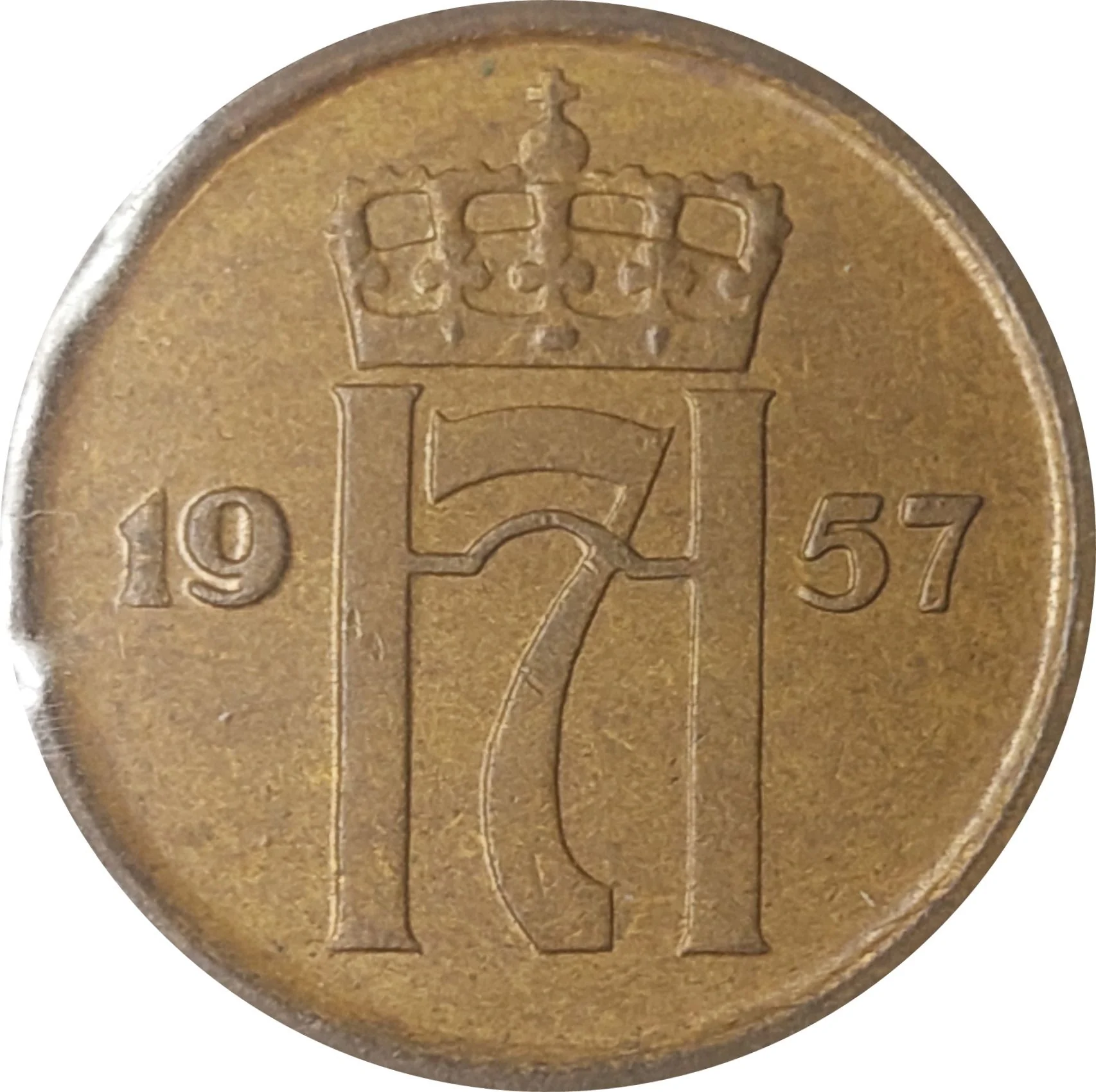
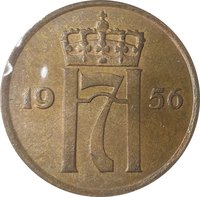
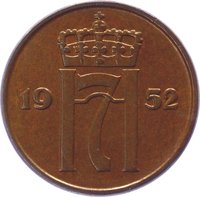
Haakon VII monogram crowns date, split by design. Solid rim ring.
Inscription:
19 | 53
H7
H7
Script: Latin
Reverse
Description:
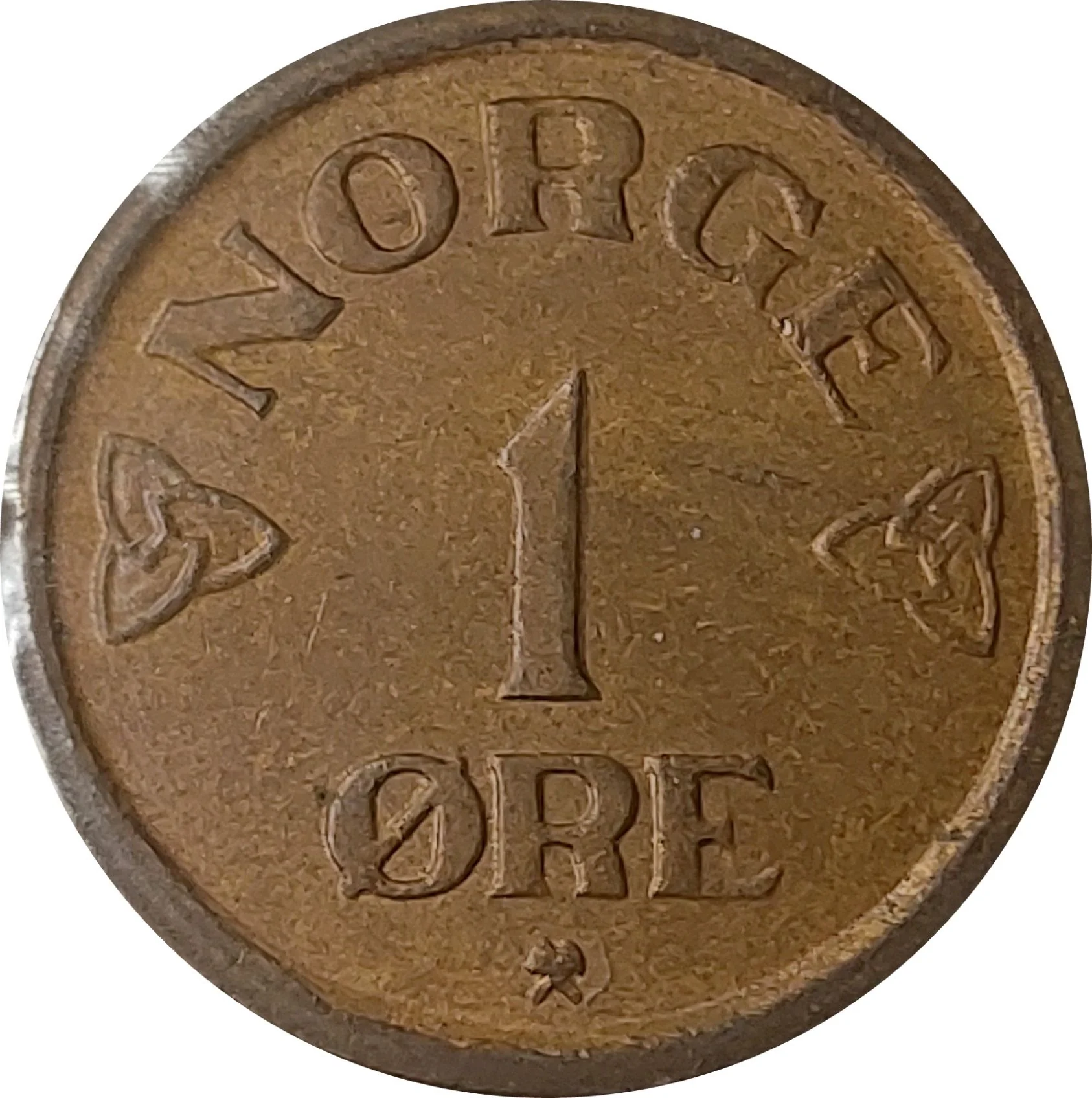
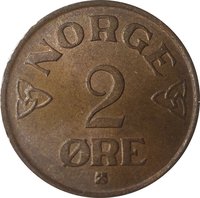
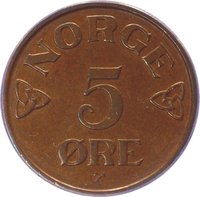
Two lines of value, inscription above, triskelion on each sides, mintmark below, solid rim.
Inscription:
NORGE
1
ØRE
⚒
1
ØRE
⚒
Translation:
Norway
1
Ore
1
Ore
Script: Latin
Edge
Plain
Mints
| Name | Mark |
|---|---|
| Norwegian Mint | — |
Mintings
| Year | Mint Mark | Mintage | Quality | Collection |
|---|---|---|---|---|
| 1952 | — | — | ||
| 1953 | — | 7,440,000 | ||
| 1954 | — | 7,650,000 | ||
| 1955 | — | 8,635,000 | ||
| 1956 | — | 11,705,000 | ||
| 1957 | — | 15,750,000 |
Historical background
In 1952, Norway's currency situation was defined by the Bretton Woods system, which pegged the Norwegian krone (NOK) to the US dollar at a fixed rate of 7.142 NOK per gram of gold, equivalent to 20 NOK per US dollar. This arrangement, managed by Norges Bank (the central bank), provided stability for international trade and reconstruction but required strict capital controls to maintain the parity. These controls were a legacy of the post-war period, limiting the free flow of currency to prevent speculative attacks and preserve Norway's limited foreign exchange reserves, which were crucial for importing essential goods for the nation's rebuilding and industrialization.
The domestic economy was still in a phase of post-war reconstruction and rapid industrialization, guided by the Labour government's strong emphasis on planning and regulation. While the fixed exchange rate provided a stable framework, it also meant that monetary policy was largely subordinated to the external balance. Price and wage controls, alongside rationing for certain goods, remained in effect to manage inflationary pressures and support the fixed peg. The primary economic focus was on rebuilding, investing in heavy industry, and developing the welfare state, rather than currency liberalization.
Internationally, Norway was an active participant in the European Payments Union (EPU), established in 1950. This system was vital for facilitating multilateral trade and payments between European nations, which individually suffered from dollar shortages and non-convertible currencies. Through the EPU, Norway could settle trade balances with other member countries without using scarce gold or dollars, thus easing the pressures on its krone. Therefore, the 1952 currency situation was one of managed stability, embedded in both the global Bretton Woods framework and regional European cooperation, serving the broader goals of economic recovery and controlled growth.
The domestic economy was still in a phase of post-war reconstruction and rapid industrialization, guided by the Labour government's strong emphasis on planning and regulation. While the fixed exchange rate provided a stable framework, it also meant that monetary policy was largely subordinated to the external balance. Price and wage controls, alongside rationing for certain goods, remained in effect to manage inflationary pressures and support the fixed peg. The primary economic focus was on rebuilding, investing in heavy industry, and developing the welfare state, rather than currency liberalization.
Internationally, Norway was an active participant in the European Payments Union (EPU), established in 1950. This system was vital for facilitating multilateral trade and payments between European nations, which individually suffered from dollar shortages and non-convertible currencies. Through the EPU, Norway could settle trade balances with other member countries without using scarce gold or dollars, thus easing the pressures on its krone. Therefore, the 1952 currency situation was one of managed stability, embedded in both the global Bretton Woods framework and regional European cooperation, serving the broader goals of economic recovery and controlled growth.
Series: 1952 Norway circulation coins
🌱 Very Common