

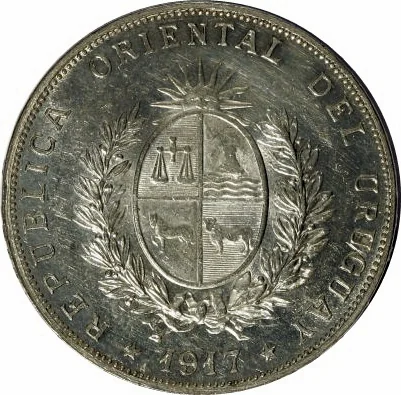
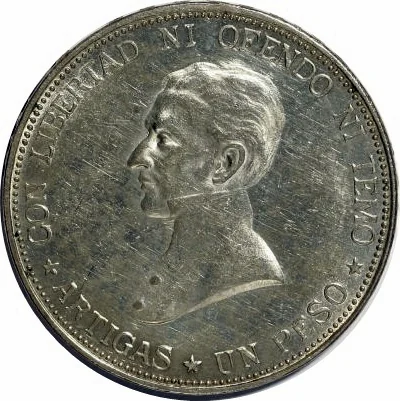
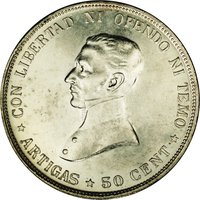
Obverse
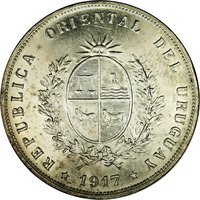
Reverse
Description:
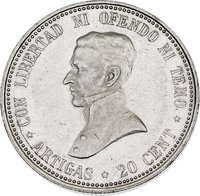
Artigas bust left, value below.
Inscription:
CON LIBERTAD NI OFENDO NI TEMO
*ARTIGAS*UN PESO*
*ARTIGAS*UN PESO*
Script: Latin
Edge
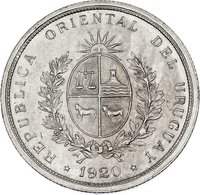
Lettering:REPUBLICA ORIENTAL DEL URUGUAY * 1917 *
Legend:
REPUBLICA ORIENTAL DEL URUGUAY * 1917 *
Translation:
ORIENTAL REPUBLIC OF URUGUAY * 1917 *
Language: Spanish
Categories
| Person> Military leader |
| Person> Politician |
| Symbols> Coat of Arms |
| Symbol> Sun |
| Symbol> Wreath |
Mintings
| Year | Mint Mark | Mintage | Quality | Collection |
|---|---|---|---|---|
| 1917 | — | 2,000,000 |
Historical background
In 1917, Uruguay's currency situation was characterized by significant instability and inflationary pressure, largely stemming from its deep economic ties to the global upheavals of World War I. The country's monetary system was based on the peso, which was nominally on a gold standard, but in practice, the government had suspended gold convertibility in 1914 at the war's outbreak. This suspension, a common measure among neutral nations to prevent gold reserve depletion, removed a key anchor for the currency's value. Uruguay, as a major exporter of beef, wool, and hides, initially experienced a wartime boom, but this influx of foreign exchange, coupled with expansive domestic credit and fiscal spending, fueled a rapid increase in the money supply.
The primary driver of inflation was the government's fiscal policy, financed heavily by money creation through the Banco de la República. Public spending increased substantially to fund public works and social programs under President José Batlle y Ordóñez's reformist agenda, while wartime disruptions also reduced imports, creating a surplus of export earnings that further increased liquidity. With the gold standard suspended, there was no automatic mechanism to check this expansion, leading to a sharp decline in the peso's purchasing power and a growing disparity between its official and market value. This period saw a classic case of "paper peso" inflation, where the currency in circulation far exceeded the gold reserves meant to back it.
Consequently, by 1917, Uruguay faced a dual challenge: managing domestic inflation and navigating complex international exchange rates. The peso depreciated against gold-backed currencies like the US dollar and British pound, increasing the cost of essential imports and contributing to a rising cost of living. This economic environment prompted serious debates within government and financial circles about the need for monetary reform and a potential return to the gold standard to restore stability, setting the stage for significant policy shifts in the post-war years.
The primary driver of inflation was the government's fiscal policy, financed heavily by money creation through the Banco de la República. Public spending increased substantially to fund public works and social programs under President José Batlle y Ordóñez's reformist agenda, while wartime disruptions also reduced imports, creating a surplus of export earnings that further increased liquidity. With the gold standard suspended, there was no automatic mechanism to check this expansion, leading to a sharp decline in the peso's purchasing power and a growing disparity between its official and market value. This period saw a classic case of "paper peso" inflation, where the currency in circulation far exceeded the gold reserves meant to back it.
Consequently, by 1917, Uruguay faced a dual challenge: managing domestic inflation and navigating complex international exchange rates. The peso depreciated against gold-backed currencies like the US dollar and British pound, increasing the cost of essential imports and contributing to a rising cost of living. This economic environment prompted serious debates within government and financial circles about the need for monetary reform and a potential return to the gold standard to restore stability, setting the stage for significant policy shifts in the post-war years.
🌟 Uncommon