

1 giulio – Papal States
Add to wishlist
Vatican City
Context
Year: 1817
Country: Vatican City
Issuer: Papal States
Ruler: Pius VII
Currency:
(1534—1835)
Demonetized: Yes
Total mintage: 47,518
Material
References
KM: #
Numista: #389151
Value
Bullion value: $6.16
Obverse
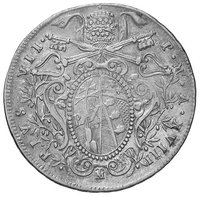
Description:
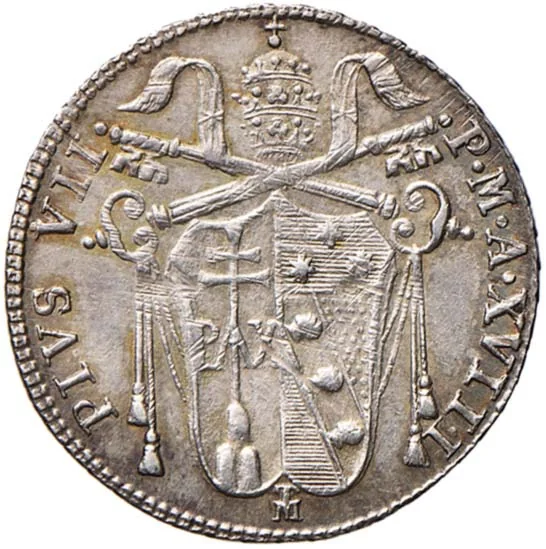
Papal coat of arms.
Inscription:
PIVS VII٠P٠M٠A٠XVIII
Translation:
Pius VII, Pontifex Maximus, Year 18.
Script: Latin
Language: Latin
Engraver: Tommaso Mercandetti
Reverse
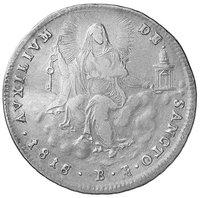
Description:
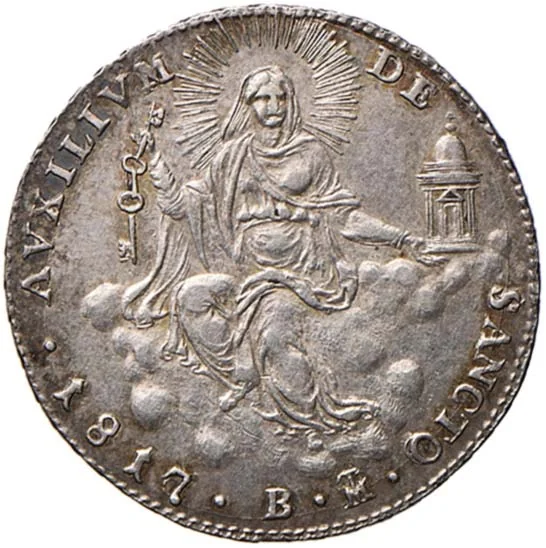
Heavenly Church on clouds, holding key and temple.
Inscription:
AVXILIVM DE SANCTO
1817
B TM
1817
B TM
Script: Latin
Engraver: Tommaso Mercandetti
Edge
Embossed leaves
Categories
| Building> Religious building |
| Symbol> Crown |
| Symbol> Allegory |
| Symbols> Coat of Arms |
Mints
| Name | Mark |
|---|---|
| Bologna | B |
Mintings
| Year | Mint Mark | Mintage | Quality | Collection |
|---|---|---|---|---|
| 1817 | B | 47,518 |
Historical background
In 1817, the Papal States faced a complex and challenging currency situation, a direct legacy of the Napoleonic Wars and the subsequent restoration of papal authority. During the French occupation (1809-1814), the territory had been integrated into the French monetary system, circulating francs and centimes. With Pope Pius VII's return in 1814, the government sought to re-establish its own monetary sovereignty but was confronted with a chaotic mix of old papal coins, French coins, and various regional and foreign currencies circulating at fluctuating values. This monetary fragmentation severely hampered trade, public finance, and economic recovery.
To address this, the papal government under Cardinal Consalvi enacted a sweeping monetary reform with the motu proprio of June 22, 1816 (implemented throughout 1817). This reform created a new, unified decimal currency system based on the Scudo (divided into 100 Baiocchi), replacing the old lira-based system. New silver and gold coins were minted bearing the pope's effigy, explicitly designed to drive out foreign specie and standardize the money in circulation. The scudo was pegged to a specific weight and fineness of silver, aligning it with other major restoration-era currencies like the Sardinian lira and the Tuscan fiorino.
Despite its logical design, the reform faced significant practical difficulties in 1817 and the years that followed. The papal treasury, drained by war and occupation, struggled to mint sufficient quantities of the new coins to fully replace the old mixed currency. Consequently, older coins and even foreign money remained in use for years, particularly in more remote provinces. Furthermore, the papal finances were structurally weak, relying heavily on deficit spending and loans, which gradually eroded confidence in the currency. Thus, while 1817 marked the official launch of a modernized monetary system intended to symbolize restored sovereignty and economic order, the Papal States continued to grapple with the deep-seated financial instability that would plague it until its final dissolution in 1870.
To address this, the papal government under Cardinal Consalvi enacted a sweeping monetary reform with the motu proprio of June 22, 1816 (implemented throughout 1817). This reform created a new, unified decimal currency system based on the Scudo (divided into 100 Baiocchi), replacing the old lira-based system. New silver and gold coins were minted bearing the pope's effigy, explicitly designed to drive out foreign specie and standardize the money in circulation. The scudo was pegged to a specific weight and fineness of silver, aligning it with other major restoration-era currencies like the Sardinian lira and the Tuscan fiorino.
Despite its logical design, the reform faced significant practical difficulties in 1817 and the years that followed. The papal treasury, drained by war and occupation, struggled to mint sufficient quantities of the new coins to fully replace the old mixed currency. Consequently, older coins and even foreign money remained in use for years, particularly in more remote provinces. Furthermore, the papal finances were structurally weak, relying heavily on deficit spending and loans, which gradually eroded confidence in the currency. Thus, while 1817 marked the official launch of a modernized monetary system intended to symbolize restored sovereignty and economic order, the Papal States continued to grapple with the deep-seated financial instability that would plague it until its final dissolution in 1870.
✨ Legendary