

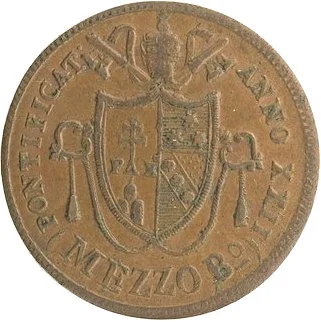
½ Baiocco – Papal States
Vatican City
Context
Year: 1822
Country: Vatican City 
Issuer: Papal States
Ruler: Pius VII
Currency:
(1534—1835)
Demonetized: Yes
Material
References
KM: #Click to copy to clipboard1290
Numista: #119559
Obverse
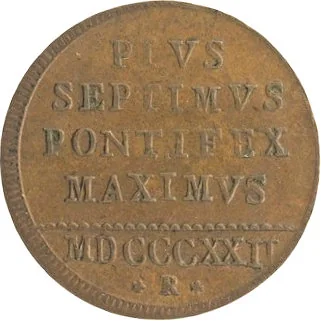
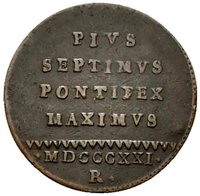
Reverse
Description:
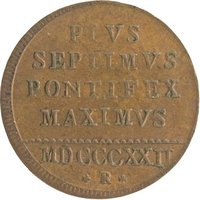
3-line legend, Roman numeral date, mintmark in exergue.
Inscription:
PIVS
SEPTIMVS
PONTIFEX
MAXIMVS
MDCCCXXII
* R *
SEPTIMVS
PONTIFEX
MAXIMVS
MDCCCXXII
* R *
Script: Latin
Edge
Categories
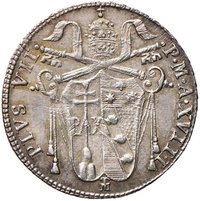
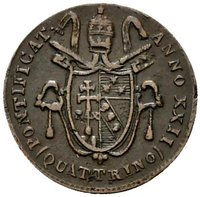
| Symbol> Crown |
| Symbols> Coat of Arms |
Mintings
| Year | Mint Mark | Mintage | Quality | Collection |
|---|---|---|---|---|
| 1822 | R | — |
Historical background
In 1822, the currency situation in the Papal States was a complex and fragmented system, reflecting the region's political and economic stagnation under the restored papal government following the Napoleonic Wars. The territory lacked a unified, modern monetary system. Instead, circulation was a chaotic mix of coins from various eras and origins, including old papal coinage from before the French occupation, coins minted by the Napoleonic "Kingdom of Italy," and even a significant influx of foreign currencies, particularly French and Austrian. This multiplicity made commerce cumbersome and exchange rates uncertain, hindering trade and economic development.
The primary unit of account was the Scudo Romano (Roman Scudo), divided into 100 Baiocchi. However, the actual physical scudo coin was rarely minted. Daily transactions relied on a confusing array of subsidiary coins like baiocchi, quattrini, and grossi, often in short supply and of varying metallic purity. The papal mint struggled with low output and technological backwardness, unable to produce sufficient quantities of standardized coinage to meet the needs of the state's economy. Consequently, much business was conducted using worn, clipped, or foreign coins, with their value often determined by weight and bullion content rather than face value.
This monetary disarray was symptomatic of broader administrative and fiscal weaknesses. The papal treasury, burdened by debt and reliant on inefficient taxes and monopolies, had limited capacity for reform. While there were discussions about monetary standardization, substantive action would not come until later, with the introduction of a slightly more unified system based on the Scudo and the Baiocco in the 1830s. Thus, in 1822, the currency of the Papal States remained a tangible symbol of its pre-modern economic structures, posing a persistent challenge to merchants and the populace alike.
The primary unit of account was the Scudo Romano (Roman Scudo), divided into 100 Baiocchi. However, the actual physical scudo coin was rarely minted. Daily transactions relied on a confusing array of subsidiary coins like baiocchi, quattrini, and grossi, often in short supply and of varying metallic purity. The papal mint struggled with low output and technological backwardness, unable to produce sufficient quantities of standardized coinage to meet the needs of the state's economy. Consequently, much business was conducted using worn, clipped, or foreign coins, with their value often determined by weight and bullion content rather than face value.
This monetary disarray was symptomatic of broader administrative and fiscal weaknesses. The papal treasury, burdened by debt and reliant on inefficient taxes and monopolies, had limited capacity for reform. While there were discussions about monetary standardization, substantive action would not come until later, with the introduction of a slightly more unified system based on the Scudo and the Baiocco in the 1830s. Thus, in 1822, the currency of the Papal States remained a tangible symbol of its pre-modern economic structures, posing a persistent challenge to merchants and the populace alike.
✨ Legendary