

⅛ rial – Mutawakkilite Kingdom
Add to wishlist
Yemen
Context
Year: 1921
Islamic (Hijri) Year:: 1339
Country: Yemen
Issuer: Mutawakkilite Kingdom
Ruler: Yahya Muhammad Hamid ed-Din
Currency:
(1918—1974)
Demonetized: Yes
References
Y: #
Numista: #142881
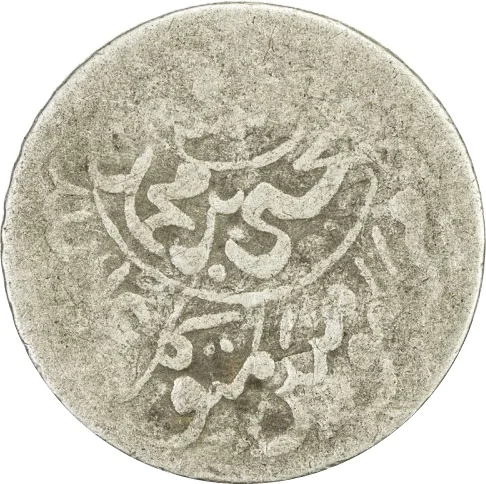
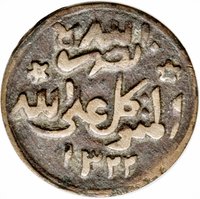
Obverse
Description:
1 or no stars below accession date AH1322.
Script: Arabic
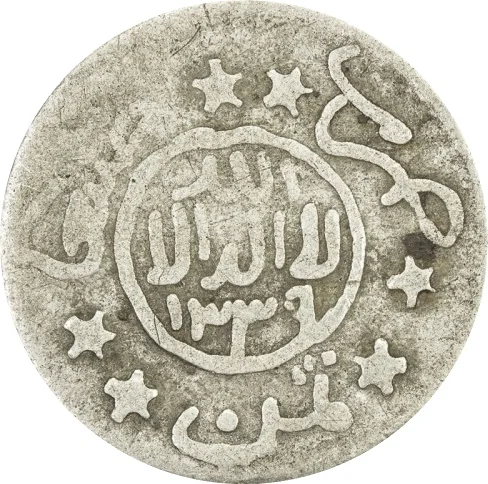
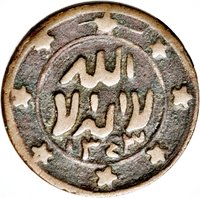
Reverse
Description:
Six-star
Script: Arabic
Edge
Mintings
| Year | Mint Mark | Mintage | Quality | Collection |
|---|---|---|---|---|
| 1921 | — | — |
Historical background
The Mutawakkilite Kingdom of Yemen, established in 1918 under Imam Yahya Muhammad Hamid ed-Din, entered the 1920s with a currency system reflecting its historical isolation and recent political consolidation. Following the collapse of the Ottoman Empire, from which the Imamate had secured its independence, the kingdom inherited a monetary landscape dominated by the Ottoman qirsh (piastre) and the Maria Theresa thaler. The latter, a large silver coin minted in Austria but circulated globally, was particularly entrenched in the highlands and Red Sea trade, serving as the de facto standard for large transactions and state finances.
Imam Yahya, seeking to assert both sovereignty and economic control, initiated a cautious currency reform. In 1921, his government began minting its own silver coins in Sana'a, including the 1-rial and its fractional denominations. These new coins were deliberately conservative in design, featuring Arabic script and Islamic motifs to gain public trust, and were intended to physically replace the worn Ottoman and foreign coins in circulation. However, this was not a swift decimalization or the creation of a modern fiat system; the new Mutawakkilite rial was pegged to and interchangeable with the Maria Theresa thaler, ensuring continuity in a society deeply suspicious of sudden change.
Consequently, the currency situation in 1921 was one of transition and duality. The state was actively projecting its authority through new coinage, yet the monetary reality remained a complex bazaar of concurrently circulating coins: the newly minted Imam Yahya rials, old Ottoman qirsh, Turkish gold liras, British sovereigns and Indian rupees in coastal areas, and the ever-reliable Maria Theresa thaler. This system lacked a central bank or paper money, leaving the kingdom with a fragmented, commodity-based monetary economy that mirrored its limited integration into global finance and the Imam's primary focus on political unification over economic modernization.
Imam Yahya, seeking to assert both sovereignty and economic control, initiated a cautious currency reform. In 1921, his government began minting its own silver coins in Sana'a, including the 1-rial and its fractional denominations. These new coins were deliberately conservative in design, featuring Arabic script and Islamic motifs to gain public trust, and were intended to physically replace the worn Ottoman and foreign coins in circulation. However, this was not a swift decimalization or the creation of a modern fiat system; the new Mutawakkilite rial was pegged to and interchangeable with the Maria Theresa thaler, ensuring continuity in a society deeply suspicious of sudden change.
Consequently, the currency situation in 1921 was one of transition and duality. The state was actively projecting its authority through new coinage, yet the monetary reality remained a complex bazaar of concurrently circulating coins: the newly minted Imam Yahya rials, old Ottoman qirsh, Turkish gold liras, British sovereigns and Indian rupees in coastal areas, and the ever-reliable Maria Theresa thaler. This system lacked a central bank or paper money, leaving the kingdom with a fragmented, commodity-based monetary economy that mirrored its limited integration into global finance and the Imam's primary focus on political unification over economic modernization.
✨ Legendary