

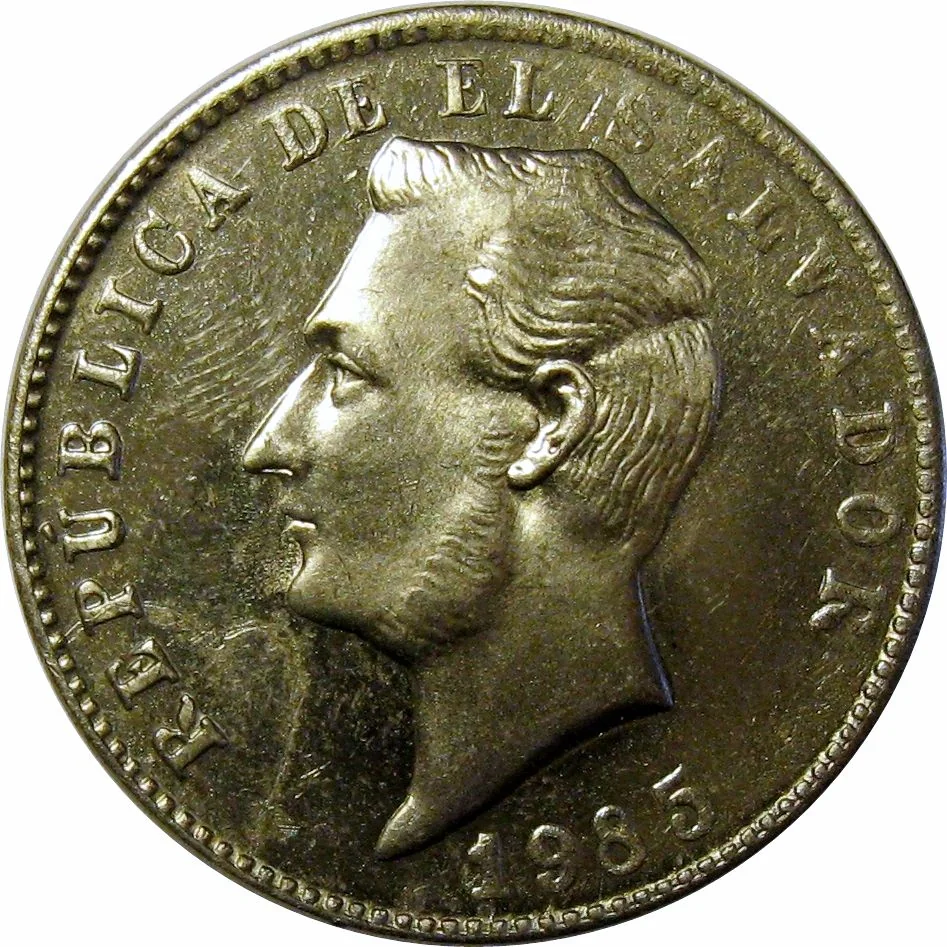
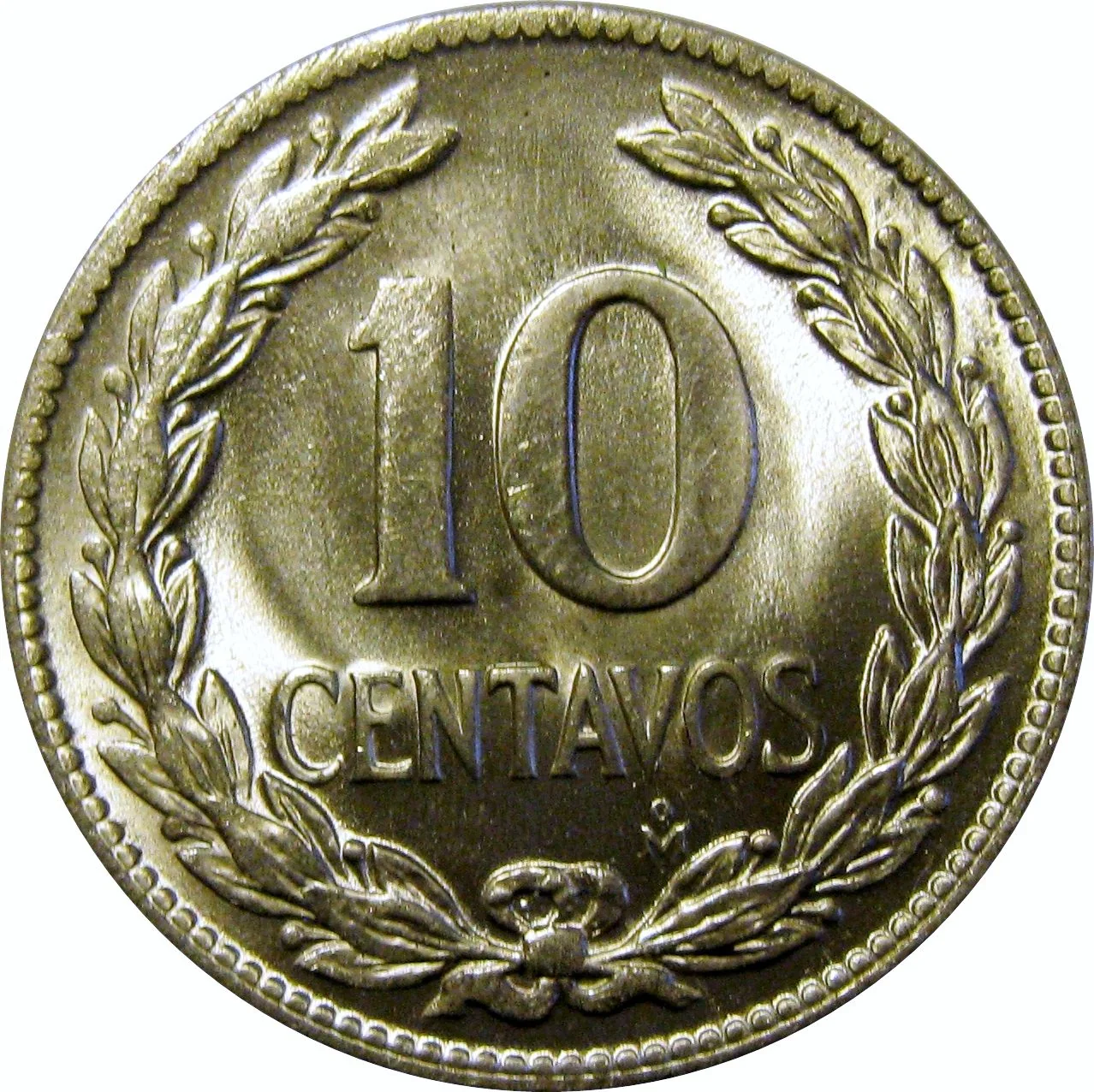
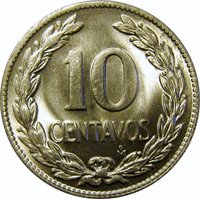
10 Centavos – El Salvador
El Salvador
Context
Years: 1952–1985
Issuer: El Salvador 
Issuing organization: Central Reserve Bank of El Salvador
Period:
(since 1841)
Currency:
(since 1892)
Demonetization: 1 January 2001
Total mintage: 17,000,000
Material
References
KM: #Click to copy to clipboard130a
Numista: #14260
Value
Exchange value: 0.10 SVC
Obverse
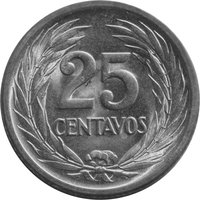
Reverse
Edge
Plain
Categories
| Symbols> Coat of Arms |
| Symbol> Wreath |
Mints
| Name | Mark |
|---|---|
| United States Mint of San Francisco | — |
| Mexican Mint | Mo |
Mintings
| Year | Mint Mark | Mintage | Quality | Collection |
|---|---|---|---|---|
| 1952 | 1952-1953 | 2,000,000 | ||
| 1952 | — | — | ||
| 1985 | Mo | 15,000,000 |
Historical background
In 1952, El Salvador's currency situation was defined by its adherence to the Colón, introduced in 1919 to replace the Salvadoran peso. The Colón was firmly pegged to the United States dollar at a fixed exchange rate of 2.5 colones to 1 USD, a parity established in 1934. This dollar peg provided a crucial anchor for monetary stability and facilitated trade, particularly with its dominant economic partner, the United States. The system was managed by the Central Reserve Bank of El Salvador, which held sufficient dollar reserves to back the currency and maintain confidence in this orthodox, gold-exchange standard framework.
Economically, this period followed the profound disruptions of the Great Depression and World War II but preceded the major political and social upheavals of the later Cold War era. The Salvadoran economy was heavily dependent on coffee exports, which generated the bulk of the foreign exchange needed to sustain the currency peg. While the fixed rate provided predictability for the landed oligarchy and export sector, it also tied El Salvador's monetary policy directly to U.S. economic conditions, limiting the government's ability to independently respond to domestic financial needs or devalue to boost competitiveness.
Overall, the currency situation in 1952 was one of superficial stability underpinned by a vulnerable monoculture. The rigid peg served the interests of the export-oriented elite and provided a stable unit of account, but it masked deeper structural issues of inequality and economic dependence. This system would remain largely unchanged for decades, even as social pressures mounted, until a civil war and economic crises eventually forced a move to dollarization in 2001.
Economically, this period followed the profound disruptions of the Great Depression and World War II but preceded the major political and social upheavals of the later Cold War era. The Salvadoran economy was heavily dependent on coffee exports, which generated the bulk of the foreign exchange needed to sustain the currency peg. While the fixed rate provided predictability for the landed oligarchy and export sector, it also tied El Salvador's monetary policy directly to U.S. economic conditions, limiting the government's ability to independently respond to domestic financial needs or devalue to boost competitiveness.
Overall, the currency situation in 1952 was one of superficial stability underpinned by a vulnerable monoculture. The rigid peg served the interests of the export-oriented elite and provided a stable unit of account, but it masked deeper structural issues of inequality and economic dependence. This system would remain largely unchanged for decades, even as social pressures mounted, until a civil war and economic crises eventually forced a move to dollarization in 2001.
🌱 Common