

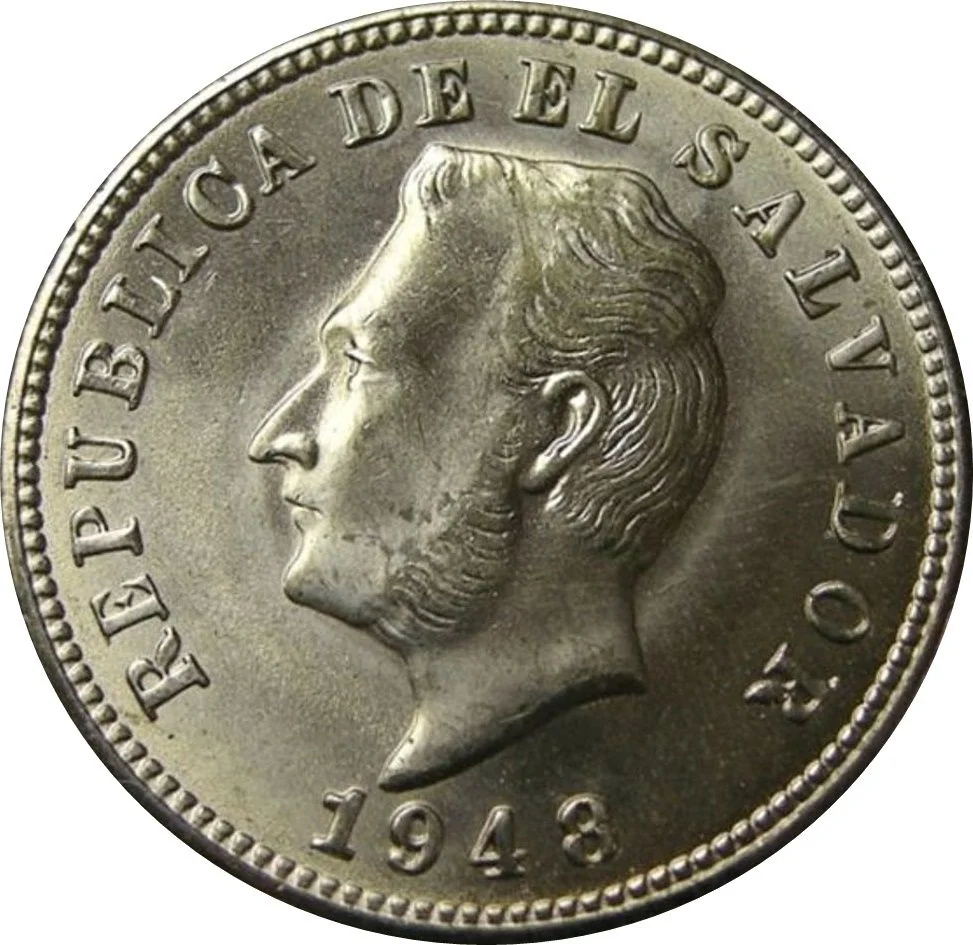
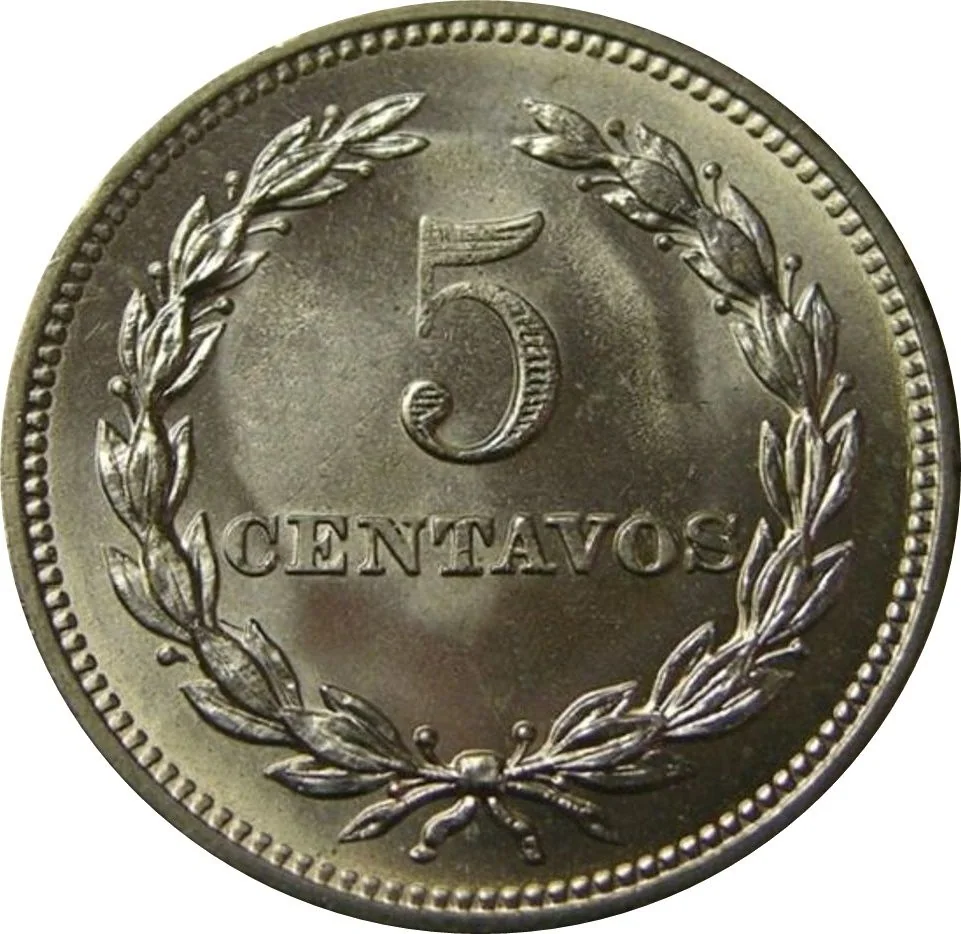
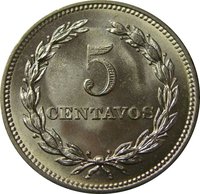
5 Centavos – El Salvador
El Salvador
Context
Years: 1944–1953
Issuer: El Salvador 
Issuing organization: Central Reserve Bank of El Salvador
Period:
(since 1841)
Currency:
(since 1892)
Demonetization: 1 January 2001
Total mintage: 14,000,000
Material
References
KM: #Click to copy to clipboard134a
Numista: #9704
Value
Exchange value: 0.05 SVC
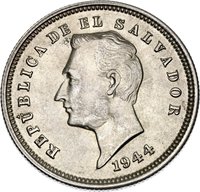
Obverse
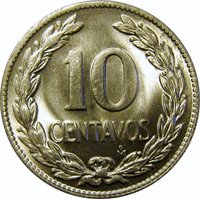
Reverse
Edge
Plain
Categories
| Person> Politician |
| Symbol> Wreath |
Mints
| Name | Mark |
|---|---|
| United States Mint of San Francisco | — |
Mintings
| Year | Mint Mark | Mintage | Quality | Collection |
|---|---|---|---|---|
| 1944 | — | 5,000,000 | ||
| 1948 | — | 3,000,000 | ||
| 1950 | — | 2,000,000 | ||
| 1952 | 1952-1953 | 4,000,000 |
Historical background
In 1944, El Salvador's currency situation was characterized by the exclusive use of the Salvadoran colón, which had been the nation's official currency since its introduction in 1919, replacing the Salvadoran peso. The colón was pegged to the United States dollar at a fixed rate of 2.5 colones to 1 dollar, a regime established in 1934 during the administration of General Maximiliano Hernández Martínez. This peg provided a degree of monetary stability and facilitated trade, primarily with the United States, which was crucial for an economy heavily dependent on coffee exports.
The year 1944 itself was one of profound political upheaval rather than monetary reform. A general strike and civic uprising in April and May forced the resignation of the long-standing dictator Hernández Martínez. While his authoritarian regime had maintained fiscal and monetary conservatism, the political instability of his ouster created underlying economic uncertainty. The new provisional governments, first under Andrés Ignacio Menéndez and then Osmín Aguirre y Salinas, were preoccupied with consolidating political control and did not implement significant changes to the currency peg or monetary policy during this turbulent transition.
Therefore, the currency background for 1944 is one of institutional continuity within a framework of political chaos. The colón-dollar peg held, providing a stable nominal anchor. However, the nation's economic fundamentals were strained by the global disruptions of World War II, which affected export markets and the availability of imported goods. The primary challenges were political instability and social unrest, with the established monetary system persisting as a point of relative order amidst the volatile fight for democratic change that would culminate in the "Revolution of 1948."
The year 1944 itself was one of profound political upheaval rather than monetary reform. A general strike and civic uprising in April and May forced the resignation of the long-standing dictator Hernández Martínez. While his authoritarian regime had maintained fiscal and monetary conservatism, the political instability of his ouster created underlying economic uncertainty. The new provisional governments, first under Andrés Ignacio Menéndez and then Osmín Aguirre y Salinas, were preoccupied with consolidating political control and did not implement significant changes to the currency peg or monetary policy during this turbulent transition.
Therefore, the currency background for 1944 is one of institutional continuity within a framework of political chaos. The colón-dollar peg held, providing a stable nominal anchor. However, the nation's economic fundamentals were strained by the global disruptions of World War II, which affected export markets and the availability of imported goods. The primary challenges were political instability and social unrest, with the established monetary system persisting as a point of relative order amidst the volatile fight for democratic change that would culminate in the "Revolution of 1948."
🌱 Common