

1 ducat – Netherlands
Add to wishlist
Netherlands
Context
Years: 1814–1816
Issuer: Netherlands
Ruler: William I
Currency:
(1817—2001)
Demonetized: Yes
Total mintage: 3,846,339
Material
References
KM: #
Numista: #38122
Value
Exchange value: 17⁄3 NLG
Bullion value: $528.11
Obverse
Description:
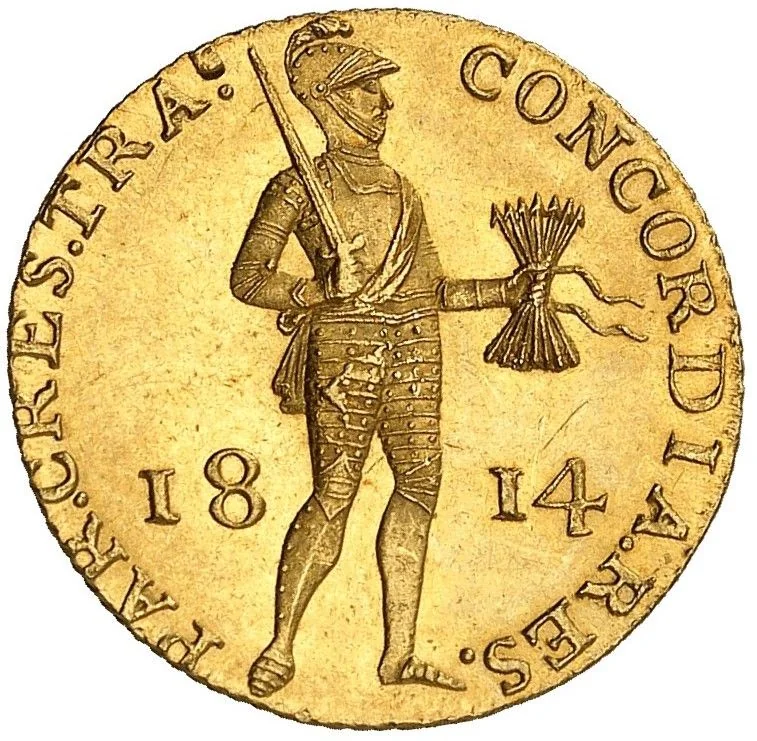
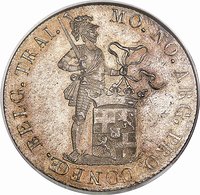
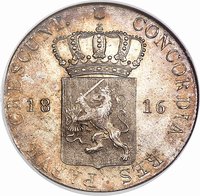
Knight with swords and arrows divides date; Utrecht coat of arms above.
Inscription:
CONCORDIA . RES . PAR . CRES . TRA :
1814
1814
Translation:
Concord . Res . Par . Cres . Tra . :
1814
1814
Script: Latin
Language: Latin
Engraver: David van der Kellen Sr.
Reverse
Edge
Reeded
Categories
| Object> Armour |
| Object> Cold weapons |
Mints
| Name | Mark |
|---|---|
| Royal Dutch Mint | — |
Mintings
| Year | Mint Mark | Mintage | Quality | Collection |
|---|---|---|---|---|
| 1814 | — | 2,947,639 | ||
| 1815 | — | 676,830 | ||
| 1816 | — | 221,870 |
Historical background
Following the Napoleonic Wars and the establishment of the Sovereign Principality of the United Netherlands in 1813-1814, the new state faced a complex and chaotic currency situation. The country was a patchwork of former French-occupied territories and older Dutch provinces, each with circulating coins from different regimes: old Dutch guilders, French francs, and various German thalers. This monetary fragmentation severely hampered trade, economic recovery, and the very process of national unification, creating an urgent need for a standardized national currency system.
Consequently, one of the first major legislative acts of the new sovereign, King William I, was the Coinage Act of 1814. This law aimed to restore monetary order by reintroducing the Dutch guilder (gulden) as the sole official unit of account. It was deliberately aligned with the pre-revolutionary standard, defined as containing 9.613 grams of fine silver, to evoke stability and trust. The act also decimalized the currency, subdividing the guilder into 100 cents, moving away from the older system of 20 stuivers to the guilder, which reflected modern French financial influence.
However, the 1814 law was primarily a foundational decree. The actual minting and full circulation of the new national coinage took years to implement, and foreign coins, particularly the widely used silver ducaton (rijksdaalder), remained legally recognized alongside the new guilder until 1847. Thus, the situation in 1814 was one of transition—a decisive legal framework was established to unify the currency, but the practical reality remained one of temporary coexistence as the state began the slow process of replacing the diverse coins in circulation with its own new monetary symbols of sovereignty.
Consequently, one of the first major legislative acts of the new sovereign, King William I, was the Coinage Act of 1814. This law aimed to restore monetary order by reintroducing the Dutch guilder (gulden) as the sole official unit of account. It was deliberately aligned with the pre-revolutionary standard, defined as containing 9.613 grams of fine silver, to evoke stability and trust. The act also decimalized the currency, subdividing the guilder into 100 cents, moving away from the older system of 20 stuivers to the guilder, which reflected modern French financial influence.
However, the 1814 law was primarily a foundational decree. The actual minting and full circulation of the new national coinage took years to implement, and foreign coins, particularly the widely used silver ducaton (rijksdaalder), remained legally recognized alongside the new guilder until 1847. Thus, the situation in 1814 was one of transition—a decisive legal framework was established to unify the currency, but the practical reality remained one of temporary coexistence as the state began the slow process of replacing the diverse coins in circulation with its own new monetary symbols of sovereignty.
💎 Extremely Rare