

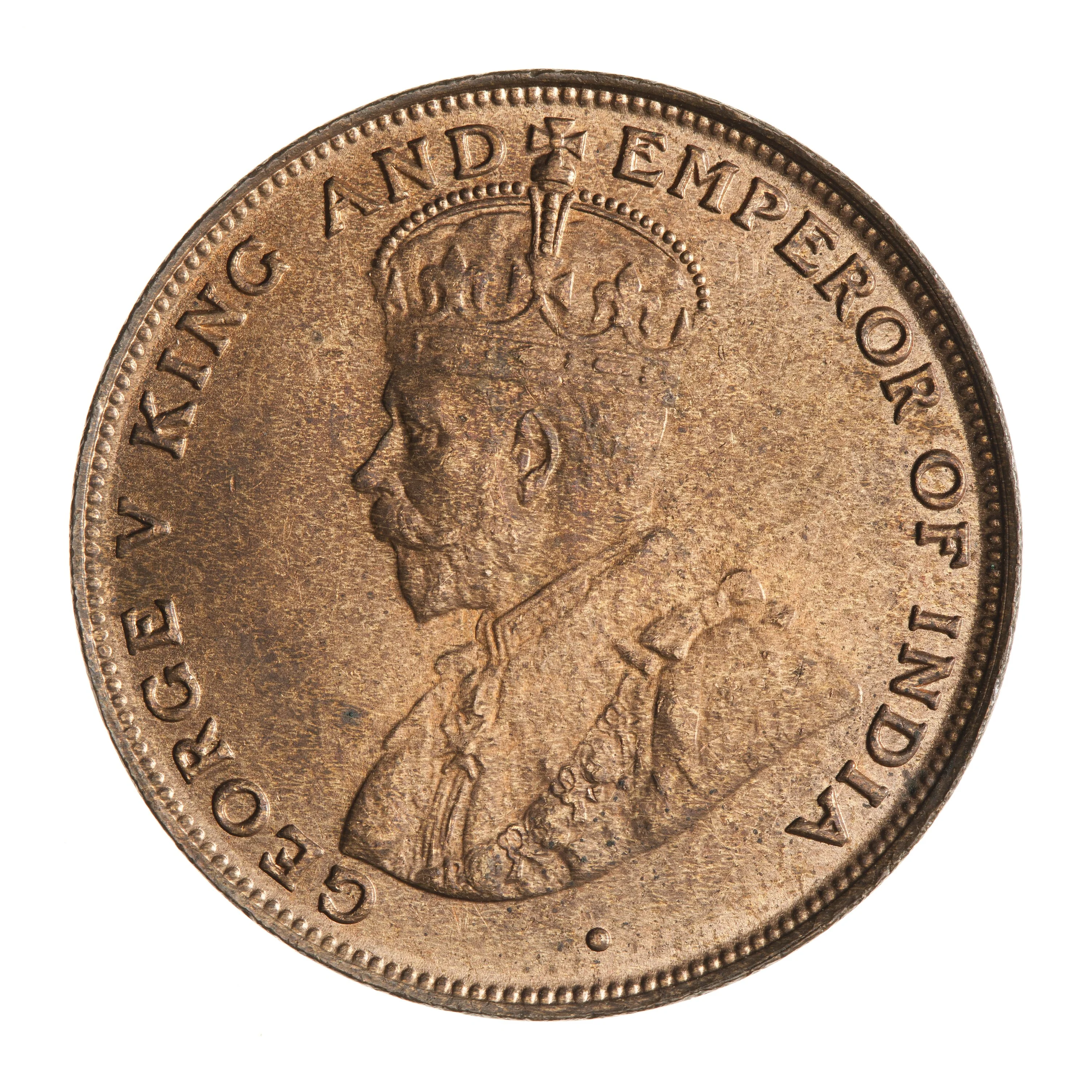
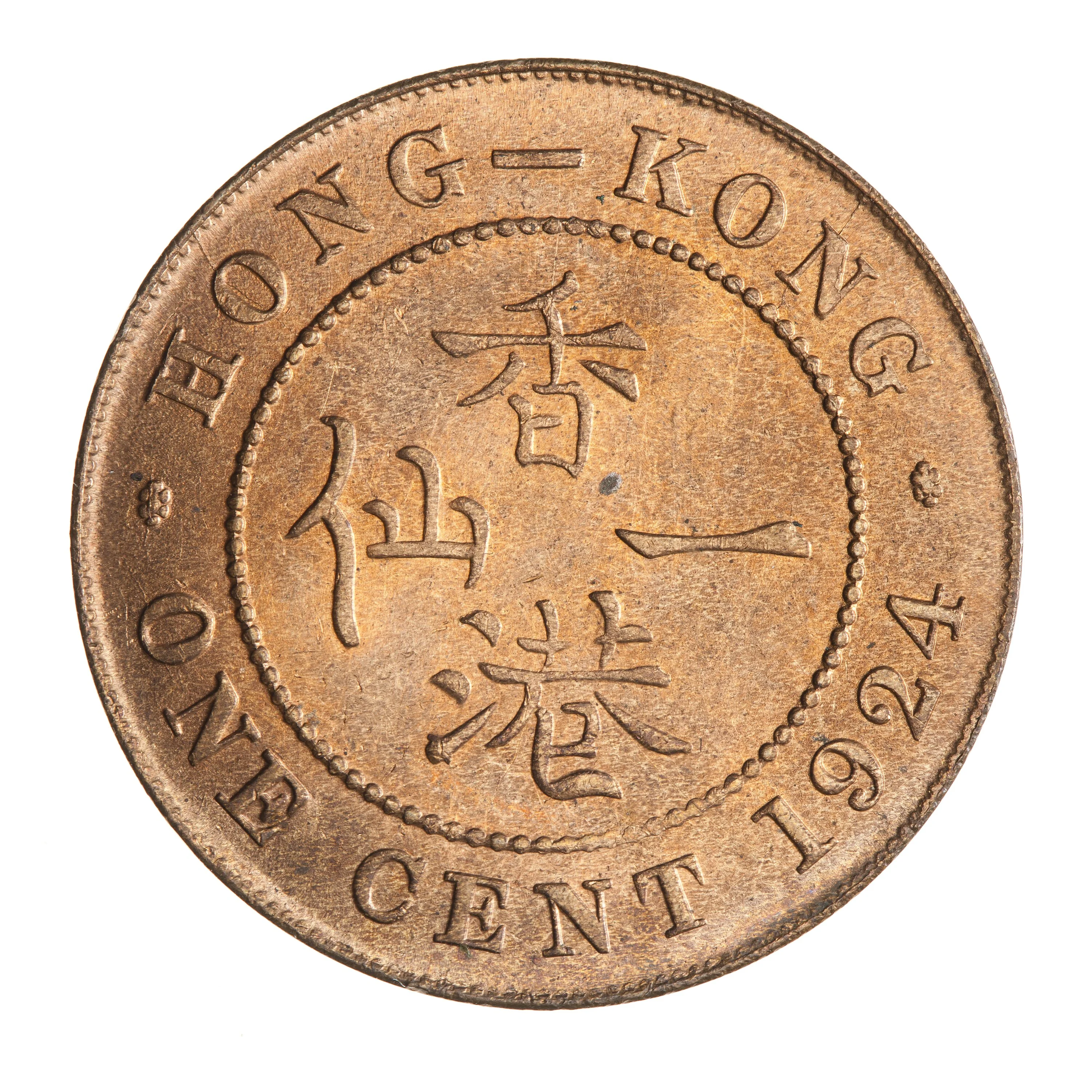
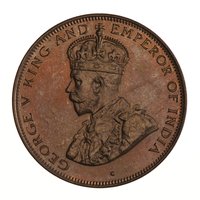
Obverse
Description:
Crowned left-facing bust.
Inscription:
GEORGE V KING AND EMPEROR OF INDIA
.
.
Script: Latin
Engraver: Edgar Bertram MacKennal
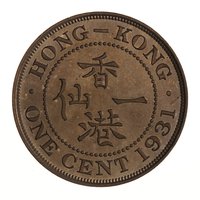
Reverse
Edge
Plain
Mints
| Name | Mark |
|---|---|
| Royal Mint (Tower Hill) | — |
| Heaton and Sons / The Mint Birmingham | H |
Mintings
| Year | Mint Mark | Mintage | Quality | Collection |
|---|---|---|---|---|
| 1919 | H | 2,500,000 | ||
| 1923 | — | 2,500,000 | ||
| 1924 | — | 5,000,000 | ||
| 1925 | — | 2,500,000 | ||
| 1926 | — | 2,500,000 | ||
| 1926 | — | — | Proof |
Historical background
In 1919, Hong Kong's currency situation was characterized by a complex and evolving system under British colonial administration. The primary legal tender was the Hong Kong dollar, which had been officially established in 1863, but the monetary landscape was far from unified. The colony operated on a silver standard, with the Hong Kong dollar's value directly tied to its silver content. This meant its exchange rate against gold-based currencies like the British pound sterling fluctuated with the volatile global price of silver, creating inherent instability for trade and public finances.
The year 1919 fell within a period of significant global monetary upheaval following World War I, which profoundly impacted Hong Kong. A major development was the de facto departure of the British pound sterling from the gold standard in 1919, leading to wider exchange rate fluctuations. While Hong Kong remained on silver, its trade was heavily conducted with sterling-area countries. Furthermore, the Hong Kong government continued to grapple with the circulation of multiple forms of money. Alongside government-issued silver coins and banknotes from authorized British banks like the Hongkong and Shanghai Banking Corporation (HSBC), substantial amounts of Mexican and other silver trade dollars, as well as Chinese silver yuan and copper coins, circulated freely in daily commerce, especially in retail and remittances to mainland China.
This multi-currency environment, combined with the instability of silver, presented ongoing challenges for the colonial government. Efforts to assert greater control and move toward a more managed currency system were underway, but 1919 represented a transitional point. The system was ultimately deemed unsustainable, leading to a major reform in 1935 when Hong Kong abandoned the silver standard and pegged the Hong Kong dollar to sterling, establishing a formal Currency Board system. Thus, the situation in 1919 was one of a silver-based colonial currency navigating a turbulent post-war world economy while managing a practical, on-the-ground reality of diverse metallic and paper monies.
The year 1919 fell within a period of significant global monetary upheaval following World War I, which profoundly impacted Hong Kong. A major development was the de facto departure of the British pound sterling from the gold standard in 1919, leading to wider exchange rate fluctuations. While Hong Kong remained on silver, its trade was heavily conducted with sterling-area countries. Furthermore, the Hong Kong government continued to grapple with the circulation of multiple forms of money. Alongside government-issued silver coins and banknotes from authorized British banks like the Hongkong and Shanghai Banking Corporation (HSBC), substantial amounts of Mexican and other silver trade dollars, as well as Chinese silver yuan and copper coins, circulated freely in daily commerce, especially in retail and remittances to mainland China.
This multi-currency environment, combined with the instability of silver, presented ongoing challenges for the colonial government. Efforts to assert greater control and move toward a more managed currency system were underway, but 1919 represented a transitional point. The system was ultimately deemed unsustainable, leading to a major reform in 1935 when Hong Kong abandoned the silver standard and pegged the Hong Kong dollar to sterling, establishing a formal Currency Board system. Thus, the situation in 1919 was one of a silver-based colonial currency navigating a turbulent post-war world economy while managing a practical, on-the-ground reality of diverse metallic and paper monies.
🌱 Common