

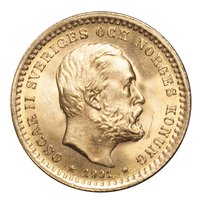
Obverse
Description:
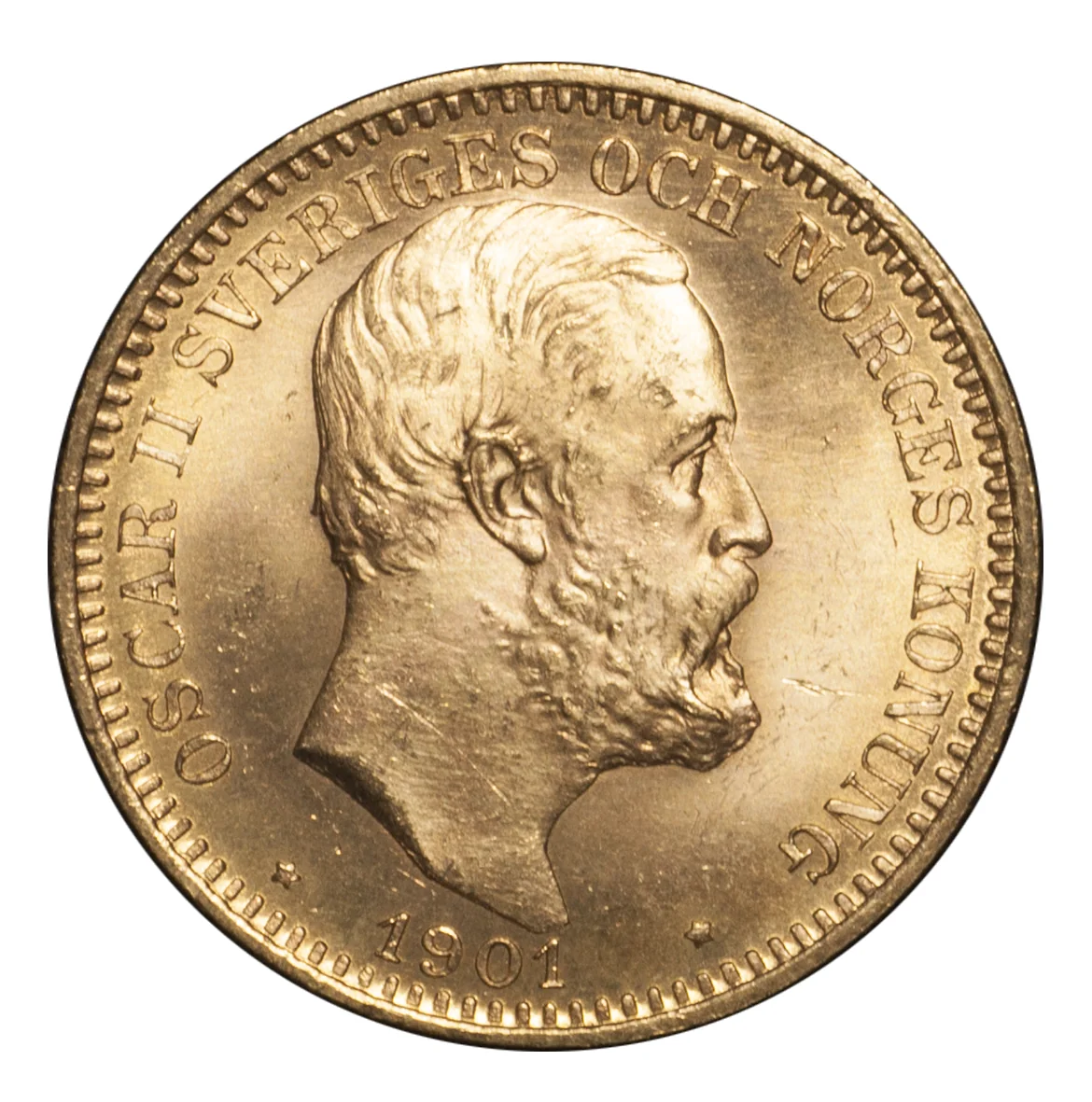
Oscar II facing right, inscription surrounding. Date between stars below.
Inscription:
OSCAR II SVERIGES OCH NORGES KONUNG
⋆ 1901 ⋆
⋆ 1901 ⋆
Translation:
Oscar II, Sweden's and Norway's King
⋆ 1901 ⋆
⋆ 1901 ⋆
Script: Latin
Engraver: Adolf Lindberg
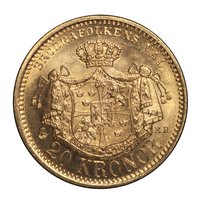
Reverse
Description:
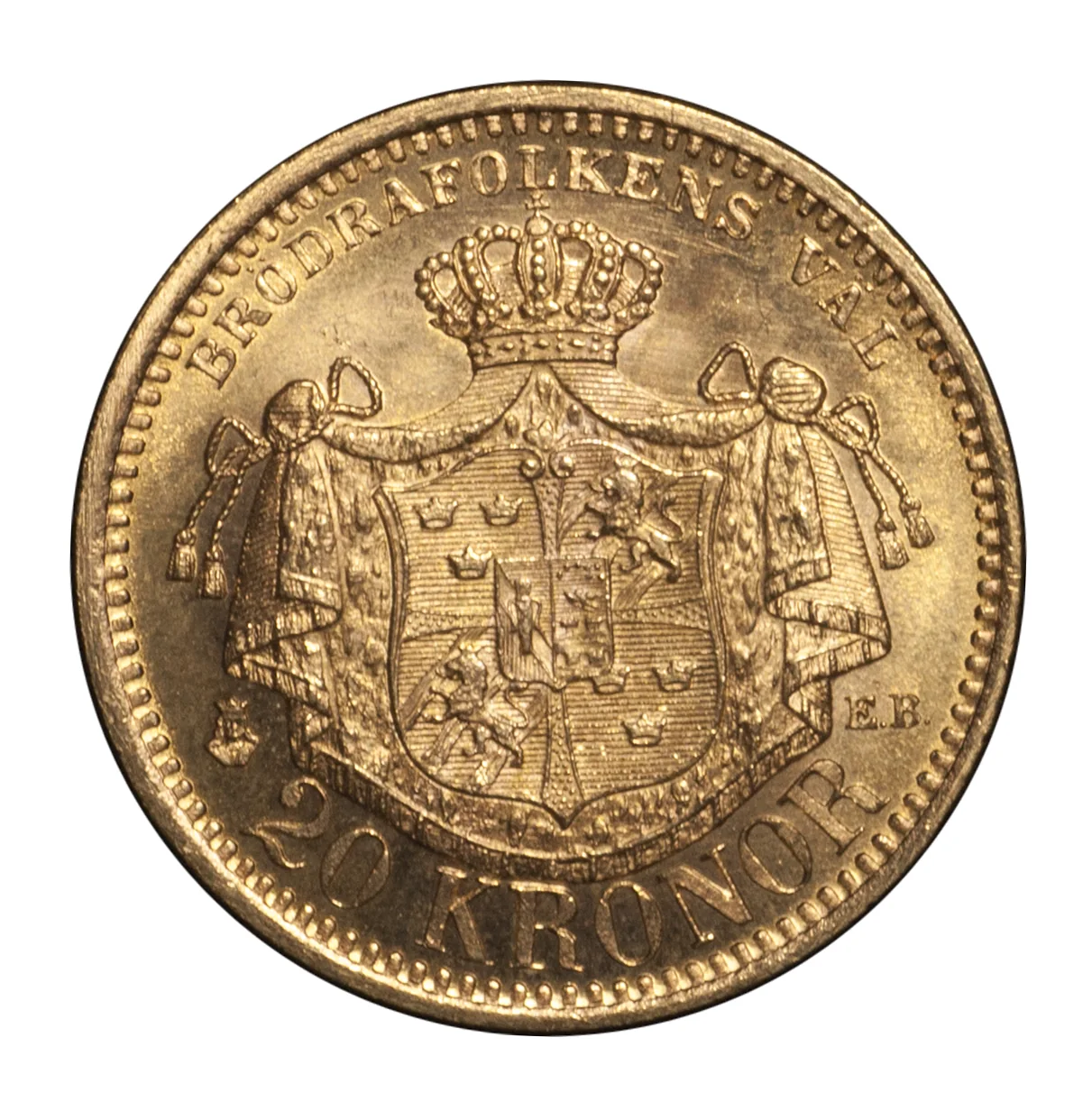
Crowned mantle with royal arms divides mintmarks, motto above, value below.
Inscription:
BRÖDRAFOLKENS VÄL
E.B.
20 KRONOR
E.B.
20 KRONOR
Translation:
The Welfare of the Brother Peoples
E.B.
20 Kronor
E.B.
20 Kronor
Script: Latin
Language: Swedish
Engraver: Adolf Lindberg
Edge
Reeded
Categories
| Symbols> Coat of Arms |
Mints
| Name | Mark |
|---|---|
| Kungliga Myntet | — |
Mintings
| Year | Mint Mark | Mintage | Quality | Collection |
|---|---|---|---|---|
| 1900 | — | 104,199 | ||
| 1901 | — | 226,679 | ||
| 1902 | — | 113,810 |
Historical background
By 1900, Sweden had been part of the Scandinavian Monetary Union (SMU) with Denmark and Norway for nearly three decades. Established in 1873, the Union created a common gold standard, pegging the Swedish krona, the Danish krone, and the Norwegian krone to gold and making them legally accepted across all three nations. This system facilitated trade and economic stability, with Swedish banknotes and coins circulating freely alongside Danish and Norwegian currency within the kingdom. The period was one of formal monetary integration and relative predictability, underpinned by the international gold standard.
However, the system's stability was increasingly dependent on mutual trust and the consistent gold backing of each member's currency. In practice, Sweden, with its strong industrial economy and substantial gold reserves, often acted as the Union's anchor. The Riksbank, Sweden's central bank, maintained a conservative policy, ensuring the krona was fully convertible to gold. This stood in contrast to periods where Norway and Denmark, facing different economic pressures, issued more notes than their gold reserves strictly warranted, relying on Sweden's strength to maintain confidence in the shared system.
Consequently, while outwardly stable, the currency situation in 1900 was one of underlying asymmetry. Sweden enjoyed a robust and trusted currency, but it was yoked within a union that was beginning to show strains due to the lack of a central governing authority or unified fiscal policy. The pressures of World War I would ultimately rupture the union in 1914, but at the turn of the century, the system remained intact, providing Sweden with the benefits of a regional currency zone while masking the vulnerabilities that would later lead to its dissolution.
However, the system's stability was increasingly dependent on mutual trust and the consistent gold backing of each member's currency. In practice, Sweden, with its strong industrial economy and substantial gold reserves, often acted as the Union's anchor. The Riksbank, Sweden's central bank, maintained a conservative policy, ensuring the krona was fully convertible to gold. This stood in contrast to periods where Norway and Denmark, facing different economic pressures, issued more notes than their gold reserves strictly warranted, relying on Sweden's strength to maintain confidence in the shared system.
Consequently, while outwardly stable, the currency situation in 1900 was one of underlying asymmetry. Sweden enjoyed a robust and trusted currency, but it was yoked within a union that was beginning to show strains due to the lack of a central governing authority or unified fiscal policy. The pressures of World War I would ultimately rupture the union in 1914, but at the turn of the century, the system remained intact, providing Sweden with the benefits of a regional currency zone while masking the vulnerabilities that would later lead to its dissolution.
💎 Very Rare