

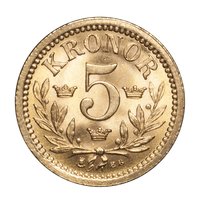
Obverse
Description:
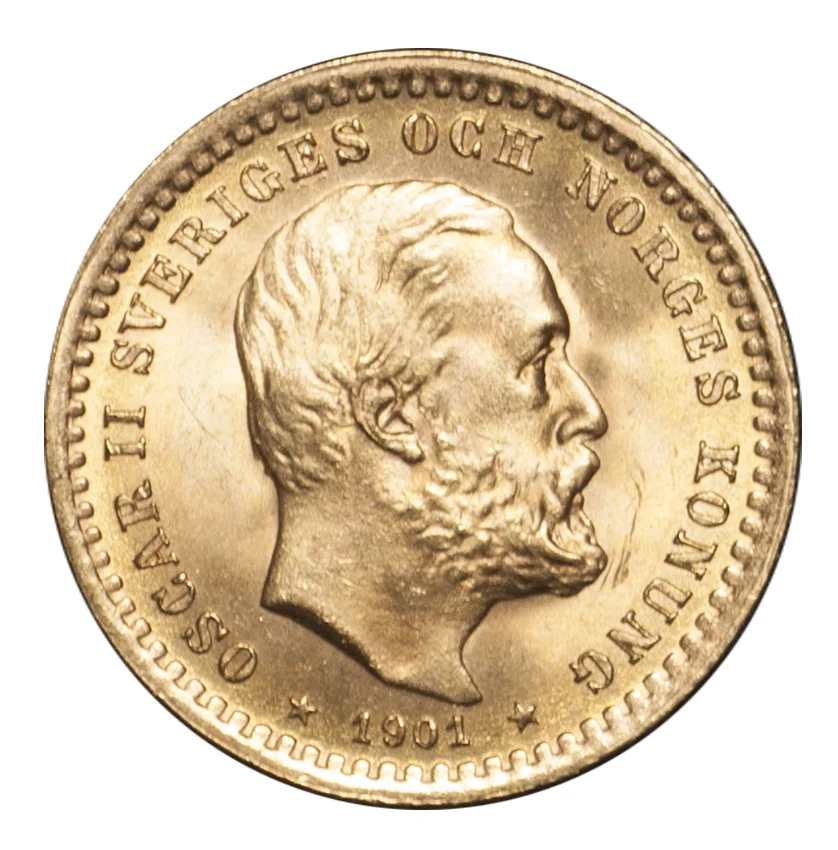
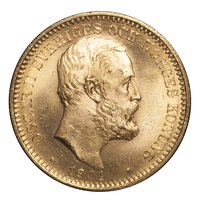
Oscar II facing right, inscription surrounding. Date between stars below.
Inscription:
OSCAR II SVERIGES OCH NORGES KONUNG
★ 1901 ★
★ 1901 ★
Translation:
OSCAR II KING OF SWEDEN AND NORWAY
★ 1901 ★
★ 1901 ★
Script: Latin
Engraver: Adolf Lindberg
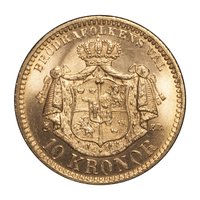
Reverse
Description:
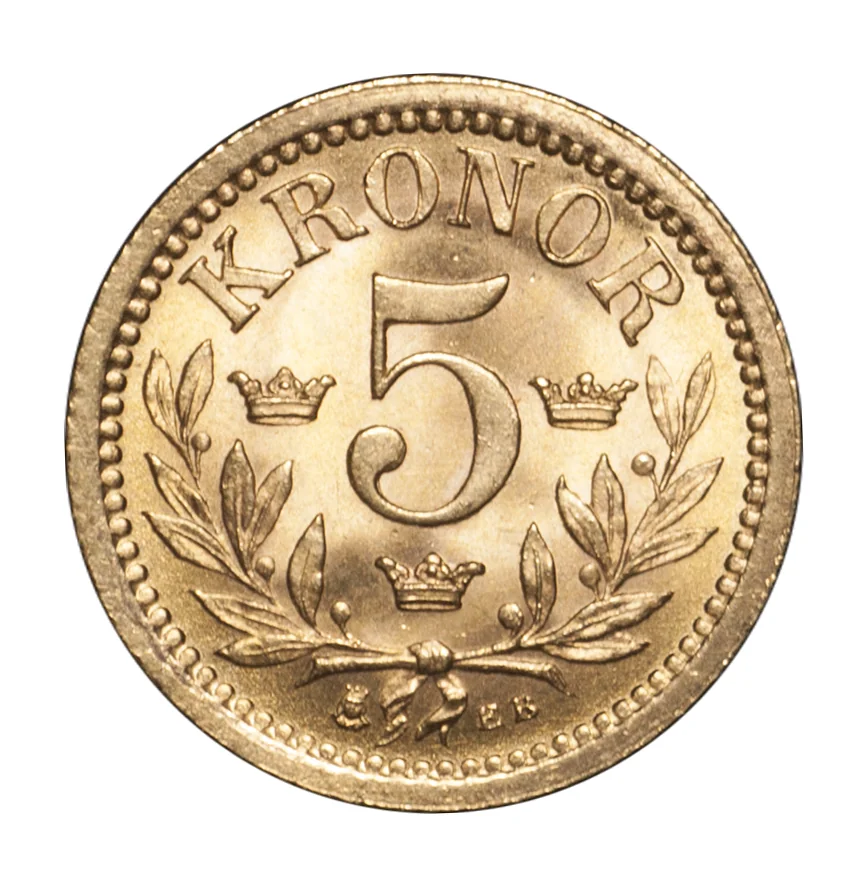
Swedish three crowns and numeral in wreath, text above, mintmarks below.
Inscription:
KRONOR
5
EB
5
EB
Script: Latin
Engraver: Adolf Lindberg
Edge
Reeded
Mints
| Name | Mark |
|---|---|
| Kungliga Myntet | — |
Mintings
| Year | Mint Mark | Mintage | Quality | Collection |
|---|---|---|---|---|
| 1901 | — | 109,186 |
Historical background
In 1901, Sweden operated under the gold standard, a system it had formally adopted in 1873 upon forming the Scandinavian Monetary Union (SMU) with Denmark. This union established the Swedish krona (krona meaning "crown") as the national currency, replacing the former riksdaler riksmynt. The core principle was that the Swedish krona was directly convertible into a fixed quantity of gold, and it was legally interchangeable at par with the Danish krone and, from 1875, the Norwegian krone. This created a stable, integrated monetary area in Scandinavia, facilitating trade and capital flows with the backing of the Riksbank's gold reserves.
The period leading up to 1901 was one of economic transition and debate. The late 19th century had seen deflationary pressures and agricultural distress, leading to political contention over monetary policy. While the gold standard provided international credibility and price stability, it was criticized by agrarian and emerging industrial interests for being too restrictive, especially during economic downturns when the money supply could not be easily expanded. By 1901, these debates were simmering but the system itself was firmly entrenched; the krona's value was firmly anchored to gold, and the Monetary Union, though showing early signs of strain, was still functionally intact.
Internationally, Sweden's currency situation in 1901 was thus characterized by stability and orthodox finance. The Riksbank's primary mandate was to maintain the gold convertibility of the krona, which dictated its interest rate and monetary decisions. This alignment with the global gold standard, dominant at the time, integrated Sweden into the world economy and provided a predictable framework for foreign investment and trade. The significant monetary questions of the era revolved not around abandoning this system, but around managing its social and economic consequences within a rapidly industrializing nation.
The period leading up to 1901 was one of economic transition and debate. The late 19th century had seen deflationary pressures and agricultural distress, leading to political contention over monetary policy. While the gold standard provided international credibility and price stability, it was criticized by agrarian and emerging industrial interests for being too restrictive, especially during economic downturns when the money supply could not be easily expanded. By 1901, these debates were simmering but the system itself was firmly entrenched; the krona's value was firmly anchored to gold, and the Monetary Union, though showing early signs of strain, was still functionally intact.
Internationally, Sweden's currency situation in 1901 was thus characterized by stability and orthodox finance. The Riksbank's primary mandate was to maintain the gold convertibility of the krona, which dictated its interest rate and monetary decisions. This alignment with the global gold standard, dominant at the time, integrated Sweden into the world economy and provided a predictable framework for foreign investment and trade. The significant monetary questions of the era revolved not around abandoning this system, but around managing its social and economic consequences within a rapidly industrializing nation.
⭐ Somewhat Rare