

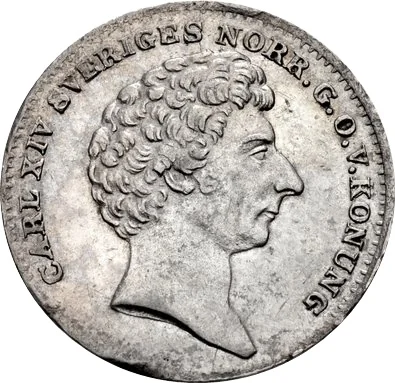
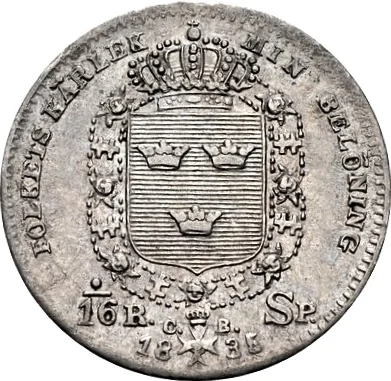
1⁄16 riksdaler specie – Sweden
Add to wishlist
Sweden
Context
Years: 1835–1836
Issuer: Sweden
Ruler: Charles XIV John
Currency:
(1830—1855)
Demonetized: Yes
Total mintage: 520,588
Material
References
KM: #
Numista: #37771
Value
Bullion value: $4.08
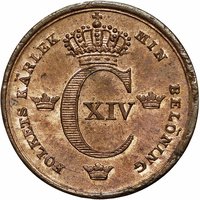
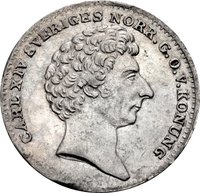
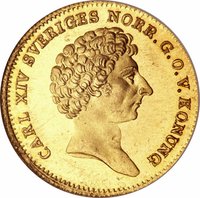
Obverse
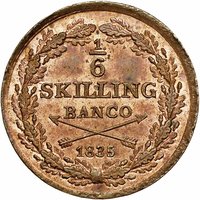
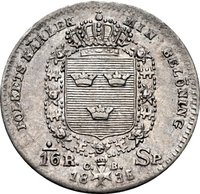
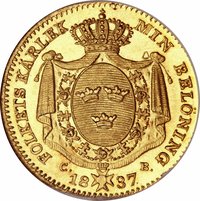
Reverse
Edge
Categories
| Symbols> Coat of Arms |
Mintings
| Year | Mint Mark | Mintage | Quality | Collection |
|---|---|---|---|---|
| 1835 | CB | 432,554 | ||
| 1836 | CB | 88,034 |
Historical background
In 1835, Sweden operated under a bimetallic monetary system, formally established by the Riksbank in 1830. This system legally fixed the value of the Swedish riksdaler specie (a silver coin) against the riksdaler riksmynt (a currency unit used in banknotes and smaller coins) at a 1:4 ratio. While theoretically based on both silver and gold, the system was effectively on a silver standard, as the gold content of coins was overvalued by law, causing gold to be driven out of circulation in accordance with Gresham's Law. The primary circulating mediums were silver coins, copper skilling coins for small transactions, and paper banknotes issued by the Riksbank and private banks, which were convertible into silver.
This period was one of relative monetary stability, following the economic turbulence of the Napoleonic Wars. The 1830 ordinance aimed to create order after a long history of currency debasement and multiple concurrent monetary standards. However, the system was not without its complexities and strains. Public trust in paper money was still developing, and the coexistence of multiple coin types (copper, silver, and a limited amount of gold) alongside banknotes required careful management. Furthermore, the fixed ratio between metals was increasingly out of step with fluctuating global market prices, creating underlying pressures.
Consequently, the situation in 1835 represented a managed but fragile equilibrium. The Riksbank held a central role, and the currency system facilitated domestic trade and early industrialization. Yet, the artificial valuation of gold and the reliance on international silver markets meant the system was vulnerable to external shocks. This inherent instability would eventually lead to Sweden's formal adoption of the gold standard in 1873, when it joined the Scandinavian Monetary Union with Denmark and Norway.
This period was one of relative monetary stability, following the economic turbulence of the Napoleonic Wars. The 1830 ordinance aimed to create order after a long history of currency debasement and multiple concurrent monetary standards. However, the system was not without its complexities and strains. Public trust in paper money was still developing, and the coexistence of multiple coin types (copper, silver, and a limited amount of gold) alongside banknotes required careful management. Furthermore, the fixed ratio between metals was increasingly out of step with fluctuating global market prices, creating underlying pressures.
Consequently, the situation in 1835 represented a managed but fragile equilibrium. The Riksbank held a central role, and the currency system facilitated domestic trade and early industrialization. Yet, the artificial valuation of gold and the reliance on international silver markets meant the system was vulnerable to external shocks. This inherent instability would eventually lead to Sweden's formal adoption of the gold standard in 1873, when it joined the Scandinavian Monetary Union with Denmark and Norway.
Series: 1835 Sweden circulation coins
⭐ Rare